

On this page
Hydrogen sulphide, carbonic acid and oxalic acid can each give away two protons, so their pH problems look as if they need two equilibria solved together. Usually they don't. Here is why, worked through exercise 6.45 from NCERT Class 11 Chemistry, plus two checks that tell you when the shortcut breaks.
Why does the first dissociation set the pH?
A diprotic acid H₂A loses its protons in two steps: H₂A ⇌ H⁺ + HA⁻ (constant Ka1), then HA⁻ ⇌ H⁺ + A²⁻ (constant Ka2). The NCERT Class 11 Chemistry unit on equilibrium explains that the higher-order constants are smaller than the first, because pulling a positive proton off an ion that is already negative is harder than pulling it off a neutral molecule.
The gap is usually huge. For H₂S, NCERT exercise 6.45 gives Ka1 = 9.1 × 10⁻⁸ and Ka2 = 1.2 × 10⁻¹³, about 760,000 times smaller. For carbonic acid, NCERT Table 6.8 lists Ka1 = 4.3 × 10⁻⁷ and Ka2 = 5.6 × 10⁻¹¹. The same unit says that in a diprotic acid solution, H₃O⁺ "comes mainly from the first dissociation step".
So for the pH, treat H₂A as a weak monoprotic acid with Ka1. Our guide to finding Ka from the pH of a weak acid runs the same algebra backwards.
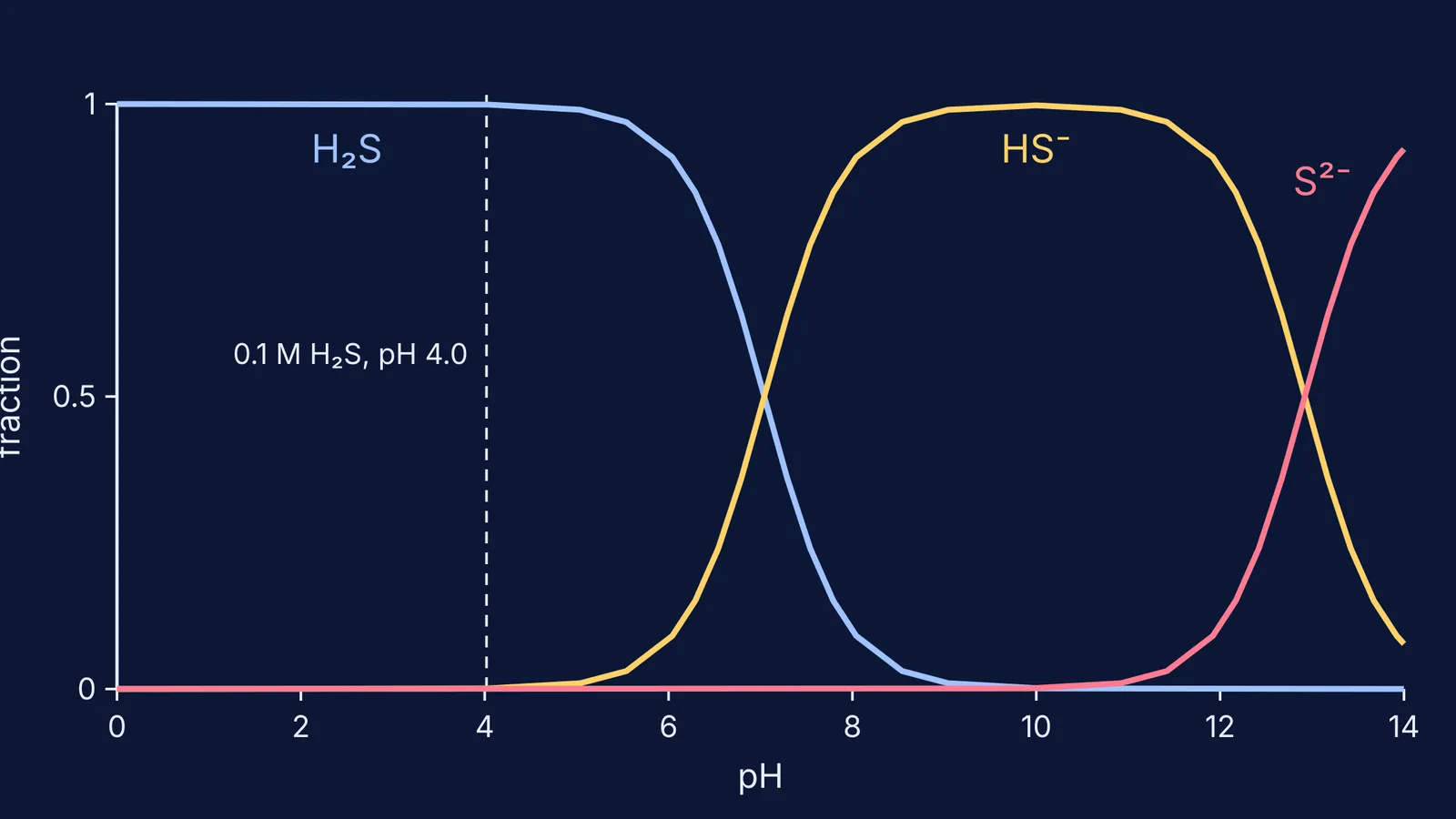
How do you calculate the pH of 0.1 M H₂S?
Using the Ka1 from NCERT exercise 6.45:
Write the first step: H₂S ⇌ H⁺ + HS⁻. Let x = [H⁺] = [HS⁻], so [H₂S] = 0.1 − x.
Set up Ka1 = x² / (0.1 − x) = 9.1 × 10⁻⁸.
Assume x is tiny next to 0.1, so x² = 9.1 × 10⁻⁹ and x = 9.5 × 10⁻⁵ M.
Check the assumption: 9.5 × 10⁻⁵ M is under 0.1% of 0.1 M, so it holds.
pH = −log(9.5 × 10⁻⁵) = 4.02.
The second step adds only about 1.2 × 10⁻¹³ M of H⁺ (shown below), roughly a billionth of what the first step supplies.
How do you find [S²⁻] or [CO₃²⁻]?
Use the second equilibrium, with NCERT's Ka2 and the [H⁺] and [HS⁻] you already have: Ka2 = [H⁺][S²⁻] / [HS⁻].
In plain H₂S, [H⁺] and [HS⁻] are about equal (both 9.5 × 10⁻⁵ M), so they cancel and [S²⁻] = Ka2 = 1.2 × 10⁻¹³ M. Remember the rule: for a diprotic acid on its own, [A²⁻] ≈ Ka2, whatever the starting concentration.
Carbonic acid works the same way. For 0.01 M H₂CO₃ with the NCERT Table 6.8 values, [H⁺] = √(4.3 × 10⁻⁷ × 0.01) = 6.6 × 10⁻⁵ M, the pH is 4.18, and [CO₃²⁻] ≈ Ka2 = 5.6 × 10⁻¹¹ M.
The second half of NCERT exercise 6.45 tests exactly this. Make the solution 0.1 M in HCl as well, so [H⁺] = 0.1 M from the HCl. Then:
[HS⁻] = Ka1 × [H₂S] / [H⁺] = 9.1 × 10⁻⁸ × 0.1 / 0.1 = 9.1 × 10⁻⁸ M
[S²⁻] = Ka2 × [HS⁻] / [H⁺] = 1.2 × 10⁻¹³ × 9.1 × 10⁻⁸ / 0.1 = 1.1 × 10⁻¹⁹ M
Adding the HCl cut [S²⁻] about a million-fold. That is the common-ion effect, the same idea as in our practical on how acetate changes the pH of acetic acid.
If you get stuck partway, the Fermi Problem Library has worked problems with a step-by-step solver that explains the reasoning rather than printing an answer.
When can you safely ignore the second step?
Run two quick checks after the first-step calculation:
Is the H⁺ from step 2 small? For the acid on its own, step 2 adds about Ka2 mol/L of H⁺. If that is under 5% of your [H⁺] from step 1, ignore it.
Is a strong acid present? Extra H⁺ pushes both steps back, so the second step matters even less.
H₂S and carbonic acid pass the first check by many powers of ten. Sulphuric acid fails it: NCERT Table 6.8 lists its Ka1 as "very large" and its Ka2 as 1.2 × 10⁻². In 0.01 M H₂SO₄, the first step alone gives [H⁺] = 0.01 M and pH 2.00. Solving the second step with the quadratic x(0.01 + x) / (0.01 − x) = 1.2 × 10⁻² gives x = 0.0045 M, so [H⁺] = 0.0145 M and the pH is 1.84. Skipping step 2 would leave you 0.16 pH units out.
The same 5% test applies to step 1 itself. Oxalic acid has Ka1 = 5.9 × 10⁻² in the same table, so in 0.1 M solution x comes out near 0.053 M, more than half the acid. You need the quadratic for the first step, even though its Ka2 of 6.4 × 10⁻⁵ is still small enough to skip.
To see how pH responds as an acid gets weaker, try our pH scale simulation for strong and weak acids. Then redo NCERT exercise 6.45 from a blank page: if you can get [HS⁻] = 9.5 × 10⁻⁵ M, pH 4.02, and [S²⁻] of 1.2 × 10⁻¹³ M and 1.1 × 10⁻¹⁹ M without looking, you have this topic.


