

On this page
In qualitative analysis, detecting the sulphide ion (S²⁻) is a standard requirement for high school chemistry practicals. Whether you are analysing an inorganic salt mixture or checking an organic compound for sulphur, you will rely on two classic confirmatory tests: the sodium nitroprusside test and the lead acetate test. These chemical tests are essential for confirming the presence of sulphur in various samples and form the foundation of elementary salt analysis.
What is the sodium nitroprusside test for sulphide ions?
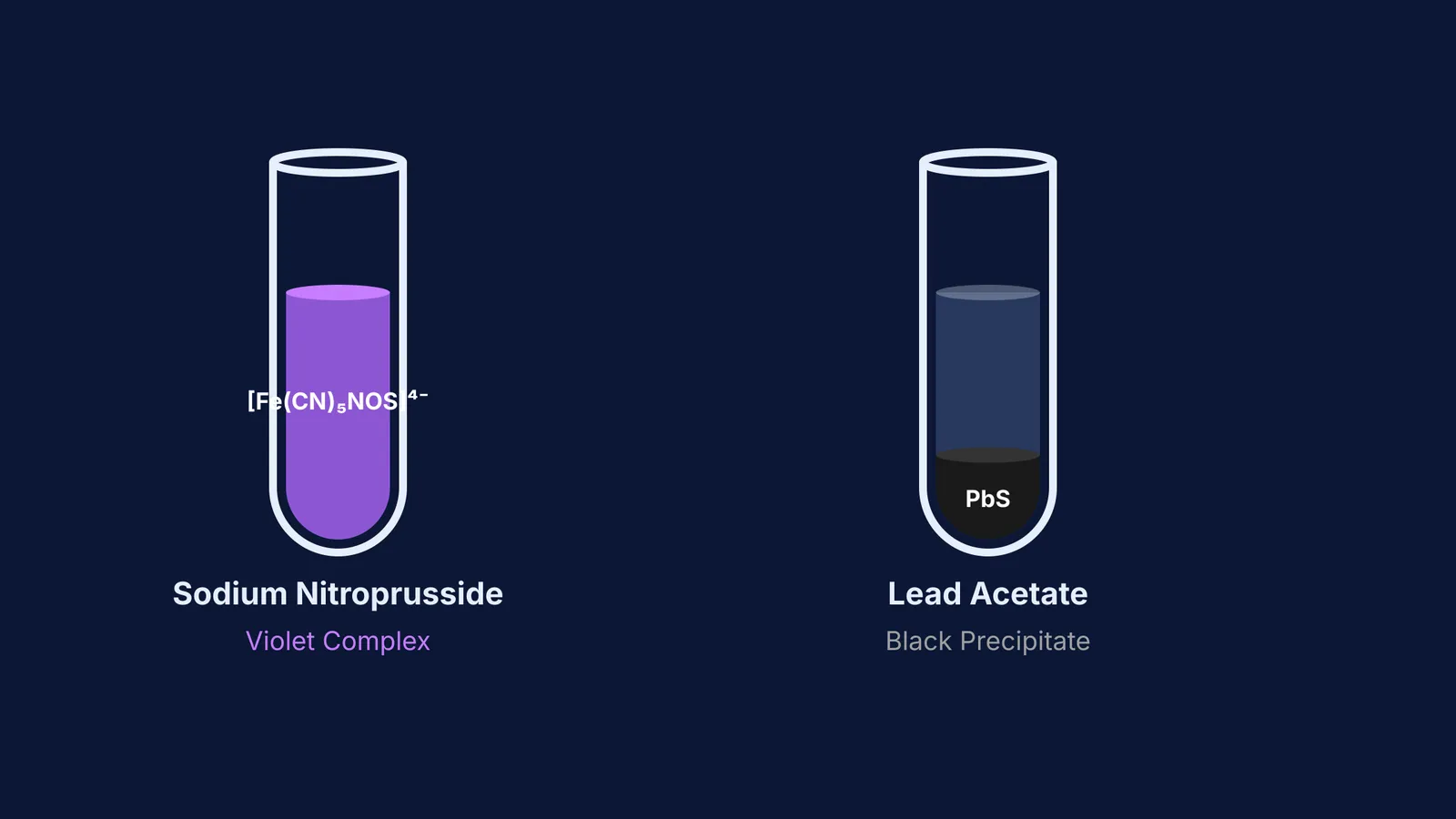
When a few drops of freshly prepared sodium nitroprusside solution (Na₂[Fe(CN)₅NO]) are added to a solution containing sulphide ions, the mixture immediately turns a brilliant purple or violet. According to the NCERT laboratory manual, this striking colour change is the definitive confirmation of sulphide in the sample.
The reaction occurs because the sulphide ion coordinates directly with the iron complex. Sodium nitroprusside is an octahedral complex of iron(II) with five cyanide ligands and one nitrosyl ligand. The sulphide attacks the nitrosyl ligand, forming a new, highly coloured complex ion called sodium thionitroprusside:
S²⁻ + [Fe(CN)₅NO]²⁻ → [Fe(CN)₅NOS]⁴⁻
For this test to work reliably, the reaction must take place in a strictly alkaline medium. If your initial salt extract is not basic, you must add a few drops of sodium hydroxide (NaOH) or ammonium hydroxide (NH₄OH). If you are brushing up on the uses of these specific bases, our guide on ICSE analytical chemistry: NaOH and NH4OH tests for metal ions explains their broader role in precipitating other metal complexes.
Why is an alkaline medium required?
If the solution is even slightly acidic, the sulphide ions will react with the available hydrogen ions (H⁺) to form hydrogen sulphide gas (H₂S). This gas is volatile and simply bubbles out of the liquid, leaving too few S²⁻ ions in the solution to react with the sodium nitroprusside reagent.
By adding an alkali like sodium hydroxide, you neutralize any acid present and keep the sulphur dissolved as stable, highly soluble sodium sulphide (Na₂S). The alkaline environment suppresses the hydrolysis of the sulphide ion, ensuring a high concentration of free S²⁻ is available to attack the complex.
How does the lead acetate test compare?
While sodium nitroprusside is excellent for testing aqueous extracts directly, the lead acetate test is often used when reacting a dry solid salt with an acid. When a metal sulphide is treated with dilute sulphuric acid (H₂SO₄), it releases hydrogen sulphide gas, which carries a characteristic rotten egg smell.
To confirm that the evolved gas is indeed H₂S, you dip a strip of filter paper into a lead acetate solution and hold it near the mouth of the test tube. The gas reacts with the lead acetate on the paper to form a shiny black or brownish-black solid precipitate of lead sulphide (PbS), as detailed in standard qualitative analysis procedures:
(CH₃COO)₂Pb + H₂S → PbS ↓ + 2CH₃COOH
You can review the stoichiometry of these precipitation and complexation reactions in the Fermi Concept Library, which provides a detailed lesson for every concept in chemistry and maps out how ions exchange partners in solution.
How is the sodium nitroprusside test used in organic chemistry?
In organic chemistry, sulphur is typically tightly bound within covalent molecules and will not react directly with inorganic reagents like sodium nitroprusside. Before you can test for its presence, you must convert the covalently bonded sulphur into a free ionic sulphide.
This conversion is achieved through a sodium fusion extract, famously known as Lassaigne's test: detecting nitrogen, sulphur and halogens. The organic compound is fused with a small piece of molten sodium metal in an ignition tube. The extreme heat of the fusion process forces the highly reactive sodium to strip the sulphur from the organic molecule, creating inorganic sodium sulphide (Na₂S).
Once the fusion extract is boiled in distilled water and filtered, it provides the perfect alkaline solution of S²⁻. You then simply add a few drops of freshly prepared sodium nitroprusside, and the immediate appearance of the violet complex confirms that the original organic compound contained sulphur.
What are the common mistakes when performing this test?
A frequent error in the laboratory is using an old sodium nitroprusside solution. Since the reagent is light-sensitive and decomposes into other iron cyanides over time, an aged solution might yield a murky green or brown colour instead of the expected brilliant violet, leading to a false negative result.
Another common mistake is failing to maintain the alkaline pH. If a student adds the reagent to a neutral or slightly acidic extract, the violet colour may either not appear at all or fade very rapidly. Ensuring that the sodium carbonate extract or the sodium fusion extract has enough residual alkalinity is crucial for the stability of the sodium thionitroprusside complex. Always check the pH with litmus paper before adding the reagent.


