On this page
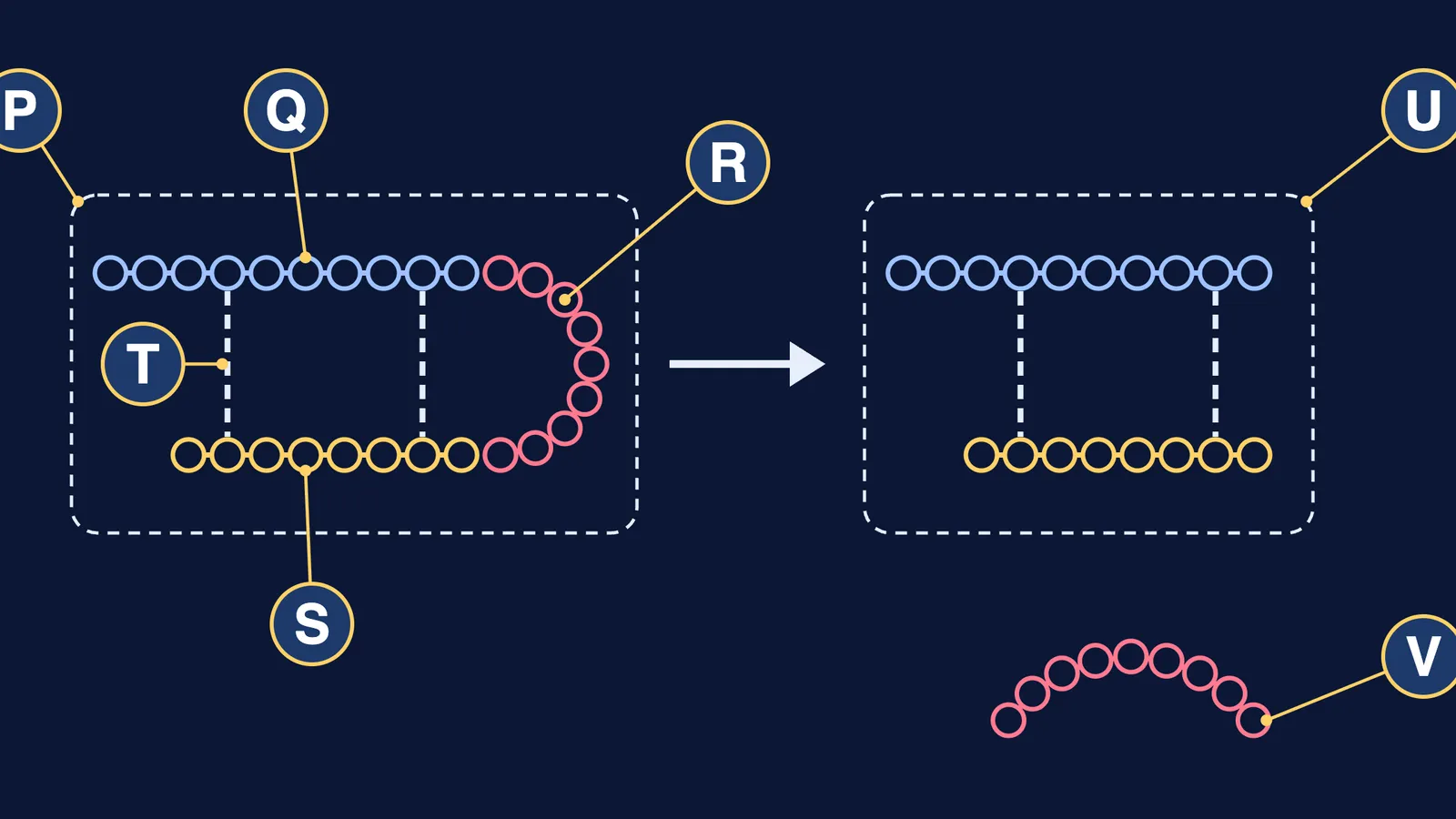
These 13 original questions use the figures of Chapter 10, Biotechnology and its Applications, in NCERT Class 12 Biology (Reprint 2026-27). Questions 1 to 6 use the lettered insulin schematic above; 7 to 13 describe the other figures in words.
Insulin appears here only as NCERT describes it. This is a study summary, not medical advice.
Which figures does Chapter 10 actually contain?
Just three: cotton bolls with and without bollworm damage (10.1), control versus transgenic roots after a nematode infection (10.2), and pro-insulin maturing into insulin (10.3).
Gene therapy, diagnosis and transgenic animals have no figure here. The NEET (UG) 2026 syllabus places human insulin production, Bt crops and transgenic animals in its Biology Unit 9 (Biotechnology and Its Applications).
How do you read a molecule drawn as a string of beads?
Count the strands: one folded strand is a precursor, two linked strands a finished molecule.
Each colour is one stretch of chain.
Dashed links between strands are bonds, never chains. Name the bond type NCERT uses.
Across an arrow, list what is lost or gained.
Statement I/II key for this post: (1) Statement II alone is correct (2) Both statements are correct (3) Statement I alone is correct (4) Neither statement is correct.
Questions 1 to 6: what are parts P to V?
Q1. Which lettered part is present in P but missing from U? (1) Q (2) S (3) T (4) R
Answer: (4). R is the C peptide, removed during maturation.
Q2. Statement I: Q and S are the two short polypeptide chains of insulin. Statement II: Each T is a peptide bond joining Q to S.
Answer: (3). NCERT says the chains are linked by disulphide bridges.
Q3. Pair each letter with what it is. List-I: (a) P (b) R (c) T (d) V List-II: (i) A link holding the two chains together (ii) A pro-hormone that must be processed before it works (iii) The C peptide after it has been cut away (iv) An extra stretch carried only by the precursor (1) a-ii, b-iv, c-i, d-iii (2) a-iv, b-ii, c-i, d-iii (3) a-ii, b-iii, c-i, d-iv (4) a-ii, b-iv, c-iii, d-i
Answer: (1). See the key below.
Q4. In 1983, two DNA sequences were put into *E. coli* plasmids to make human insulin. Which lettered parts did they code for? (1) P only (2) Q and S (3) R and V (4) U only
Answer: (2). The sequences matched chains A and B, produced separately.
Q5. Statement I: The separately made chains were extracted and combined by creating bonds of the T kind. Statement II: In mammals, including humans, insulin is first synthesised in the form shown as P.
Answer: (2). Both follow section 10.2.1.
Q6. NCERT compares the change from P to U with which process? (1) A pro-enzyme being processed before it works (2) Totipotency of an explant (3) dsRNA silencing an mRNA (4) Two protoplasts fusing
Answer: (1). Like a pro-enzyme, the pro-hormone must be processed to become functional.
Answer key for the lettered diagram
P: pro-insulin
Q: chain B
R: C peptide, still attached
S: chain A
T: disulphide bridge
U: mature insulin
V: free C peptide
Can you answer the cotton boll and root figures from words alone?
Each compares two panels; first say what differs between (a) and (b).
Q7. Figure 10.1(a) shows a boll destroyed by bollworms. Proteins coded by which genes control this pest? (1) cryIAb only (2) Nematode-specific genes (3) cryIAc and cryIIAb (4) The genes for chains A and B
Answer: (3). NCERT links cryIAb to corn borer instead.
Q8. Statement I: *Bacillus thuringiensis* survives its crystals because their toxin, though active, cannot enter its cells. Statement II: Alkaline pH in the gut of an insect that eats them solubilises the crystals.
Answer: (1). Inside the bacterium the toxin is an inactive protoxin.
Q9. Why is one Bt gene not put into every crop? (1) Bt genes work only in cotton (2) Plants cannot express bacterial genes (3) All crops share the same pests (4) Most Bt toxins act on one insect group, so the gene depends on crop and pest
Answer: (4). Gene choice follows the crop and the targeted pest.
Q10. Match each panel with what it shows. List-I: (a) Figure 10.1(a) (b) Figure 10.1(b) (c) Figure 10.2(a) (d) Figure 10.2(b) List-II: (i) Roots of a typical control plant (ii) A boll destroyed by bollworms (iii) Transgenic roots protected after deliberate infection (iv) A fully mature boll (1) a-iv, b-ii, c-i, d-iii (2) a-ii, b-iv, c-i, d-iii (3) a-ii, b-iv, c-iii, d-i (4) a-ii, b-i, c-iv, d-iii
Answer: (2). Per the NCERT captions.
Q11. Which molecule, formed in the host cells, set off the protection seen in Figure 10.2(b)? (1) dsRNA formed by sense and antisense RNA (2) An inactive Bt protoxin (3) An antibody against the nematode (4) A functional ADA enzyme
Answer: (1). The dsRNA initiated RNAi.
Q12. Statement I: RNAi works as a defence only in plant cells. Statement II: The nematode-specific DNA was introduced so that host cells made sense RNA alone.
Answer: (4). RNAi occurs in all eukaryotes; the host made sense and antisense RNA.
Q13. In the Figure 10.2(b) roots, which mRNA is silenced, and with what result? (1) The host's own, so roots grow faster (2) *Agrobacterium*'s, so the vector disappears (3) A specific nematode mRNA, so the parasite cannot survive (4) The Bt toxin's, so the parasite cannot attach
Answer: (3). *Meloidogyne incognita* could not survive in the transgenic host.
What should you do with the ones you got wrong?
Redraw the P to V schematic from memory, then add names.
Reread section 10.2.1 for insulin slips, 10.1 for Bt and RNAi.
Practise with the Statement I/II and match-the-list questions on this chapter, try the lettered bioreactor set on biotechnology principles, and fill gaps from the board exam guide to this chapter.
Unsure which of these topics to revise first? Fermi's AI tutor works out what you already know and builds a plan for the session.