On this page
NCERT's Class 11 equilibrium chapter prints a table of solubility products, Table 6.9, and one row in it is worth a second look: nickel sulphide, NiS, with Ksp = 4.7 × 10⁻⁵. You can test it in a few lines with NCERT's own data and what you know about salt analysis. Below are three checks, then a comparison with standard thermodynamic tables. The skill is general: before you trust a Ksp, ask whether it fits the chemistry you have seen in the lab.
What Ksp does NCERT give for nickel sulphide?
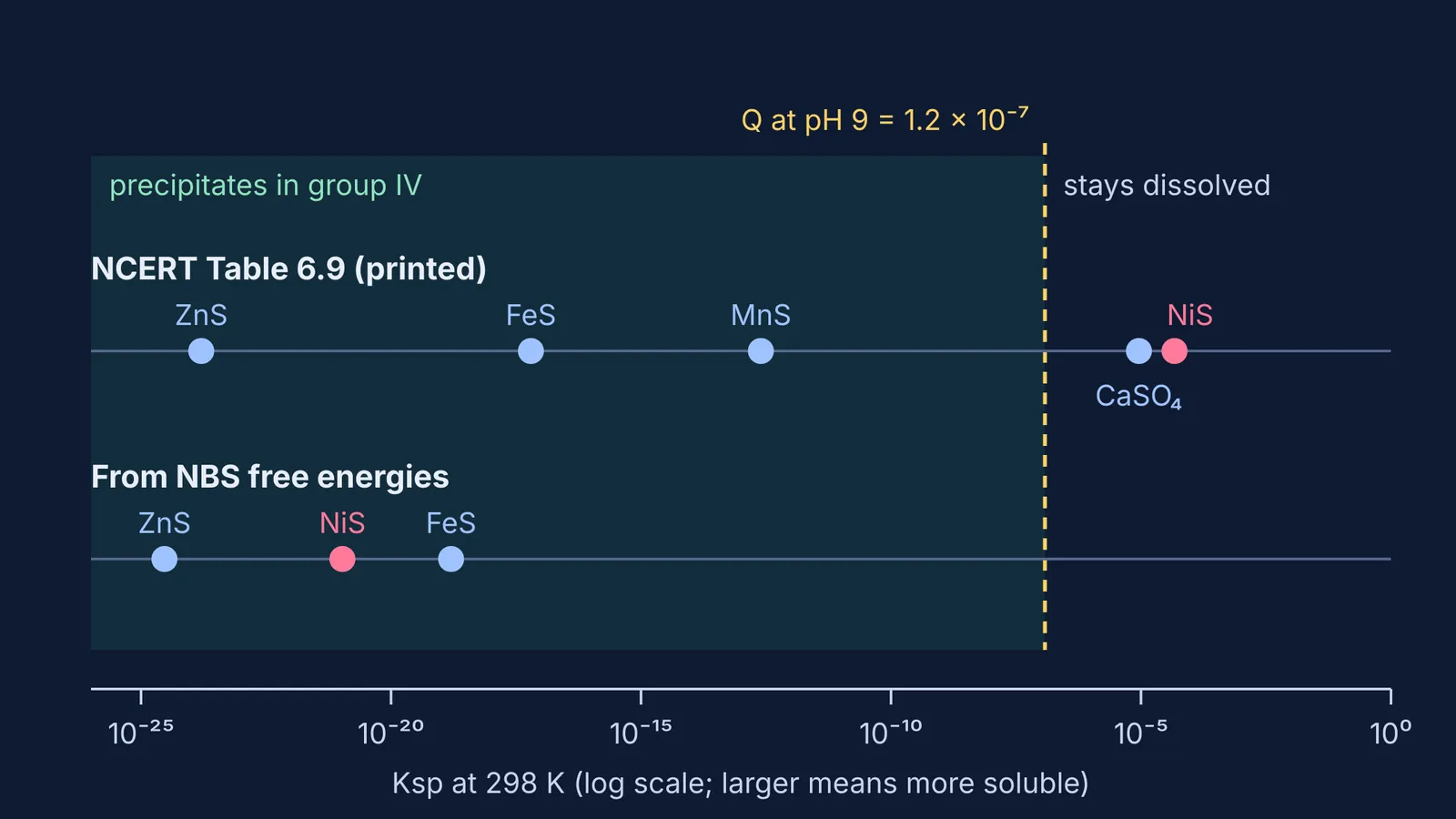
Table 6.9 ("The Solubility Product Constants, Ksp of Some Common Ionic Salts at 298K", page 205 of NCERT Class 11 Chemistry, Unit 6, Reprint 2026-27) lists these sulphides of the group IV cations:
Manganese sulphide, MnS: 2.5 × 10⁻¹³
Ferrous sulphide, FeS: 6.3 × 10⁻¹⁸
Nickel sulphide, NiS: 4.7 × 10⁻⁵
Zinc sulphide, ZnS: 1.6 × 10⁻²⁴
The same table gives calcium sulphate, CaSO₄, as 9.1 × 10⁻⁶. The same chapter gives the H₂S constants used below: Ka₁ = 9.1 × 10⁻⁸ and Ka₂ = 1.2 × 10⁻¹³ (exercise 6.45).
NiS is the black precipitate you get when H₂S is passed through an ammoniacal nickel solution. Keep that picture in mind.
Check 1: would NiS be more soluble than calcium sulphate?
For a 1:1 salt, Ksp = s², so s = √Ksp.
NiS with the printed value: s = √(4.7 × 10⁻⁵) = 6.9 × 10⁻³ mol/L. With M = 90.8 g/mol, that is about 0.62 g/L.
CaSO₄: s = √(9.1 × 10⁻⁶) = 3.0 × 10⁻³ mol/L.
So the printed value makes NiS more than twice as soluble, mole for mole, as calcium sulphate, which is the classic "sparingly soluble" salt. A salt that dissolves to 0.6 g/L would not drop out of solution as a black solid in a test tube.
Check 2: would NiS precipitate in group IV?
This is the check that matters most, because group IV is where you actually make NiS. Here is the worked example.
Problem. A solution is 0.01 M in Ni²⁺ and buffered at pH 9 with NH₄Cl and NH₄OH. H₂S is passed until the solution holds 0.1 M dissolved sulphide in total. Use NCERT's constants. Does NiS precipitate if Ksp = 4.7 × 10⁻⁵?
Which sulphide species dominates? At pH 9, [H⁺] = 10⁻⁹ M. The ratio [HS⁻]/[H₂S] = Ka₁/[H⁺] = 9.1 × 10⁻⁸ / 10⁻⁹ = 91. So almost all of the 0.1 M is HS⁻: [HS⁻] ≈ 0.1 × 91/92 = 0.099 M.
Find [S²⁻]. From HS⁻ ⇌ H⁺ + S²⁻, [S²⁻] = Ka₂[HS⁻]/[H⁺] = 1.2 × 10⁻¹³ × 0.099 / 10⁻⁹ = 1.2 × 10⁻⁵ M.
Ionic product. Q = [Ni²⁺][S²⁻] = 0.01 × 1.2 × 10⁻⁵ = 1.2 × 10⁻⁷.
Compare. Q = 1.2 × 10⁻⁷ is smaller than 4.7 × 10⁻⁵, so with the printed Ksp, nothing would precipitate.
A generous estimate does not rescue it. Plugging [H₂S] = 0.1 M into [S²⁻] = Ka₁Ka₂[H₂S]/[H⁺]² gives 1.1 × 10⁻³ M and Q = 1.1 × 10⁻⁵, still below 4.7 × 10⁻⁵. (That shortcut overstates [S²⁻] at pH 9, since most H₂S has become HS⁻.)
In a real group IV test, ammonia also ties up some Ni²⁺ as ammine complexes, which lowers [Ni²⁺] and makes precipitation harder still. So the printed value predicts no NiS at all, which is the opposite of what you see.
A note on S²⁻: chemists now doubt that free S²⁻ exists in water in measurable amounts. That does not change this check, because sulphide Ksp values and Ka₂ are conventional numbers that work together, and S²⁻ cancels out of the real equilibrium. The full story is in our post on why S²⁻ is not really present in water.
Check 3: does it fit with the other group IV sulphides?
The other group IV sulphides in the same table sit between 10⁻¹³ (MnS) and 10⁻²⁴ (ZnS). NiS at 4.7 × 10⁻⁵ is eight orders of magnitude above MnS, the most soluble of them.
Exercise 6.73 of the same chapter states that [S²⁻] in 0.1 M HCl saturated with H₂S is 1.0 × 10⁻¹⁹ M. That is the low sulphide level that keeps group IV ions in solution during group II, as explained in why H₂S is passed in acidic medium for group 2 and ammoniacal medium for group 4. For the scheme to work, a group IV sulphide must have a Ksp small enough to precipitate at pH 9, yet large enough not to precipitate at 10⁻¹⁹ M sulphide.
What Ksp do thermodynamic tables give for NiS?
You can compute a Ksp from standard Gibbs energies of formation using ΔG° = −RT ln K. The values below are from the NBS Tables of Chemical Thermodynamic Properties (Wagman et al., 1982), at 298.15 K.
For NiS(s) ⇌ Ni²⁺(aq) + S²⁻(aq):
ΔfG°: Ni²⁺(aq) = −45.6 kJ/mol; S²⁻(aq) = +85.8 kJ/mol; NiS(crystal) = −79.5 kJ/mol.
ΔrG° = (−45.6) + 85.8 − (−79.5) = +119.7 kJ/mol.
RT ln 10 = 8.314 × 298.15 × 2.303 J/mol = 5.708 kJ/mol, so log Ksp = −119.7 / 5.708 = −20.97.
Ksp ≈ 1.1 × 10⁻²¹.
The same route, run on the same tables for the other two, gives FeS ≈ 1.6 × 10⁻¹⁹ (NCERT: 6.3 × 10⁻¹⁸) and ZnS ≈ 2.9 × 10⁻²⁵ (NCERT: 1.6 × 10⁻²⁴). Those agree with NCERT to within factors of about 40 and 5, which is normal scatter for sulphide data. For NiS, the gap is a factor of about 4 × 10¹⁶.
One caution: NiS has different solid forms. The NBS tables list a separate "precipitated" NiS with a different enthalpy and no Gibbs energy, so fresh precipitate need not match the crystal. None of that moves the answer anywhere near 10⁻⁵; the right order of magnitude is around 10⁻²⁰.
Now the group analysis makes sense. At pH 9, Q = 1.2 × 10⁻⁷ is about 10¹⁴ times the NBS Ksp, so NiS comes down. In 0.1 M HCl, Q = 0.01 × 1.0 × 10⁻¹⁹ = 1.0 × 10⁻²¹, about equal to Ksp, so the acid strength matters. Because [S²⁻] varies as 1/[H⁺]², doubling [H⁺] cuts it fourfold and pushes Q below Ksp. Zinc's place in group IV is covered in why zinc gives a white sulphide in group 4.
What should you write in the exam?
If you want to practise ionic-equilibrium numericals like these with feedback on each step, Fermi Test Prep covers JEE Main and Advanced preparation with an AI tutor you can ask when a step does not make sense. To revise Ksp, Q and the common ion effect from the start, use the Concept Library.
Quick checklist for any Ksp
Convert Ksp to solubility (s = √Ksp for a 1:1 salt) and ask whether that solubility fits what you see in the lab.
Compare it with related salts in the same table. A value eight powers of ten outside its family needs a second source.
Run the group test: calculate Q for the medium where the salt should precipitate and where it should not.
If you can, compute Ksp from ΔfG° with log K = −ΔG°/(5.708 kJ/mol) at 298 K.
For NiS: NCERT prints 4.7 × 10⁻⁵; NBS free energies give about 1 × 10⁻²¹. Use the given value in numericals.