On this page
Walk across a field under a big transmission line and the air itself is part of a circuit. The wires carry charge that swings back and forth fifty times a second, and that charge sets up an electric field all the way down to the ground. Under a 400 kV line it can be several thousand volts per metre. You can work out how strong it is with nothing more than the line charge and the image charge from Class 12 electrostatics.
Safety first. This post describes calculations and published measurements, not an experiment to try. Never climb a tower, go near a fallen or low wire, fly a kite or a drone near lines, or carry a long pole or pipe under them. A high-voltage line can arc across a gap of air to a person or object that comes too close, and a contact can kill.
How strong is the electric field under a 400 kV line?
The World Health Organization says that underneath power lines, electric fields can be several thousand volts per metre, while mean values in a home are up to several tens of volts per metre. Even on a clear day there is a much weaker natural field near the ground, set by the charge discussed in how fast Earth's surface charge would leak away.
The worked example below gives about 6 kV/m at 1 m above the ground for an illustrative 400 kV line. Real lines differ in height and layout.
How do you calculate the field near the ground?
The model itself is in why 765 kV lines use bundles of wires: treat each conductor bundle as a long line charge λ and replace the ground by an image charge −λ the same distance below it. That post stops at the wire's surface. Here you need the field far from the wires, near your feet, and that brings in two new steps.
Find the charges from the voltages. The potential of wire i is V_i = Σ (λ_j/2πε₀) ln(D_ij/d_ij), where d_ij is the distance to wire j and D_ij is the distance to the image of wire j. For a wire's own term, d is its radius and D is twice its height. Three wires give three equations in three unknown λ.
Add the fields of the wires and their images. A wire at height H and its image both push the field the same way at a point below the wire. Directly under it, at height y, E = (λ/2πε₀)[1/(H − y) + 1/(H + y)], pointing vertically.
The twist is that the three phases are 120° apart in time. When one wire is most positive, the other two are partly negative. Their fields partly cancel, so you add them as phasors, not as plain numbers.
Worked example: the field 1 m above the ground
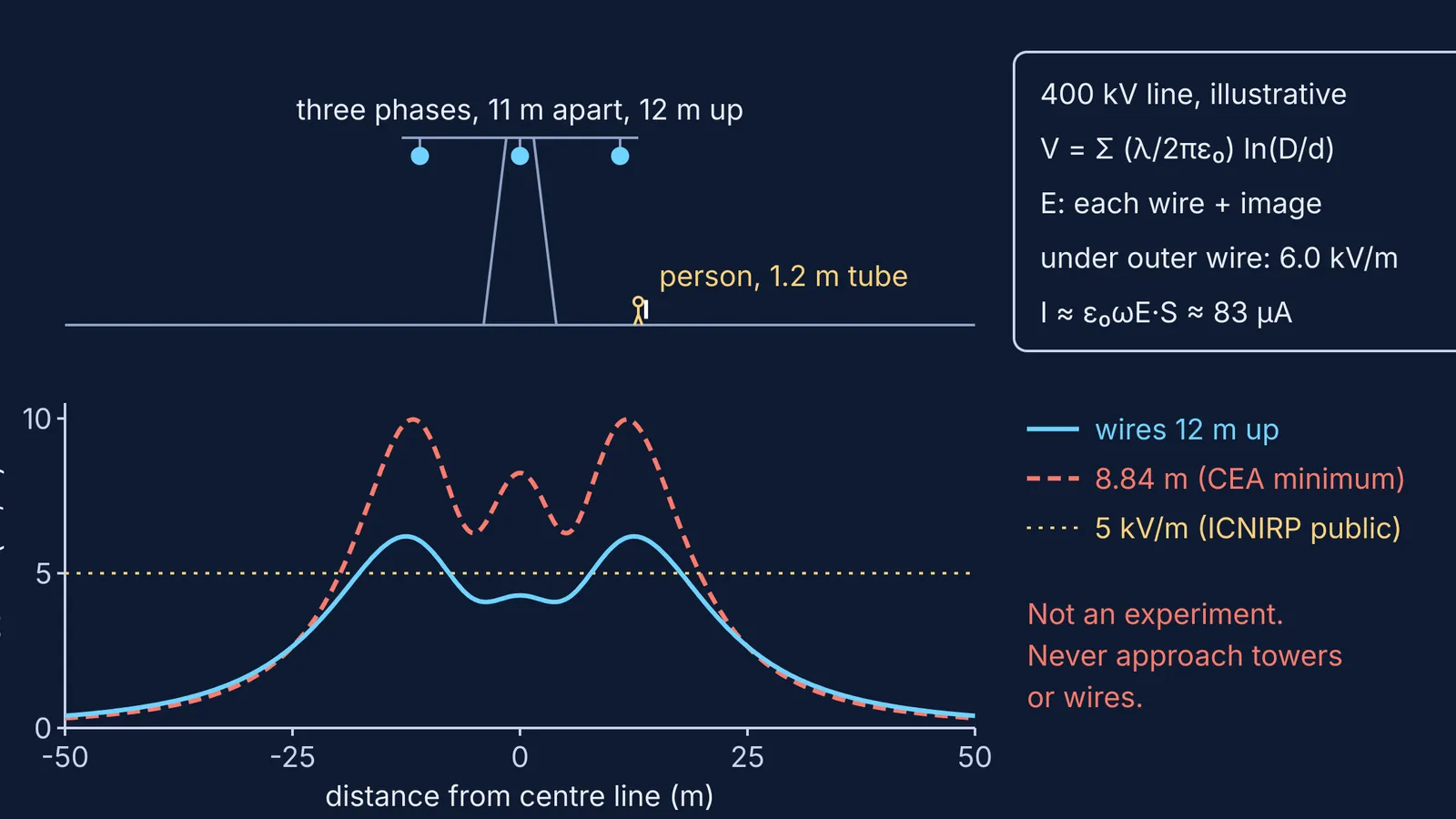
Take an illustrative line, not any specific one: three phases side by side, 11 m apart, all 12 m above flat ground, each bundle with an equivalent radius of 0.2 m, and 400 kV between phases. All values are rms.
Phase voltage. V = 400/√3 = 230.9 kV to ground.
One wire alone. λ = 2πε₀V/ln(2H/r) = 230.9 × 10³/(1.798 × 10¹⁰ × ln 120) = 2.68 µC/m.
All three together. Solving the three potential equations gives 3.11 µC/m on each outer bundle and 3.34 µC/m on the middle one. The neighbours, being at other phases, pull more charge onto each wire.
Outer wire and its image, at 1 m under it. E = 1.798 × 10¹⁰ × 3.11 × 10⁻⁶ × (1/11 + 1/13) = 9.38 kV/m.
Add the other two phases. At the same point the middle phase gives 5.43 kV/m and the far phase 2.13 kV/m, each at a different phase angle. The phasor sum is 6.04 kV/m.
Units check. (V m/C)(C/m)(1/m) = V/m.
Doing the same sum at other points gives about 4.3 kV/m under the middle phase, 6.0 kV/m under the outer phases, 1.7 kV/m 30 m from the centre and 0.39 kV/m at 50 m.
In mid-span on a hot day the wires sag lower, as why power lines sag in summer shows. India's CEA safety regulations, 2023 (Schedule VIII A) set the minimum clearance above ground for a 400 kV line at 8.84 m. With all three wires at that height, the same model gives a peak of 9.9 kV/m.
How much current flows through a person standing there?
A grounded person in this field is like one plate of a capacitor. As the field reverses 100 times a second, charge flows up and down through the body to the earth, a current I = ε₀ωES, where S is an effective collecting area. The Radiofrequency Radiation Dosimetry Handbook, chapter 9 gives the short-circuit current of a grounded person as I = 0.09h²Ef (I in mA, h in metres, E in kV/m, f in kHz), and reports that measurements, including Deno's at 60 Hz on a foil-covered mannequin, agree with it.
For a person 1.75 m tall at 50 Hz: I = 0.09 × 1.75² × 6.04 × 0.05 = 0.083 mA, about 83 µA. That matches an effective area S = I/(ε₀ωE) of about 5 m², several times the body's own outline, because a tall conductor gathers field lines from around it. At the 8.84 m clearance the current rises to about 136 µA.
A 1.2 m fluorescent tube held upright spans about 6.0 × 1.2 = 7.3 kV of the undisturbed field. That is why tubes stuck in the ground under a line can glow faintly: the artist Richard Box lit 1,301 fluorescent tubes under an overhead line near the M4 in England in 2004. This is a reason to keep away, not an invitation: in a strong field, touching a long object can also give you a spark.
Is the electric field under a power line harmful?
ICNIRP. The ICNIRP 2010 guidelines set a reference level of 5 kV/m (250/f kV/m at f = 50 Hz) for the general public and 10 kV/m for workers, and a contact-current reference level of 0.5 mA for the public. They report that the most sensitive 10% of volunteers could perceive 50–60 Hz fields of 2 to 5 kV/m, and that a spark discharge from a person to ground was painful to 7% of volunteers at 5 kV/m.
WHO. WHO's Task Group concluded that there are no substantive health issues related to ELF electric fields at levels generally encountered by members of the public.
The field also changes as soon as something stands in it. A person, a tree or a vehicle distorts it and concentrates it at the top, and a building shields most of it. ICNIRP's reference levels are for the undisturbed field.
If image charges or phasors feel shaky, look them up in the Concept Library, and try the Simulation Lab for ideas that are easier to see than read.
Quick checklist
Model each phase as a line charge with an image charge below the ground.
Get λ from the voltages first, then add fields as phasors.
An illustrative 400 kV line gives about 6 kV/m at 1 m above the ground, falling to 0.4 kV/m at 50 m.
A grounded person carries about 13.8 µA per kV/m at 50 Hz, so about 83 µA here.
Never approach, touch or climb towers and wires.