On this page
A cable reel's label usually carries two power ratings, one for the cable fully unwound and a much smaller one for the cable left wound on its drum. The physics behind the two ratings is ordinary Class 12 current electricity plus a little heat transfer: the same 97 W of Joule heat that a loose cable sheds easily gets trapped when the cable is wound.
Why do cable reels have two power ratings?
Take one real example. A distributor's listing for a Masterplug 25 m open cable reel with 1.25 mm² cable gives 3120 W (13 A) fully unwound but only 720 W (3 A) fully wound, and says the reel has a thermal cut-out "for protection against overloading when fully reeled" (Rapid Online product listing). Only the way the cable gets rid of its heat changes.
The reel maker Brennenstuhl states the rule plainly: "To avoid overheating the cable, it should always be completely unwound from the drum body." It explains that heat is hard to get out of a coiled cable, especially at the core of the drum, that reels carry an overheating cut-out that trips at about 65 °C, and that without one the insulation can melt and, in the worst case, the reel can catch fire (Brennenstuhl safety guide).
How much heat does a heater make in a 25 m reel?
Take a 25 m reel of 1.5 mm² copper cable feeding a 3 kW heater at 230 V. The current is I = P/V = 3000/230 = 13.0 A, so use 13 A.
Resistance of one core. R = ρL/A = (1.72 × 10⁻⁸ Ω m × 25 m)/(1.5 × 10⁻⁶ m²) = 0.287 Ω.
The loop. Current goes out along one core and back along the other, so the cable puts 2 × 0.287 = 0.573 Ω in series with the heater. The earth core carries no current.
Heat in the cable. P = I²R = 13² × 0.573 = 96.9 W, spread along the cable.
Voltage lost. IR = 13 × 0.573 = 7.5 V, about 3% of the supply.
How hot does the cable get when it is laid out straight?
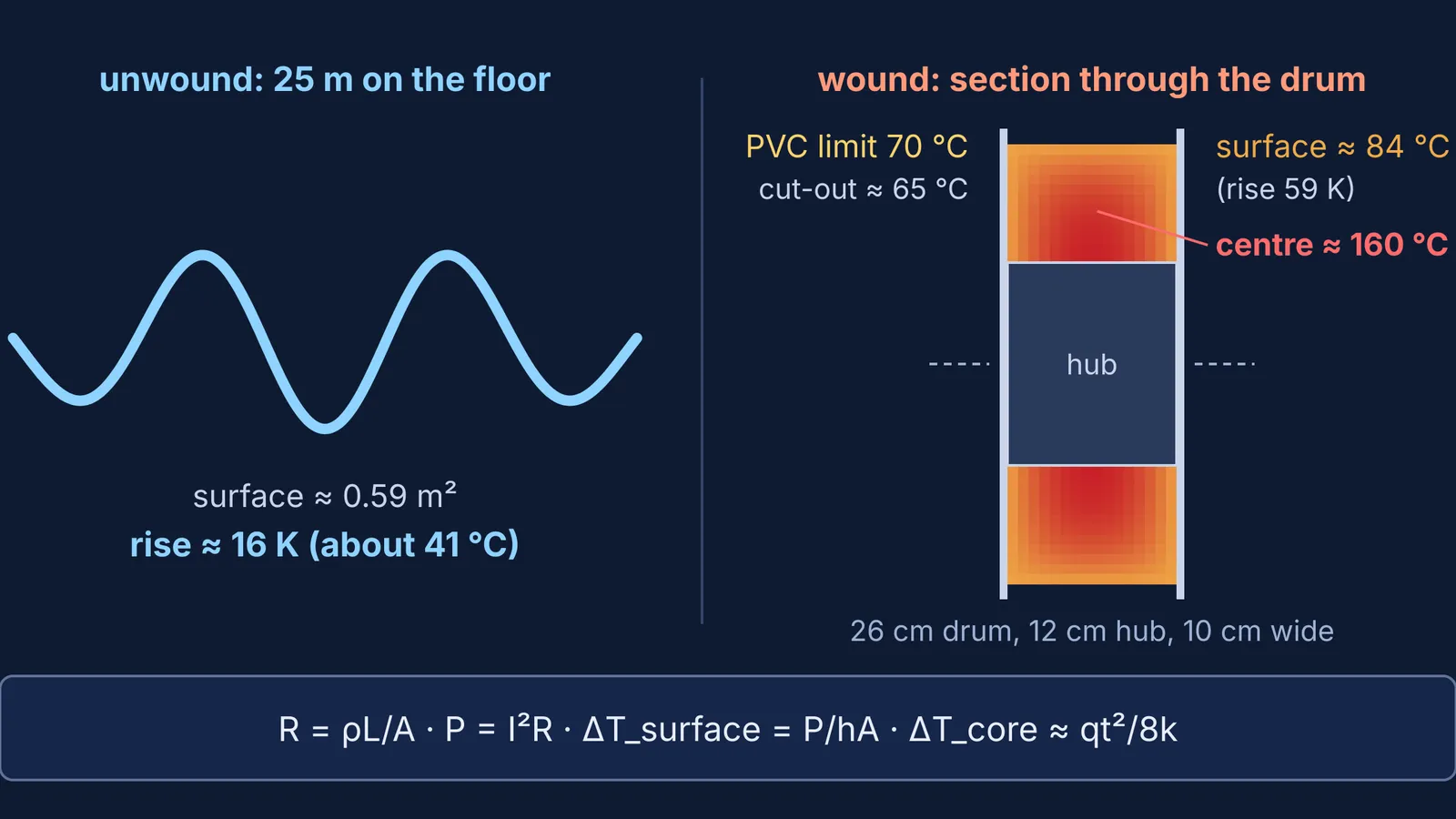
A loose cable sheds heat from its whole surface to the air. Take a round three-core cable about 7.5 mm across. Its surface area is A = πdL = π × 0.0075 × 25 = 0.589 m².
For cooling by still air, use a heat transfer coefficient of h = 10 W/m² K as a round illustrative value (real values depend on air movement and radiation). In the steady state, heat made equals heat lost, so ΔT = P/(hA) = 96.9/(10 × 0.589) = 16.4 K.
In a 25 °C room the cable settles near 41 °C, warm to touch but far below the 70 °C upper operating temperature a cable maker lists for PVC-insulated cable (Belden PVC cable datasheet). How the insulation itself affects a single wire's cooling is in the critical radius of insulation for a thin wire; this post is about many turns packed together.
How hot does the same cable get when it stays wound?
Wind the same 25 m onto an illustrative drum 26 cm across, with a 12 cm hub and 10 cm between the side plates. Two things go wrong at once.
Less surface. Only the outside of the winding touches the air: the curved face, π × 0.26 × 0.10 = 0.082 m², plus two side faces of (π/4)(0.26² − 0.12²) = 0.042 m² each. Total 0.165 m², less than a third of 0.589 m².
Surface rise. ΔT = 96.9/(10 × 0.165) = 58.6 K. The outside of the winding sits near 84 °C, already above 70 °C.
Heat made inside. The 96.9 W is made throughout the winding, whose volume is (π/4)(0.26² − 0.12²) × 0.10 = 4.18 × 10⁻³ m³. That is q = 23,200 W/m³.
Trapped heat. Heat from the middle must conduct out through layers of PVC and air. For a slab of thickness t that makes heat q per cubic metre and is cooled on both faces, the middle is hotter than the faces by qt²/8k. Take an effective conductivity k = 0.3 W/m K, a round illustrative value for PVC and trapped air. Across the 10 cm width: 23,200 × 0.10²/(8 × 0.3) = 97 K.
A better estimate. Heat can also escape outwards through the curved face, so 97 K is an upper bound. Solving the same heat equation for the whole 10 cm × 7 cm cross-section, with the plastic hub treated as insulating, gives about 75 K.
So the centre of the winding reaches roughly 25 + 59 + 75 ≈ 160 °C, while the same cable laid out stays near 41 °C. The exact figure depends on the uncertain k and h, but the conclusion does not: less cooling surface, and heat trapped inside.
What current is safe when the cable is wound?
Every temperature rise above scales as I², because P = I²R. Allow a 45 K rise, from a 25 °C room to the 70 °C limit.
Total rise at 13 A. 58.6 + 74.8 = 133.4 K.
Scale down. I = 13 × √(45/133.4) = 7.5 A, or about 1.7 kW at 230 V.
Compare with the straight cable. 13 × √(45/16.4) = 21.5 A, well above the 13 A load. Unwound, the cable is not the weak link.
The idealised model gives 1.7 kW, while the label quoted above says 720 W. Real windings are packed tighter, rooms are warmer, and makers build in a safety margin, so always follow the label, not a calculation. The model also ignores a feedback that makes things worse: copper's resistance rises by about 0.4% per kelvin, so a hotter core makes more heat. How quickly heat damages PVC in a fault is worked in how long a house cable survives a short circuit.
If you want more Joule-heating and heat-flow numericals like this one, the Fermi Problem Library has a step-by-step solver that explains the reasoning at each stage.
What do reel makers advise?
Brennenstuhl's guidance is to unwind the cable completely whenever a load is connected, and, if the overheating cut-out trips, to unplug everything, fully unroll the cable, let it cool and only then press the reset (Brennenstuhl safety guide). Check the two ratings on your own reel's label. A reel that is damaged, scorched or warm to the touch should not be used. Any repair or rewiring is a job for a licensed electrician.
Quick checklist
25 m of 1.5 mm² copper, two cores: R = 0.573 Ω; at 13 A it makes 96.9 W and drops 7.5 V.
Laid out, 0.589 m² of surface keeps the rise near 16 K (illustrative h = 10 W/m² K).
Wound, only 0.165 m² is exposed: the surface rises about 59 K.
Heat made inside adds roughly 75 K at the centre (illustrative k = 0.3 W/m K).
All rises scale as I², so the wound current must fall to about 7.5 A in this model.
The heating is I²R, not induction.
Follow the label's wound rating, and always unwind fully for heaters.