On this page
NCERT gives you hydroboration-oxidation as one line in the Alcohols chapter: diborane, then alkaline hydrogen peroxide, and propene becomes propan-1-ol. Textbooks credit Herbert C. Brown, who shared the 1979 Nobel Prize in Chemistry. In his own Nobel lecture, Brown says the reaction turned up because a coworker, Dr. B. C. Subba Rao, got a number that was slightly too big. Here is that story, and the chemistry it teaches.
How was hydroboration discovered?
In the 1950s Brown's group at Purdue was studying which hydride reagents reduce which functional groups. Subba Rao "was examining the reducing characteristics of sodium borohydride in diglyme catalyzed by aluminum chloride", Brown wrote. Diglyme is an ether solvent. NaBH₄ alone reduces esters only slowly; with AlCl₃ it reduces them.
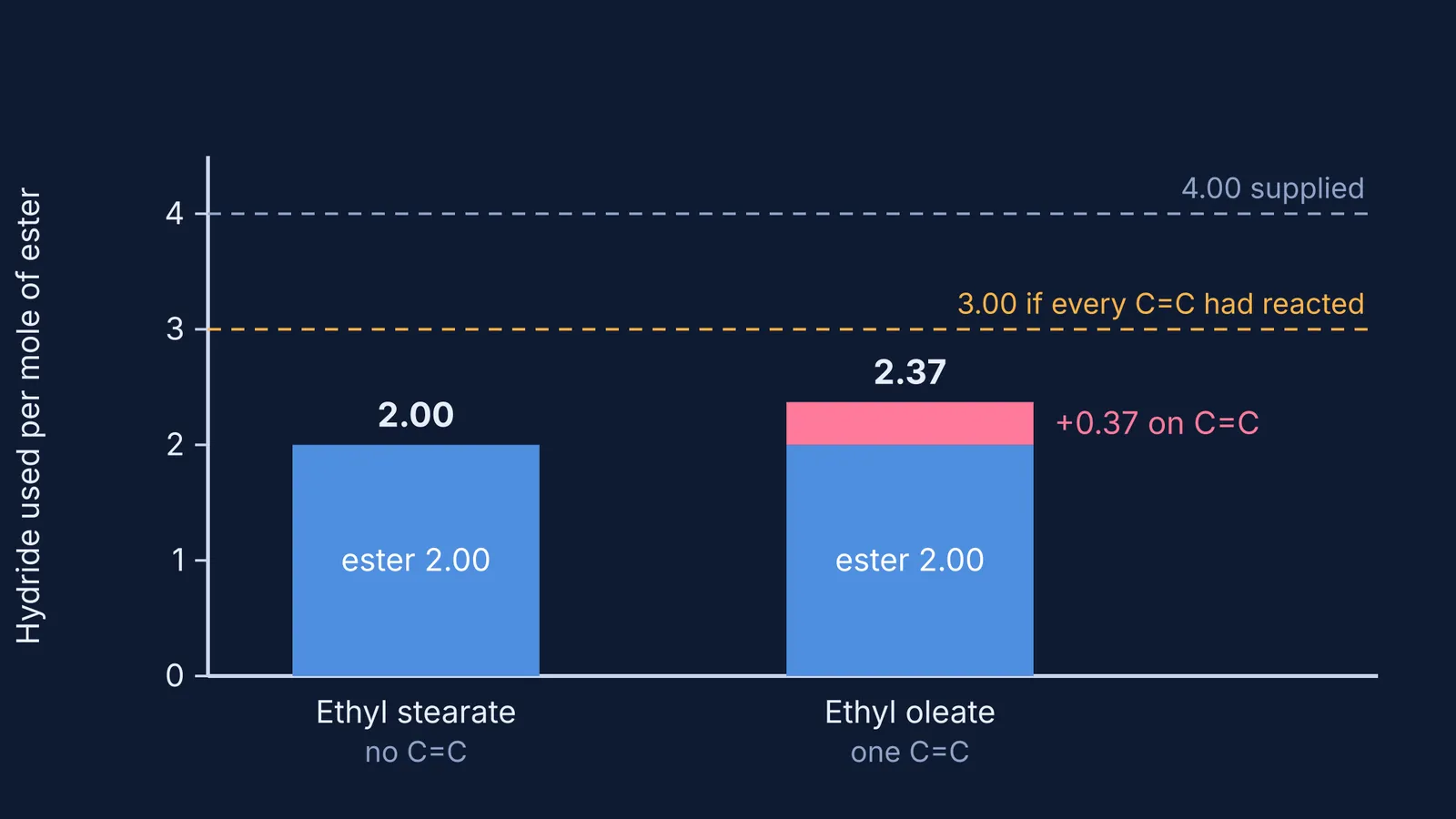
The group used fixed "standard conditions": 4 moles of hydride per mole of compound, one hour at 25 °C. In the lecture's words, the reduction of ethyl oleate "took up 2.37 equivalents of hydride per mole of ester. This contrasted with a value of 2.00 for ethyl stearate."
Brown calls this "a minor anomaly". The two esters differ in one way only. Ethyl stearate, CH₃(CH₂)₁₆COOC₂H₅, has a saturated chain. Ethyl oleate, CH₃(CH₂)₇CH=CH(CH₂)₇COOC₂H₅, has one C=C in the middle of the chain. "Investigation soon established that the reagent was adding an H-B bond to the carbon-carbon double bond to form the corresponding organoborane."
The first report was Brown and Subba Rao in the Journal of the American Chemical Society, volume 78, page 5694, in 1956 (reference 26 in the lecture). Their 1957 Journal of Organic Chemistry paper (reference 27) is cited for the finding that ethers speed up the addition of diborane to alkenes, making it "practically instantaneous and quantitative".
Why does an ester use 2 hydrides and a C=C only 1?
Count how many C–H bonds the reagent has to make.
Ester to two alcohols. An ester RCOOR′ is reduced to RCH₂OH and R′OH. The carbonyl carbon goes from no hydrogens to two, so it takes 2 H⁻: RCOOR′ + 2H⁻ → RCH₂O⁻ + R′O⁻. Workup adds 2 H⁺. For ethyl stearate that gives octadecan-1-ol and ethanol: C₂₀H₄₀O₂ + 4[H] → C₁₈H₃₈O + C₂H₆O. Atoms and charge both balance.
C=C to C–C. Hydroboration adds one H and one B across the double bond. Only one hydride lands on carbon. The boron stays attached to the other carbon.
So a molecule with one ester group and one C=C can use at most 2 + 1 = 3 hydrides. Ethyl stearate has no C=C, so 2.00 is its full value.
What does the extra 0.37 actually mean?
It does not mean 0.37 of a bond in each molecule. The figure is an average over a huge number of molecules.
Assume the ester group in oleate used 2.00, as it did in stearate. Then 2.37 − 2.00 = 0.37 hydride per molecule went to the double bonds. Each C=C that reacts takes exactly 1, so it is as if about 37 of every 100 double bonds had picked up an H–B in that hour. The rest had not reacted when the hydride was measured.
It was not a shortage of reagent: 4.00 hydrides were supplied, and 2.37 used leaves 1.63. The lecture does not say why the figure stopped at 2.37, so treat the "37 in 100" reading as an interpretation of the arithmetic, not something Brown reported.
How did the organoborane become an alcohol?
Next, Subba Rao "established that oxidation of such organoboranes, in situ, with alkaline hydrogen peroxide, proceeds quantitatively, producing alcohols with the precise structure of the organoborane". In plain terms, the OH goes exactly where the boron was. Nothing moves.
At this point, the lecture says, Subba Rao returned to India after five years in Brown's group.
Why does boron go to the less substituted carbon?
In the addition step, H and B add across the C=C at the same time, in one four-centre step. There is no carbocation.
Boron is the electrophile. BH₃ has an empty p orbital. As boron bonds to one carbon, the other carbon becomes slightly positive. That partial charge is better on the more substituted carbon, so boron goes to the less substituted one.
Sterics agree. Boron with its substituents is bulkier than H, so it prefers the less crowded end.
Both atoms add to the same face. This is syn addition. Brown notes that the addition "takes place preferentially from the less hindered side of the double bond". The oxidation keeps the configuration, so the H and OH that were added end up cis to each other on a ring.
No rearrangement. With no carbocation, the skeleton stays as it was.
The result looks like anti-Markovnikov addition of water. The full mechanism and ring examples are in our guide to hydroboration-oxidation and anti-Markovnikov alcohols.
Worked example: propene to propan-1-ol
You have 2.10 g of propene (M = 42.08 g/mol). Give the product, the balanced equations and the theoretical yield.
Place boron. In CH₃–CH=CH₂, the CH₂ end carries more hydrogens and is less substituted. Boron goes there and H goes to the middle carbon.
Count the B–H bonds. Each BH₃ has three, so each adds to three alkenes. One B₂H₆ serves six: 6CH₃CH=CH₂ + B₂H₆ → 2(CH₃CH₂CH₂)₃B.
Oxidise. (CH₃CH₂CH₂)₃B + 3H₂O₂ + OH⁻ → 3CH₃CH₂CH₂OH + B(OH)₄⁻. Check: 9 C, 28 H, 7 O, 1 B and charge −1 on each side. NCERT writes the same step as (CH₃CH₂CH₂)₃B + 3H₂O₂ → 3CH₃CH₂CH₂OH + B(OH)₃, with OH⁻ over the arrow. That also balances.
Moles. 2.10 ÷ 42.08 = 0.0499 mol propene. B₂H₆ needed: 0.0499 ÷ 6 = 0.00832 mol, about 0.23 g.
Yield. One alcohol per alkene, so at most 0.0499 mol propan-1-ol (M = 60.10 g/mol), which is 0.0499 × 60.10 ≈ 3.00 g.
Acid-catalysed hydration of propene would give propan-2-ol instead.
To try the hydride count yourself, take ethyl linoleate, an ester with two C=C. Under the same conditions it could use at most 2 + 2 = 4.00 hydrides, all of the 4.00 supplied. For more problems like this, the Fermi Problem Library has a step-by-step solver that explains the reasoning.
Where does this show up in JEE and NEET?
Class 12 Alcohols, Phenols and Ethers: preparation of alcohols from alkenes. Propene to propan-1-ol is the standard question.
Reagent questions: NaBH₄ alone does not reduce esters at a useful rate, while LiAlH₄ does. The comparison is in the difference between LiAlH₄ and NaBH₄.
For the history further back, Brown says he entered the field because Sarah Baylen, soon to be his wife, gave him Alfred Stock's book The Hydrides of Boron and Silicon as a graduation gift. It was, he wrote, "the most economical chemistry book ($2.06)" in the University of Chicago bookstore. Read more on Alfred Stock's glass vacuum line and the boranes it opened. If you are revising this for the exam, Fermi Test Prep covers JEE Main and Advanced preparation with an AI tutor.
Quick checklist
Hydroboration was first reported in 1956, after a hydride count: 2.37 for ethyl oleate against 2.00 for ethyl stearate.
An ester takes 2 hydrides; each C=C takes 1 in hydroboration.
A fractional hydride count is an average over many molecules.
Boron goes to the less substituted carbon; H and B add syn; no carbocation, no rearrangement.
H₂O₂/OH⁻ puts OH exactly where boron was.
Propene gives propan-1-ol. Six alkenes per B₂H₆.