On this page
In the salt analysis practical you add group reagents in a fixed order: dilute HCl, then H₂S in acid, then ammonium hydroxide with ammonium chloride, then H₂S in ammoniacal solution, then ammonium carbonate. That plan goes back to Carl Remigius Fresenius, who taught analysis in Justus Liebig's laboratory at Giessen. His textbook's English edition, Elementary Instruction in Chemical Analysis (London, 1843), is free to read as a scan on the Internet Archive. It uses the same reagents in nearly the same order, but it numbers the groups from the other end.
Who was Carl Remigius Fresenius?
According to Wikipedia's biography, Fresenius was born in Frankfurt in 1818 and became an assistant in Liebig's laboratory at Giessen in 1841. His qualitative analysis book first appeared in German that year, the quantitative one in 1846, and in 1862 he founded the Zeitschrift für analytische Chemie.
The 1843 title page calls him "Chemical Assistant in the Laboratory of the University of Giessen". The editor, J. Lloyd Bullock, says the translation was "undertaken by the express desire of Professor Liebig", and that the book had already gone through two German editions. We have read only this English edition, so everything below describes it, not the 1841 original.
Big manuals, the editor explains, confused beginners partly through "the absence of explanations of the causes of phenomena". The book avoided ready-made tables, which the editor says "satisfy the student before they have really informed him".
How did Fresenius number the salt analysis groups?
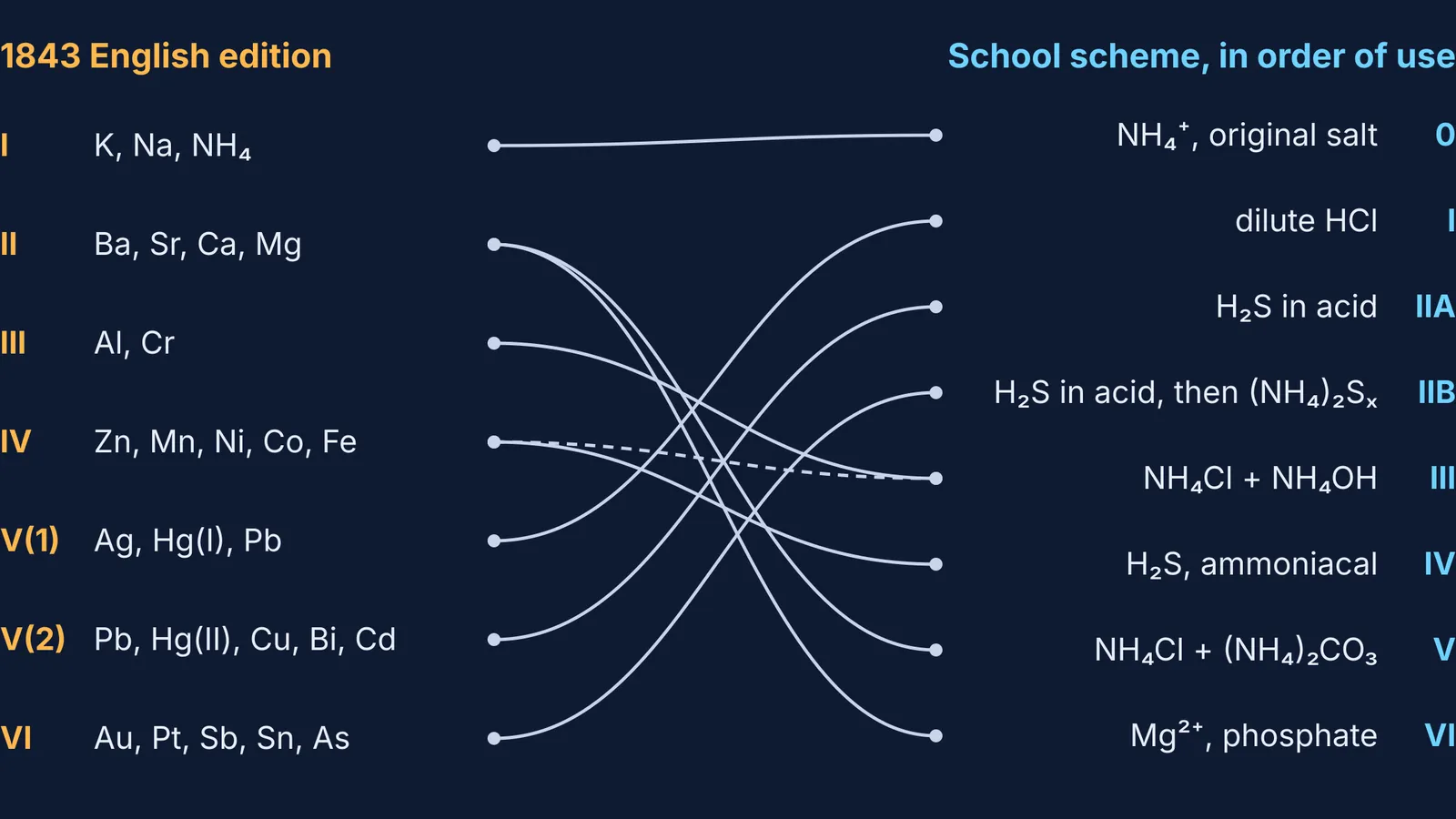
He named oxides, not ions ("oxide of zinc", "barytes"). His six groups of bases are:
Group I: potash, soda and ammonia (K, Na, NH₄). Not precipitated by sulphuretted hydrogen (H₂S) "under any condition whatever".
Group II: barytes, strontian, lime and magnesia (Ba, Sr, Ca, Mg). Carbonates and phosphates insoluble.
Group III: alumina and oxide of chromium, thrown down as hydrated oxides by ammonium sulphide.
Group IV: oxides of zinc, manganese, nickel, cobalt and iron. Sulphides soluble in dilute acids.
Group V: oxides of silver, mercury, lead, bismuth, copper and cadmium. Sulphides "insoluble both in dilute acids and in alkaline sulphurets". A first section (silver, mercurous mercury, lead) is precipitated by hydrochloric acid.
Group VI: gold, platinum, antimony, tin and arsenic. Sulphides "insoluble in dilute acids. They combine with alkaline sulphurets, forming soluble sulphur salts".
So his numbers climb as the compounds become less soluble.
In what order did Fresenius add the reagents?
The analysis starts from the least soluble. In his words, the general reagents are "HYDROCHLORIC ACID, SULPHURETTED HYDROGEN, HYDROSULPHURET OF AMMONIA, and CARBONATE OF AMMONIA; this is also the order of succession in which they are employed." Mapped by reagent, not by number:
Dilute HCl removes his Group V first section. Today this is Group I.
H₂S in the acid filtrate takes the rest of Group V and all of Group VI. Today this is Group II.
Ammonium sulphide on that precipitate dissolves his Group VI as sulphur salts and leaves Group V. Today this is the IIA/IIB split, explained in Group 2A vs 2B with yellow ammonium sulphide.
Ammonium sulphide on the filtrate brings down his Groups III and IV together: alumina, chromium oxide, and the sulphides of iron, manganese, cobalt, nickel and zinc. The school scheme splits this step in two, with NH₄Cl + NH₄OH (Group III) and then H₂S in ammoniacal solution (Group IV). Iron moves to Group III.
Ammonium carbonate, with sal ammoniac (NH₄Cl) added first "in order completely to prevent the precipitation of magnesia", brings down barium, strontium and calcium. Today this is Group V, and magnesium is tested on its own as Group VI.
Two details survive. Fresenius notes that H₂S reduces "peroxide of iron" to a lower oxide, which is why today's scheme boils with nitric acid before Group III. And he says "a fresh specimen must, of course, be employed for the detection of ammonia", since the reagents add ammonium salts. That is why NH₄⁺ (often called Group 0) is tested on the original salt.
We could not find who first renumbered the groups into today's order, so we leave that open.
Why does H₂S in acid split Group V from Group IV?
Fresenius explained it with "affinity": the pull of the metal for sulphur is strong enough to precipitate Groups V and VI "EVEN THOUGH THE ACID BE PRESENT IN EXCESS". Group IV sulphides dissolve in dilute acid, so they need the acid removed. The modern reason is solubility product. Acid pushes H₂S ⇌ 2H⁺ + S²⁻ to the left, keeping S²⁻ tiny, and only sulphides with a very small Ksp exceed it.
Worked example: following the 1843 scheme with Ksp
A solution holds Ag⁺, Cu²⁺, As³⁺, Fe³⁺, Mn²⁺, Ba²⁺ and Mg²⁺. Name each group in 1843 and today, then check step 2 with numbers.
Dilute HCl: white AgCl. Fresenius Group V, first section; today Group I.
H₂S in the acid: black CuS and yellow As₂S₃. His Groups V and VI; today Group II.
Warm with yellow ammonium sulphide: As₂S₃ dissolves (his VI, today IIB); CuS stays (his V, today IIA).
Fresenius would now add ammonium sulphide and get FeS and MnS together (his Group IV). The school scheme boils with HNO₃, adds NH₄Cl + NH₄OH for reddish-brown Fe(OH)₃ (Group III), then H₂S for buff MnS (Group IV).
NH₄Cl + (NH₄)₂CO₃: white BaCO₃ (his II, today V). Mg²⁺ stays and is found with phosphate (his II, today VI).
Now the numbers for step 2, with NCERT's values from the Class 11 Equilibrium chapter (Ka₁ = 9.1 × 10⁻⁸ and Ka₂ = 1.2 × 10⁻¹³ for H₂S, Table 6.9 for Ksp).
Take 0.1 M H₂S and [H⁺] = 0.1 M. [S²⁻] = Ka₁ × Ka₂ × [H₂S] / [H⁺]² = 9.1 × 10⁻⁸ × 1.2 × 10⁻¹³ × 0.1 / 0.01 = 1.1 × 10⁻¹⁹ M. (NCERT's exercise 6.73 uses 1.0 × 10⁻¹⁹ M.)
With 0.01 M metal ion, Q = 0.01 × 1.1 × 10⁻¹⁹ = 1.1 × 10⁻²¹.
CuS: Ksp = 6.3 × 10⁻³⁶. Q is about 10¹⁴ times larger, so CuS precipitates.
MnS: Ksp = 2.5 × 10⁻¹³. Q is far smaller, so Mn²⁺ stays in solution.
In ammoniacal solution [H⁺] falls to about 10⁻⁹ M. Since [S²⁻] goes as 1/[H⁺]², the formula raises it by a factor of (0.1/10⁻⁹)², or 10¹⁶, and MnS comes down.
Zinc is the awkward case: with Table 6.9's ZnS value, step 2 says Q exceeds Ksp, yet the scheme keeps zinc for Group IV. Sulphide Ksp values vary between sources, so treat this as a guide to the order, not a sharp cut-off.
How is this asked in the practical and in JEE?
Viva questions ask why HCl comes first, why Group II needs acid, why NH₄Cl goes in with NH₄OH or (NH₄)₂CO₃, and why NH₄⁺ is tested on the original salt. JEE Advanced asks the same through Ksp, pH and the IIA/IIB split. For the modern scheme with worked salts, see salt analysis in the chemistry practical.
If the Ksp steps feel shaky, the Fermi Problem Library has worked problems with a step-by-step solver that explains the reasoning. Fermi Test Prep is for JEE Main and Advanced preparation, with an AI tutor.
Quick checklist
Reagent order: dilute HCl, H₂S in acid, then ammoniacal reagents, then (NH₄)₂CO₃.
1843 Group V first section = today's Group I; Group V rest and Group VI = Group II.
Acid keeps S²⁻ near 10⁻¹⁹ M, so only very insoluble sulphides fall.
Test NH₄⁺ on a fresh sample, as Fresenius did.