On this page
The silver–silver bromide electrode, AgBr(s) + e⁻ → Ag(s) + Br⁻, looks like one more value to learn from the electrochemical series. You do not have to learn it. If you know E°(Ag⁺/Ag) and the solubility product of AgBr, you can derive it in one line, and the same line gives you AgCl/Ag and AgI/Ag too. Below is the derivation, a fully worked example with the numbers from the NCERT textbooks, and what to do in an exam when a derived value and a printed one are not the same.
What is the Ag/AgBr electrode?
It is a silver wire coated with solid silver bromide, dipped in a solution of bromide ions. It works exactly like the silver–silver chloride reference electrode described in our post on reference electrodes: calomel and Ag/AgCl, with Br⁻ in place of Cl⁻.
The electron transfer still happens between Ag⁺ and Ag. The solid AgBr simply decides how much Ag⁺ is in solution: at any moment, [Ag⁺] = Ksp ÷ [Br⁻]. That is the whole idea behind the derivation.
How do you derive E°(AgBr/Ag) from Ksp?
There are two routes, and they give the same answer.
Route 1: the Nernst equation. For the Ag⁺/Ag couple at 298 K,
E = E°(Ag⁺/Ag) + 0.0591 log [Ag⁺]
In the AgBr electrode under standard conditions, [Br⁻] = 1 M, so [Ag⁺] = Ksp. Substitute:
E°(AgBr/Ag) = E°(Ag⁺/Ag) + 0.0591 log Ksp(AgBr)
Route 2: add the ΔG° values. Write the target half-reaction as the sum of two steps:
AgBr(s) → Ag⁺ + Br⁻, with ΔG° = −RT ln Ksp
Ag⁺ + e⁻ → Ag(s), with ΔG° = −F × E°(Ag⁺/Ag)
The sum is AgBr(s) + e⁻ → Ag(s) + Br⁻, and its ΔG° is −F × E°(AgBr/Ag). Adding the two ΔG° values and dividing by −F gives the same formula, because RT ln Ksp ÷ F = 0.0591 log Ksp at 298 K. You add ΔG° values, never E° values directly; our post on getting E° of Fe³⁺/Fe from two couples shows why.
Since Ksp is far below 1, log Ksp is negative, and E°(AgX/Ag) always sits below 0.80 V. The less soluble the salt, the lower the potential.
Worked example: E° of AgCl/Ag, AgBr/Ag and AgI/Ag
Data, all from the NCERT 2026-27 reprints:
E°(Ag⁺/Ag) = 0.80 V (Table 2.1, Class 12 Electrochemistry).
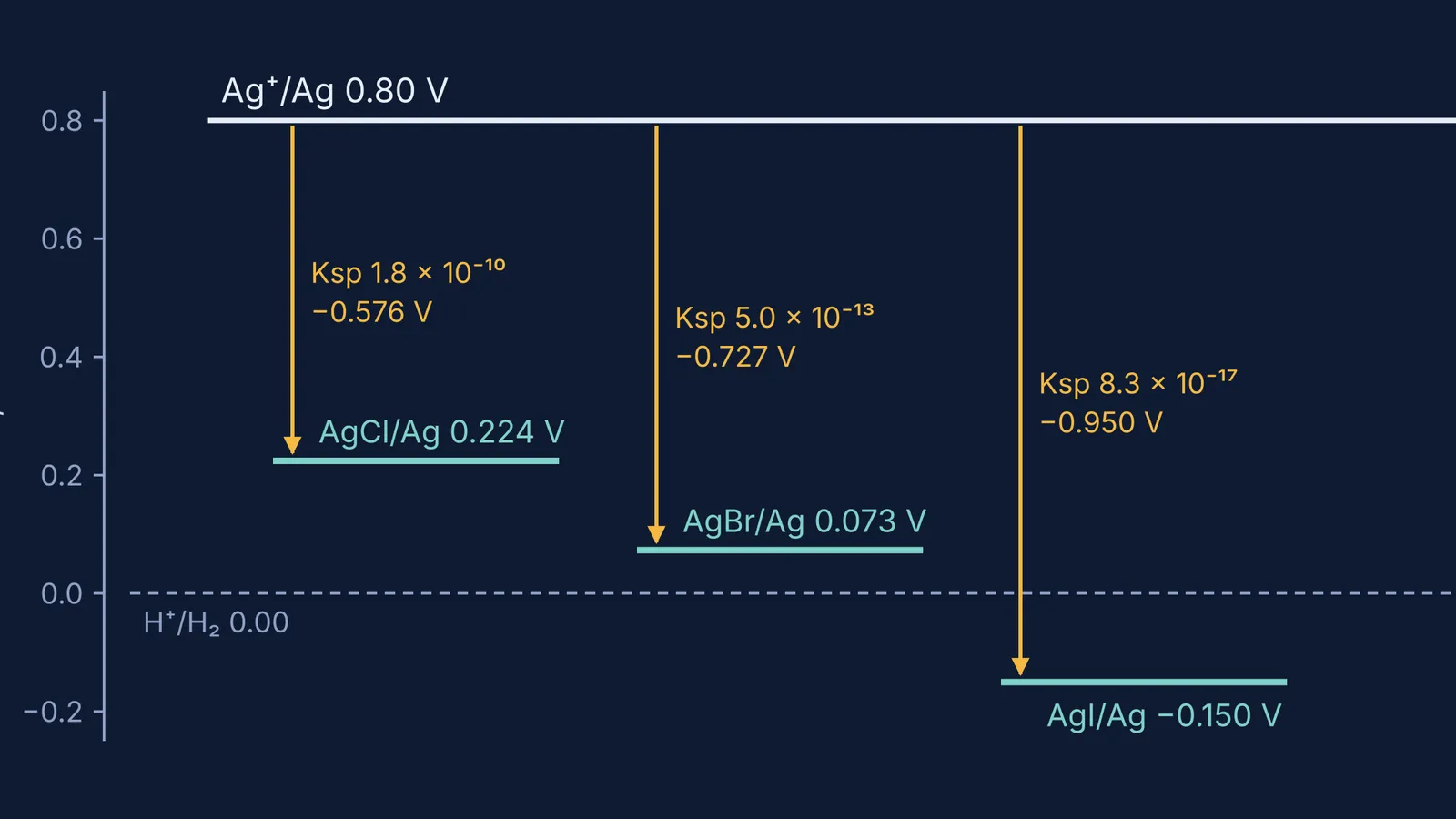
Ksp(AgCl) = 1.8 × 10⁻¹⁰, Ksp(AgBr) = 5.0 × 10⁻¹³, Ksp(AgI) = 8.3 × 10⁻¹⁷ (Table 6.9, Class 11 Equilibrium).
AgBr/Ag
log (5.0 × 10⁻¹³) = −12.301.
0.0591 × (−12.301) = −0.727 V.
E° = 0.80 − 0.727 = 0.073 V.
AgCl/Ag
log (1.8 × 10⁻¹⁰) = −9.745.
0.0591 × (−9.745) = −0.576 V.
E° = 0.80 − 0.576 = 0.224 V.
AgI/Ag
log (8.3 × 10⁻¹⁷) = −16.081.
0.0591 × (−16.081) = −0.950 V.
E° = 0.80 − 0.950 = −0.150 V.
Compare these with published tables. The LibreTexts table of standard reduction potentials lists 0.2223 V for AgCl/Ag, 0.071 V for AgBr/Ag and −0.152 V for AgI/Ag, with 0.7996 V for Ag⁺/Ag. The one-line derivation lands within a few millivolts of all three.
To run the formula the other way, from a measured E° to a Ksp, see our post on finding Ksp from cell EMF, which does it for AgCl.
What if the derived value and the table differ?
NCERT's Table 2.1 prints 0.22 V for AgCl/Ag, which matches the derivation. For AgBr/Ag it prints 0.10 V, while NCERT's own Ksp of 5.0 × 10⁻¹³ gives 0.073 V. The two numbers come from different tables, and they differ by about 0.03 V.
That gap is easy to translate. Running the formula backwards, 0.10 V corresponds to a Ksp of about 1.4 × 10⁻¹², roughly three times the 5.0 × 10⁻¹³ in Table 6.9. A difference of 0.0591 V is a factor of 10 in Ksp, so 0.03 V is a factor of about 3. This is the transferable skill: two tables that describe the same equilibrium are linked through ΔG° = −nFE° = −RT ln K, and one subtraction tells you whether they agree.
You will meet a similar case with cobalt. Table 2.1 of the electrochemistry chapter gives E°(Co³⁺/Co²⁺) = 1.81 V, while Table 4.2 of the d- and f-block chapter gives +1.97 V, and the LibreTexts table above lists 1.92 V. Every source agrees on the chemistry: Co³⁺ is a very strong oxidising agent in water. For a numerical, just use the value the question gives.
Why can silver release hydrogen from HI but not from HCl?
The derived potentials answer this directly. Consider 2Ag(s) + 2H⁺ + 2X⁻ → 2AgX(s) + H₂(g). Silver is oxidised to AgX (the anode), and H⁺ is reduced (the cathode, 0.00 V). So E°cell = 0.00 − E°(AgX/Ag).
X = Cl: E°cell = −0.224 V. Not spontaneous.
X = Br: E°cell = −0.073 V. Not spontaneous under standard conditions.
X = I: E°cell = +0.150 V. Spontaneous.
Silver itself (0.80 V) cannot reduce H⁺. Iodide removes Ag⁺ so completely, as nearly insoluble AgI, that the potential drops below zero, and then silver can release hydrogen. Check the equation: 2 Ag, 2 H and 2 X on each side, and charge 0 on both sides.
If you want to practise questions that hide equilibrium inside electrochemistry, Fermi Test Prep is built for JEE Main and Advanced preparation, and Fermi's AI tutor for JEE prep can walk through the ΔG° bookkeeping with you step by step.
Checklist for E° from Ksp
Formula: E°(AgX/Ag) = E°(Ag⁺/Ag) + 0.0591 log Ksp, for a 1:1 salt and one electron.
Sign: log Ksp is negative, so the answer is always below 0.80 V.
Order: AgCl/Ag 0.22 V > AgBr/Ag 0.07 V > AgI/Ag −0.15 V, in the same order as solubility.
Sense check: 0.059 V per factor of 10 in Ksp.
In the exam, a value the question gives always beats a value you derive.