On this page
In the village of Aranmula in Kerala, craftsmen make a mirror with no glass in it. The Aranmula kannadi is a polished disc of metal. In 2007 archaeometallurgists Sharada Srinivasan (National Institute of Advanced Studies, Bengaluru) and Ian Glover (Institute of Archaeology, University College London) published what it is made of, in a paper in Current Science. Its title gives the metal a chemical formula: Cu₃₁Sn₈. Your textbook says an alloy has no formula. Here is how both can be true, worked as an empirical-formula problem from the paper's own data.
What is the Aranmula mirror made of?
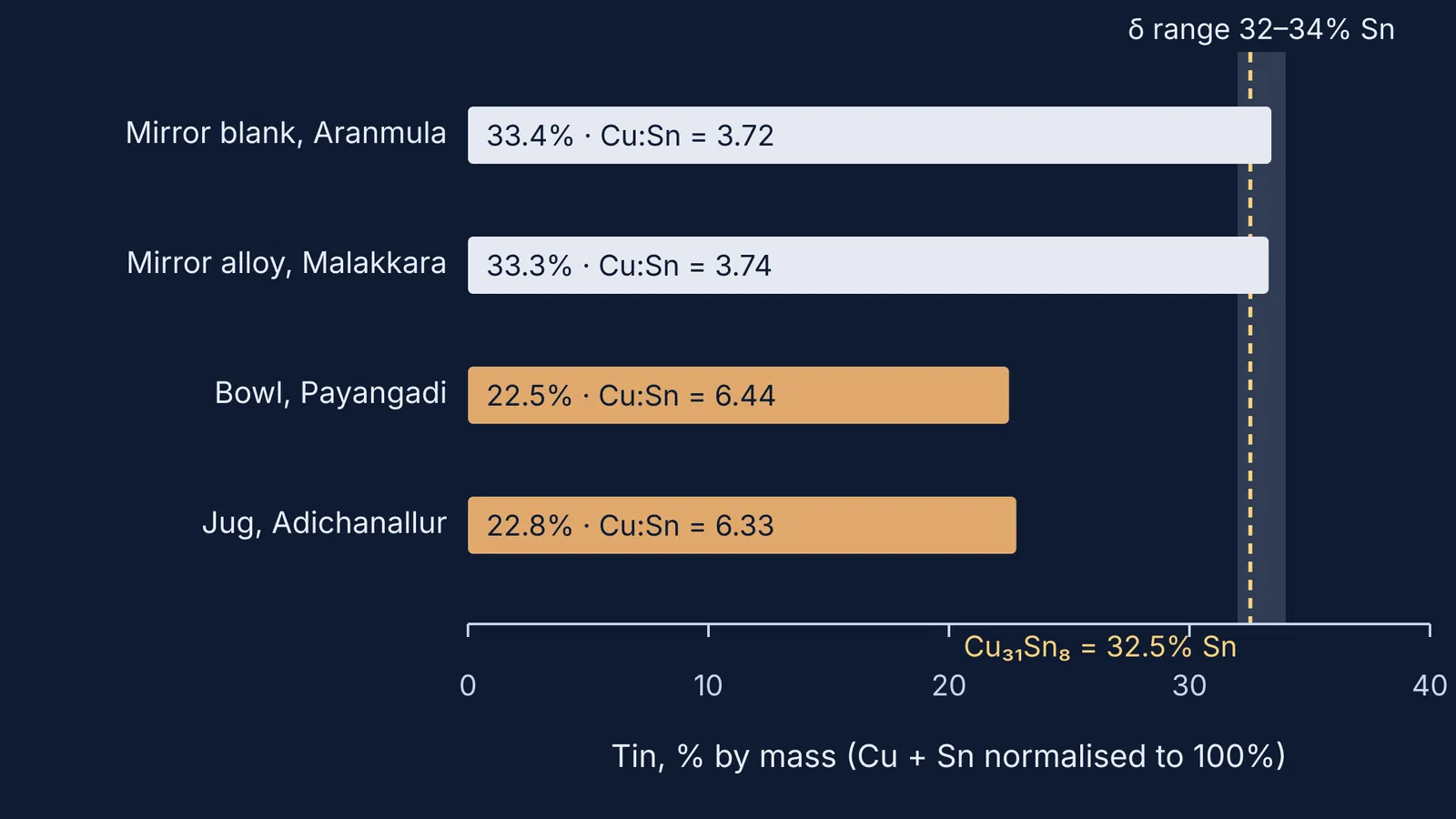
The paper calls it a "binary copper–tin alloy", in other words bronze with nothing else added on purpose. They analysed a mirror blank from Aranmula and mirror alloy from nearby Malakkara by electron probe microanalysis (EPMA). Their Table 1 gives:
Mirror blank, Aranmula: Cu 64.73%, Sn 32.47%, total 97.20%, hardness 480 VPN.
Mirror alloy, Malakkara: Cu 66.91%, Sn 33.39%, total 100.29%, hardness 500 VPN.
Bowl, Payangadi (Kerala), for comparison: Cu 77.65%, Sn 22.54%.
About one-third of the mirror's mass is tin. The paper says this composition is almost entirely the δ (delta) phase of bronze, which is silvery-white and very hard. At about 500 VPN it is harder than ordinary steel, which the paper puts at 400 VPN. Low-tin bronze is coppery in colour and reflects poorly. The craftsmen avoid lead, which many ancient mirror makers added to reduce brittleness; the paper says it would have dulled the mirror.
If an alloy is a mixture, how can it have a formula?
NCERT defines an alloy as a homogeneous mixture of metals, or of a metal and a non-metal. That is the rule explained in why an alloy is a mixture and not a compound: brass and steel can be made over a range of compositions, and their atoms share one metallic lattice.
The exception sits inside some alloy systems. When two metals are mixed in certain ratios, they form a phase with its own crystal structure and a fixed, or very narrow, composition. Such a phase is called an intermetallic compound. Srinivasan and Glover describe the δ phase as "an intermetallic compound (Cu₃₁Sn₈) of fixed composition 32.6% tin", and say it forms only within "a narrow composition range of bronze of 32–34% tin".
So keep two levels apart:
The mirror is an alloy. Under the microscope it is mostly δ, with a minor network of a second region (α + δ) between the δ grains.
The δ phase inside it is a compound with a formula.
Intermetallic formulas do not follow valency rules, so do not explain Cu₃₁Sn₈ with oxidation states.
How do you find the Cu:Sn ratio from the analysis?
Use the same five steps as for any empirical formula. Take the Aranmula mirror blank. Atomic masses: Cu = 63.55, Sn = 118.71.
Notice the total. Cu + Sn = 97.20%, not 100%. Normalise to 100% (Cu 66.59%, Sn 33.41%) if you like; the mole ratio is the same either way, because both numbers scale by the same factor. That is why a formula comes from ratios, not from one percentage.
Convert to moles (per 100 g of normalised alloy). Cu: 66.59 ÷ 63.55 = 1.048 mol. Sn: 33.41 ÷ 118.71 = 0.2814 mol.
Divide by the smaller. Cu : Sn = 1.048 ÷ 0.2814 = 3.72 : 1.
Look for whole numbers. 3.72 is not close to a whole number. Multiply by 8 and you get 29.8 : 8.
Compare with the paper's formula. Cu₃₁Sn₈ means a ratio of 31 ÷ 8 = 3.875. Going the other way, its tin content is 8 × 118.71 ÷ (31 × 63.55 + 8 × 118.71) = 949.7 ÷ 2919.6 = 32.5%.
The Malakkara sample gives almost the same ratio, 3.74 : 1. The bowl gives 6.44 : 1, a very different alloy.
The measured ratio, 3.72, is lower than 3.875, so these samples are slightly richer in tin than Cu₃₁Sn₈. They still sit inside the paper's 32–34% range. At 32% tin the ratio is 3.97, and at 34% it is 3.63. So 3.72 is consistent with Cu₃₁Sn₈ within the stated range, but composition data alone cannot prove one formula. The paper gives Cu₃₁Sn₈; choosing between nearby formulas takes crystal-structure work, which this post does not cover.
Why does 33% tin make a mirror but 22% tin make a bowl?
The same two metals give different phases at different ratios, each with its own colour and hardness:
Below about 15% tin, as-cast bronze is mostly α, a copper-rich solid solution. It is coppery and a poor reflector.
Around 23% tin, south Indian smiths make vessels and cymbals from β bronze, a high-temperature phase they keep by quenching in water. The paper describes its "golden lustre", toughness and musical ring. The Payangadi bowl (22.54% tin) and a 1st-millennium-BC jug from Adichanallur in Tamil Nadu (22.92% tin) are of this kind.
At 32–34% tin, the δ phase is silvery-white and takes a mirror polish.
The price of δ is brittleness. The paper says it "shatters quite easily, akin to brittle fracture in glass". The craftsmen handle this in three ways:
They cast a thin blank, about 7 cm long and no more than 3 mm thick, which cools more evenly.
They melt the metal in a closed clay crucible-cum-mould, which limits oxidation.
They fix the blank with heated resin onto a wooden mount before polishing. The final polish uses the same brittle alloy ground to powder and mixed with gingelly oil.
The paper links the craft to older Indian high-tin mirrors with 25–30% tin, from Taxila and the Nilgiri cairns.
What should you write in the exam?
The answer depends on the question.
"Is an alloy a mixture or a compound?" Write: a mixture, because its composition can vary and it shows the properties of its components. This is the NCERT answer and it earns the mark.
A longer answer, or a "give an exception" question: add that some alloy systems contain intermetallic compounds of fixed composition, for example the δ phase of high-tin bronze, given as Cu₃₁Sn₈ in the Aranmula mirror study.
Empirical formula from per cent composition: show percent ÷ atomic mass, divide by the smallest, then multiply to whole numbers. State the atomic masses you used.
More worked cases are in empirical and molecular formula problems. The Concept Library on Fermi has a lesson for each chemistry concept, including mixtures, compounds and the mole. For where copper alloys sit in the d-block chapter, see why transition metals form alloys easily.
Quick checklist
The Aranmula mirror is a copper–tin bronze with about 33% tin, no lead.
Most of it is the δ phase, an intermetallic compound; the paper writes it as Cu₃₁Sn₈ (32.6% tin).
Mirror blank data give Cu : Sn ≈ 3.72 : 1; Cu₃₁Sn₈ needs 3.875 : 1. Both sit in the 32–34% tin range.
A missing 2.8% in the total does not change the mole ratio.
Exam answer: alloys are mixtures; intermetallic phases inside them can be compounds.
Round a ratio only if it is within about 0.1 of a whole number.