On this page
Every Class 12 student learns that NaI in dry acetone turns an alkyl chloride or bromide into an alkyl iodide. The reaction carries the name of Hans Finkelstein, and the paper behind the name is only five pages long. It appeared in the Berichte der Deutschen Chemischen Gesellschaft, volume 43, pages 1528 to 1532, received on 9 May 1910 from the Chemical Institute of the University of Strasbourg (DOI; free scan on the Internet Archive). It already contains the SN2 reactivity order, a test for reactive halogen and a vicinal dihalide elimination, written before anyone had a theory to explain them. The quotations below are our translations from the German.
Who was Hans Finkelstein?
The paper tells you only his name, his institute and the date, and it ends with "the process has been applied for as a patent". Birth and death dates and a later industrial career are repeated online, but we could not find a primary source for them, so we leave them out and read what he wrote.
How were alkyl iodides made before 1910?
Finkelstein opens with the old method. Since Perkin and Duppa in 1859, he writes, chemists had usually made aliphatic iodides by heating the chloride or bromide with potassium iodide "in warm alcoholic solution".
His change was the solvent. "Anhydrous sodium iodide is readily soluble in acetone at ordinary temperature," he writes, and you can easily make "normal (= 15 percent)" solutions that keep indefinitely. When the acetone evaporates, NaI crystallises with three molecules of acetone. He checked this by weighing: 0.4495 g of the crystals lost 0.2398 g in a desiccator. That is 53.35 % acetone, against 53.70 % that he calculated for NaI·3C₃H₆O (53.76 % with today's atomic masses). (The page image reads 53.35; some text copies of the scan misprint it as 53.85.)
The word "normal" fits the numbers. 15 g of NaI (M = 149.89 g/mol) in 100 mL is 0.1001 mol in 0.100 L, so about 1.00 mol/L.
Why does NaI in acetone work when KI in alcohol struggles?
When the NaI solution meets a suitable organic chloride or bromide, NaCl or NaBr comes out "more or less quickly, often instantly". Taking the salt out of solution keeps pulling the equilibrium R–Br + I⁻ ⇌ R–I + Br⁻ to the right, which is Le Chatelier's principle at work. How that equilibrium argument is used in exam answers is covered in Finkelstein and Swarts reactions.
Acetone has a second advantage: unlike alcohol, it does not react with many sensitive compounds. With KI in alcohol, xylylene bromides gave mainly ethers; in acetone, Finkelstein got the iodides in quantitative yield.
He also turned the precipitate into a test. If an organic halogen compound gives a precipitate with the reagent (boiling may be needed), the halogen sits on a singly bonded carbon. If nothing happens, the halogen is "fairly surely" on a doubly bonded carbon or an aromatic ring. He adds that mistakes are possible, since some halides of the first kind react very sluggishly. This is the pattern you learn as "vinyl and aryl halides do not undergo SN2".
What order of reactivity did Finkelstein find?
He first notes that reactivity towards NaI "does not always run parallel" with reactivity towards water and alcohols. Then:
"Thus, for example, the primary alkyl bromides react with sodium iodide most easily, the secondary with more difficulty, the tertiary with the most difficulty. An explanation of this behaviour cannot yet be given. Bromides naturally always react faster than the corresponding chlorides."
He also says plainly that "quantitative experiments in this direction are still lacking". So the order 1° > 2° > 3° is qualitative. There are no rate constants in the paper, and you should not attach any to it.
Today the explanation is the SN2 mechanism. Iodide attacks the carbon from the side opposite the leaving bromide, and every extra alkyl group on that carbon blocks the approach. Water and alcohols react with tertiary halides fastest because they go by SN1 through a carbocation, which is why the two orders do not "run parallel". SN1 vs SN2 in haloalkanes sets out both mechanisms, and why neopentyl halides react slowly shows that crowding next door to the carbon matters too.
Worked example: can you see the order in his yields?
Both runs below used about 0.1 mol of NaI (100 mL of the 1 M solution).
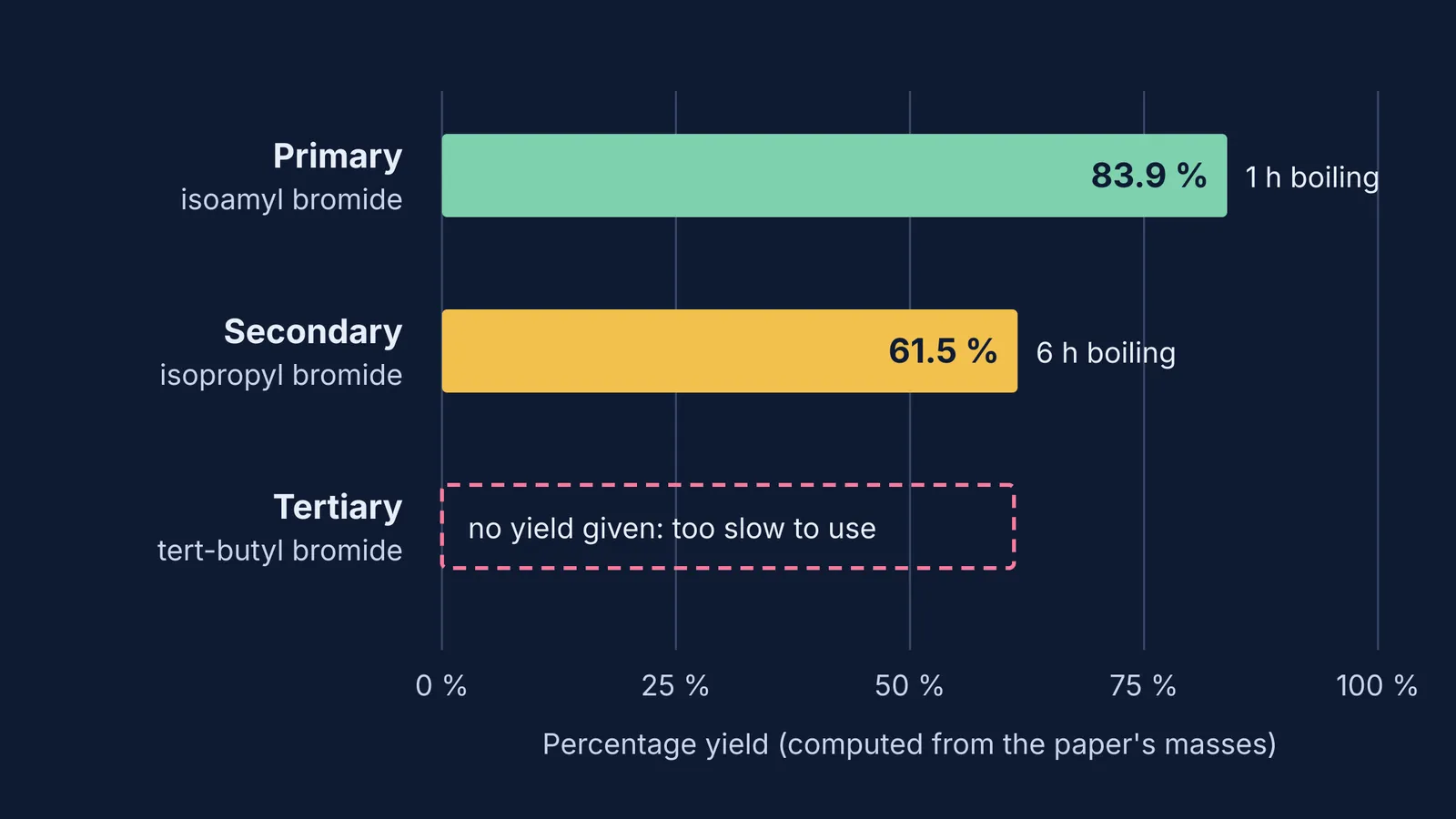
Isoamyl bromide, primary. 15 g of C₅H₁₁Br (M = 151.05 g/mol) is 15 ÷ 151.05 = 0.0993 mol. Boiled for one hour, it gave 16.5 g of isoamyl iodide.
Theoretical yield. C₅H₁₁I has M = 198.05 g/mol, so 0.0993 × 198.05 = 19.7 g. Percentage yield = 16.5 ÷ 19.7 × 100 = 84 %. The paper prints 85 %.
Isopropyl bromide, secondary. 10 g of C₃H₇Br (M = 122.99 g/mol) is 0.0813 mol. Even after six hours of boiling, it gave 8.5 g of isopropyl iodide.
Theoretical yield. C₃H₇I has M = 169.99 g/mol, so 0.0813 × 169.99 = 13.8 g. Percentage yield = 8.5 ÷ 13.8 × 100 = 61.5 %. The paper prints 63 %.
Tertiary. For tert-butyl bromide he gives no yield: it reacted "so slowly, even at the boiling point" that he did not recommend the method.
Read the trend. The secondary bromide had more NaI per mole of bromide (0.1 mol for 0.0813 mol, against about 1 : 1 for the primary) and six times longer, yet gave the lower yield. That is the 1° > 2° > 3° order showing up in the lab notebook. Yield is not a rate, so treat this as a supporting clue, not a measurement.
He also analysed his products. 0.2046 g of p-nitrobenzyl iodide gave 0.1820 g of AgI. Iodine in it = 0.1820 × 126.90 ÷ 234.77 = 0.0984 g, which is 0.0984 ÷ 0.2046 × 100 = 48.08 %. The calculated value for C₇H₆NO₂I is 48.25 % (he printed 48.28). The close match showed the product really was the iodide.
For more yield and stoichiometry problems, the Fermi Problem Library has a step-by-step solver that explains the reasoning at each stage.
What happens to a 1,2-dibromide?
Finkelstein found that the method fails where the new iodide is unstable and loses iodine. This always happens, he says, with 1,2-diiodides. Ethylene bromide gives ethene:
CH₂Br–CH₂Br + 2NaI → CH₂=CH₂ + 2NaBr + I₂
Check the balance: 2 C, 4 H, 2 Br, 2 Na and 2 I on each side, and no net charge. Cinnamic acid forms from its dibromide the same way. Excess NaI helps iodine split off, "evidently" because it forms NaI·I₂. Exam questions use this: a vicinal dibromide with NaI in acetone gives back the alkene.
To practise these steps under exam conditions, Fermi Test Prep is built for JEE Main and Advanced preparation, with an AI tutor.
Quick checklist
Finkelstein, Berichte 43, 1528 (1910), from Strasbourg: NaI in dry acetone, NaCl or NaBr precipitates.
A 15 % NaI solution in acetone is about 1 M; NaI crystallises as NaI·3C₃H₆O.
No precipitate suggests a vinyl or aryl halogen.
Order towards NaI: 1° > 2° > 3°, bromides faster than chlorides; he could not explain it, and it is qualitative.
Isoamyl bromide gave 84 % in 1 hour; isopropyl bromide 61.5 % in 6 hours.
1,2-Dibromides with NaI give the alkene, NaBr and I₂.