On this page
Zeise's salt, K[PtCl₃(C₂H₄)], turns up in JEE questions as an early organometallic compound and a test of oxidation state. The man behind it, William Christopher Zeise, also made the first mercaptans, the sulphur cousins of alcohols. His own analysis of the platinum salt survives in a German edition printed at Halle in 1831, and you can work out its formula from his numbers exactly as you would in a Class 11 percentage composition problem. The quotations below are our translations from Danish and German.
Who was W. C. Zeise?
The Dansk Biografisk Leksikon entry by E. Rancke-Madsen and Stig Veibel gives the outline. Zeise was born in Slagelse on 15 October 1789, the son of a pharmacist, and died in Copenhagen on 12 November 1847. In 1806 he moved to Copenhagen to study chemistry with H. C. Ørsted, lived in his house and assisted at his lectures. He later learned analytical chemistry from Friedrich Stromeyer in Göttingen and met Berzelius a few times in Paris.
Back in Copenhagen he ran a teaching laboratory set up in a kitchen, later moved into a stable building. He became extraordinary professor of chemistry in 1822, and the Leksikon calls him the University of Copenhagen's first professor of chemistry. It also records, kindly, that his lectures were not entertaining and that his papers were hard to follow: reading them, someone said, felt like "driving a sledge on sand".
What did Zeise discover besides his salt?
Three things, according to the Leksikon:
Xanthogenic acid and its salts (the xanthates), early in the 1820s. This won him the silver medal of the Royal Danish Academy of Sciences.
The mercaptans, early in the 1830s: organic sulphur compounds, many of which smell very bad.
Organic platinum compounds, which much later became important to S. M. Jørgensen. One of them is still called Zeise's salt.
The mercaptans come with a story, and the Leksikon tells it as one ("it is told"). There was once a keen hunt for the cats near Zeise's laboratory, because the area smelled horribly of cat urine. The cats were killed, and only then did people discover where the smell came from.
A mercaptan (thiol) is an alcohol with S in place of O. Ethanethiol, C₂H₅SH, is the analogue of ethanol, C₂H₅OH. It is also the smell added to cooking gas, explained in why LPG gas has a smell.
When was Zeise's salt discovered?
The date usually given is 1827. The text we read is later. It is a German translation, printed in Halle in 1831, of a Latin essay that Zeise published in Copenhagen for a university festival in November 1830 (Internet Archive scan). In it he says his first experiments on platinum chloride and alcohol were recorded in the proceedings of the Royal Danish Academy of Sciences for 1825 and 1826, and that he had "long since" reported to the Society that the products include peculiar salts that contain carbon and hydrogen "and are even inflammable". So the salt was known before 1830. We did not read the 1827 publication itself.
Zeise called it the "inflammable platinum-potash salt". He made it by treating platinum chloride with alcohol and adding potassium chloride. The structure was worked out much later; how the ethene binds to platinum is explained in Zeise's salt structure and bonding.
Worked example: can you get the formula from Zeise's own analysis?
In his section 36, Zeise lists what 100 parts of the dry salt gave in separate experiments. Take one value for each element (page 52 of the 1831 edition):
Platinum 51.33
Total chlorine 28.56
Potassium chloride 19.74, which contains 19.74 × 39.10 ÷ 74.55 = 10.35 of potassium
Carbon 6.89 and hydrogen 1.20 (both from the same experiment)
Divide each mass by the atomic mass. K: 10.35 ÷ 39.10 = 0.2648. Pt: 51.33 ÷ 195.08 = 0.2631. Cl: 28.56 ÷ 35.45 = 0.8057. C: 6.89 ÷ 12.01 = 0.5733. H: 1.20 ÷ 1.008 = 1.189.
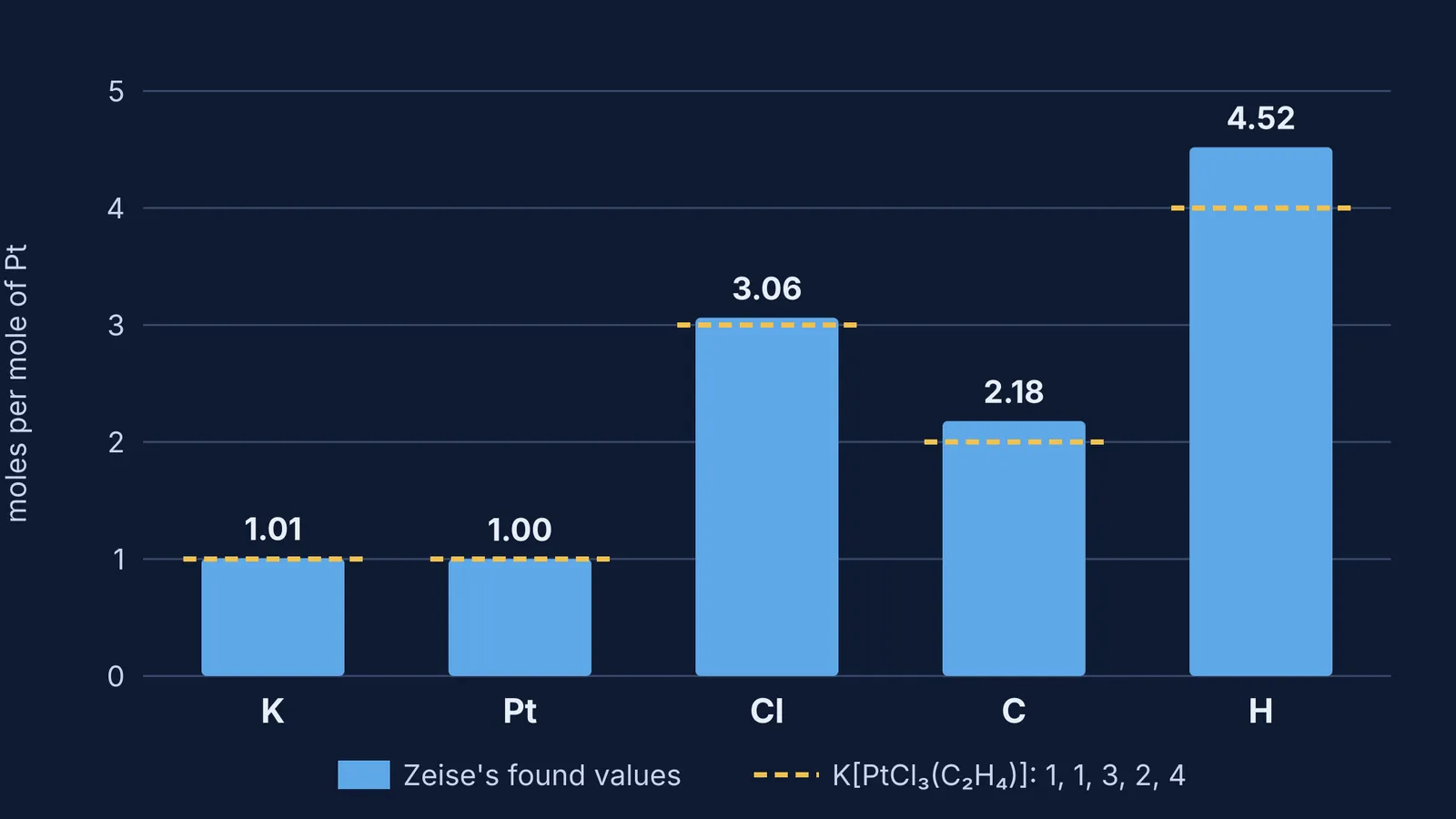
Divide by the smallest (Pt, 0.2631). K 1.01, Pt 1, Cl 3.06, C 2.18, H 4.52.
Round sensibly. K, Pt and Cl are clearly 1 : 1 : 3. The C : H ratio is 2.18 : 4.52, or 1 : 2.07, so the carbon part is made of CH₂ units. Two carbons and four hydrogens give C₂H₄, ethene.
Empirical formula. KPtCl₃C₂H₄, written today as K[PtCl₃(C₂H₄)].
Check against modern values. M = 368.60 g/mol, so Pt 52.93 %, Cl 28.86 %, K 10.61 %, C 6.52 %, H 1.09 %.
Why are Zeise's carbon and hydrogen a little high and his platinum low? His found values add up to only 98.3 %, and he says himself that "in experiments of this kind, loss of platinum is almost unavoidable". Dividing by a platinum figure that is too small inflates every other ratio. Hydrogen is the most sensitive: it is only about 1 % of the mass, so an error of 0.1 in the percentage changes the H ratio by almost 10 %. His four carbon and hydrogen runs ranged from 6.62 to 7.15 % C and 1.04 to 1.64 % H.
Zeise's own formula. Using Berzelius's atomic weights (oxygen = 100), he wrote the salt as 2 Pt, 4 Cl, 1 K, 2 Cl, 4 C, 8 H. That is exactly twice K[PtCl₃(C₂H₄)]. The "1 K" is not a mistake: Berzelius's potassium, 489.9 on his scale, is 78.4 on the O = 16 scale, about twice 39.1. His calculated platinum, 53.16 %, is close to today's 52.93 %.
Water. The crystals contain water. Zeise assumed 2 units of water for his doubled formula, which is one H₂O per K[PtCl₃(C₂H₄)]. He calculated 4.62 % water; the modern value for K[PtCl₃(C₂H₄)]·H₂O (M = 386.61) is 4.66 %. The mean of his five comparable runs was 4.97 %.
Oxidation state. K is +1, so the complex ion is −1. Three Cl⁻ give −3 and ethene is neutral, so x − 3 = −1 and Pt is +2. For the general method, see oxidation state and coordination number in a complex.
To see side-on alkene bonding and square planar Pt(II) explained step by step, the Concept Library covers every concept in physics, chemistry, biology, mathematics and computing. For timed coordination-chemistry practice, Fermi Test Prep is built for JEE Main and Advanced preparation, with an AI tutor.
Quick checklist
W. C. Zeise (1789 to 1847), Copenhagen's first professor of chemistry, a student of Ørsted.
He discovered xanthates (1820s), mercaptans (1830s) and the inflammable platinum salt.
The cat story is an anecdote ("it is told"), not a documented event.
Zeise's analysis gives K : Pt : Cl : C : H ≈ 1 : 1 : 3 : 2 : 4, that is K[PtCl₃(C₂H₄)].
His Berzelius-style formula is twice the modern one because his K weighed about 78.
Pt in Zeise's salt is +2; the salt crystallises as the monohydrate.