On this page
Menthol mint, Mentha arvensis (cornmint), is a field crop across the Indo-Gangetic plains of North India. Its leaves are distilled for oil, from which menthol crystallises. It is also a neat stereochemistry problem: eight stereoisomers are possible, and the plant makes essentially one. Here is how to count them, why menthol made from thymol starts as a mixture, and how a polarimeter tells the grades apart.
How big is India's menthol mint crop?
A 2016 MyGov blog on CSIR's mint programme says India contributes about 80% of the world's menthol mint (30,000 tons, counting menthol crystals and powder, dementholised mint oil and arvensis oil). It also says mint covered 300,000 hectares, over 90% of it under CSIR-developed varieties, and that India had become the largest exporter of menthol mint and its oil.
Treat that as one source's snapshot: other government documents and years give different figures.
How many stereoisomers does menthol have?
Menthol is 5-methyl-2-(propan-2-yl)cyclohexan-1-ol, C₁₀H₂₀O, according to PubChem's menthol record. Check the substituted ring carbons:
C1 carries OH, H and two ring paths that are not the same (one leads to C2 with the isopropyl group, the other to C6).
C2 carries the isopropyl group, H and two different ring paths.
C5 carries CH₃, H and two different ring paths.
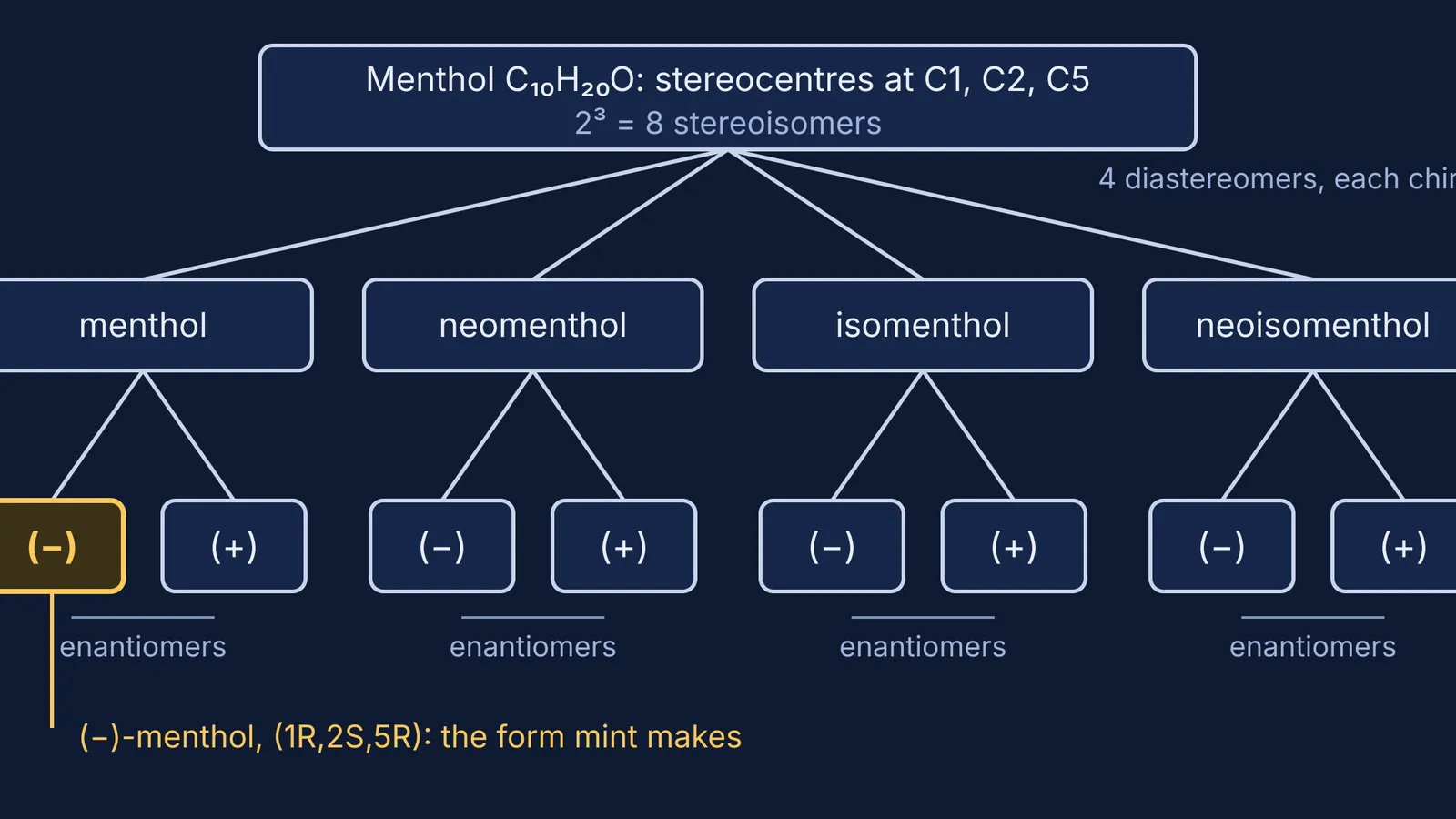
So n = 3. The molecule has no internal mirror plane, so no meso form cuts the count, and the 2ⁿ rule gives 2³ = 8 stereoisomers. For symmetry checks, see our guide to counting stereoisomers from the number of chiral centres.
The eight are four pairs of enantiomers, which PubChem names: (−)- and (+)-menthol, (−)- and (+)-isomenthol, (−)- and (+)-neomenthol, and (−)- and (+)-neoisomenthol. Each pair is a diastereomer of the other three pairs. So (−)-menthol has exactly one enantiomer and six diastereomers.
Which menthol does the mint plant make?
PubChem's (−)-menthol record gives its configuration as (1R,2S,5R) and says L-menthol is the main component of peppermint and cornmint oils, with other stereoisomers possibly present. Enzymes are chiral, so the plant makes one stereoisomer, not a mixture.
PubChem lists (+)-neomenthol as (1S,2S,5R). Compare the labels: it differs from (−)-menthol only at C1, the carbon carrying OH. Two diastereomers that differ at just one stereocentre are called epimers.
(−)-Menthol is the form the plant makes and the form sold for its strong cooling effect. How strongly the other seven forms cool is a separate question, and this post does not rank them. The nerve receptor behind the cooling is explained in why mint feels cold and chilli feels hot.
Why does menthol made from thymol come out as a mixture?
Thymol is the aromatic phenol in ajwain and thyme oils. Adding hydrogen to its ring gives menthol:
C₁₀H₁₄O + 3H₂ → C₁₀H₂₀O
Check: carbon 10 = 10, oxygen 1 = 1, hydrogen 14 + 6 = 20. Thymol is achiral and so is an ordinary metal catalyst, so nothing favours one configuration over its mirror image. PubChem's manufacturing notes say this route "yields a mixture containing the four stereoisomeric menthols in various proportions". Each of the four comes out racemic.
The same notes describe the clean-up:
Distil off (±)-menthol.
Heat the leftover neomenthol, isomenthol and neoisomenthol under the hydrogenation conditions. They interconvert (epimerise) to roughly a 6:3:1 equilibrium of (±)-menthol, (±)-neomenthol and (±)-isomenthol, and more (±)-menthol is distilled out.
Resolve (±)-menthol. One large-scale method seeds a solution of racemic menthyl benzoate with crystals of one enantiomer, so that only that enantiomer crystallises. Hydrolysis of the ester then gives pure (−)-menthol, and the unwanted (+)-menthol is converted back into the racemate.
Step 3 needs a chiral handle, here seed crystals of one enantiomer. Our post on racemic mixtures and resolution covers the diastereomeric-salt method you are more likely to be asked about.
How much (−)-menthol can 100 g of thymol give?
Use M(thymol) = 150.22 g/mol and M(menthol) = 156.27 g/mol (C₁₀H₂₀O, from atomic masses).
Moles of thymol: 100 ÷ 150.22 = 0.666 mol.
Mass of mixed menthols if conversion is complete: 0.666 × 156.27 = 104.0 g.
If the batch sits at the 6:3:1 equilibrium, (±)-menthol is 6 parts in 10: 0.6 × 104.0 = 62.4 g.
A racemate is half of each enantiomer, so one resolution gives at most 62.4 ÷ 2 = 31.2 g of (−)-menthol.
That is an idealised one-pass ceiling. The (+) half is not wasted: it is turned back into the racemate and resolved again.
How does a polarimeter tell natural menthol from DL-menthol?
PubChem gives these values:
L-menthol: specific rotation −45° to −51° (25 °C); one entry gives −50° (10% alcohol solution, 18 °C). Melting point 43 °C.
DL-menthol: specific rotation −2° to +2°. Melting point 38 °C.
DL-menthol is a 50:50 mixture, so the two rotations cancel. Two pure enantiomers melt at the same temperature, but a racemate crystallises as a different solid with its own packing, so its melting point need not match.
PubChem also notes that the USP does not distinguish L- from DL-menthol, so the rotation is a useful label check.
Worked example: how pure is this menthol sample?
Take [α] = −50° for pure (−)-menthol. A sample is dissolved at 10.0 g per 100 mL and read in a 1 dm tube. The reading is α = −4.0°.
Specific rotation. [α] = 100α ÷ (l × c) = 100 × (−4.0) ÷ (1 × 10.0) = −40°.
Enantiomeric excess. ee = 40 ÷ 50 × 100 = 80%, with (−) in excess because the sign is negative.
Composition. % (−) = (100 + 80) ÷ 2 = 90%, and % (+) = 10%.
Blend check. Someone blends 30 g of L-menthol with 70 g of DL-menthol. The DL part holds 35 g of each enantiomer, so the blend has 65 g of (−) and 35 g of (+). ee = (65 − 35) ÷ 100 = 30%, and [α] = 0.30 × (−50°) = −15°.
Two cautions. With −45° or −51° as the reference, the ee in step 2 becomes 89% or 78%, so state the value you used. And the method assumes the only impurity is (+)-menthol; diastereomers such as neomenthol have their own rotations, so a real sample also needs a separation method such as gas chromatography. For a full walk-through of the formulas, see our guide to enantiomeric excess and optical purity. The Fermi Problem Library has more problems like this one, with a step-by-step solver that explains the reasoning.
What should you write in the exam?
Stereoisomer count: three stereocentres, 2³ = 8, four enantiomeric pairs; each isomer has one enantiomer and six diastereomers.
Why plant menthol is optically active: enzymes are chiral, so the plant makes one enantiomer, (−)-menthol (1R,2S,5R).
Why thymol hydrogenation gives an inactive product: an achiral starting material with an achiral catalyst gives equal amounts of each enantiomer, a racemic mixture.
Polarimeter numbers: [α] = 100α ÷ (l × c); ee = observed ÷ pure × 100; % major = (100 + ee) ÷ 2.
If you are preparing these chapters for JEE, Fermi Test Prep for JEE Main and Advanced pairs practice with an AI tutor.
Quick checklist
Mark C1, C2 and C5 on menthol and name the four diastereomer pairs.
Balance thymol + 3H₂ → menthol and say why the product is racemic.
Turn a polarimeter reading into the percentage of each enantiomer.