On this page
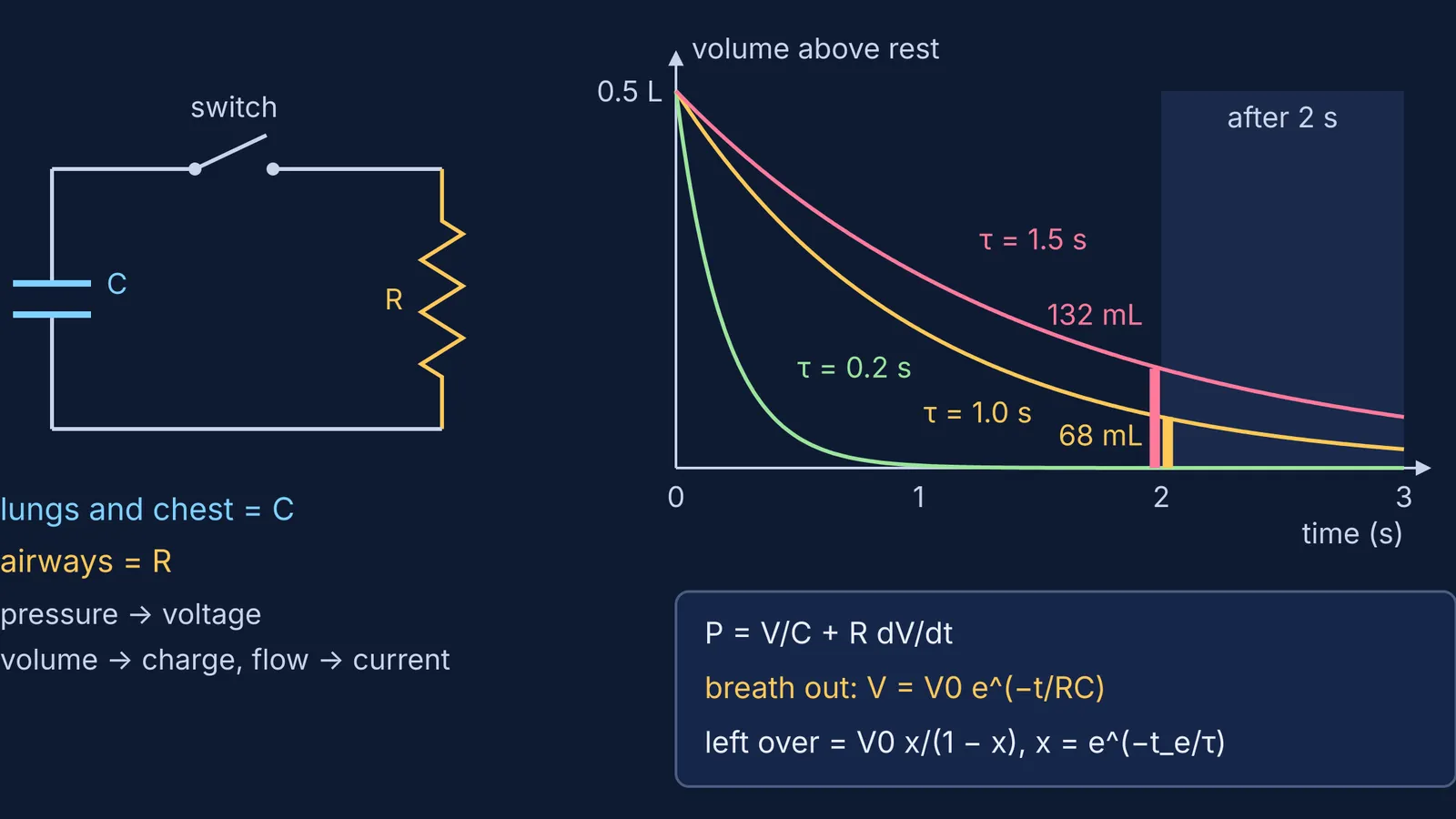
When you relax after breathing in, air flows out of your lungs on its own. The stretched lungs and chest spring back, and the airways slow the air down. That is exactly how a charged capacitor empties through a resistor. So a relaxed breath out follows the same exponential curve as an RC circuit, with a time constant τ = RC. This post uses that analogy as a physics exercise. It is a simple model, not a medical tool.
Important: this is physics only. The numbers below are round values chosen to show how the model behaves. They are not a way to judge anyone's lungs, and nothing here is advice on any illness. If you or someone you know has trouble breathing, see a doctor.
How are the lungs like a capacitor and a resistor?
A capacitor stores charge in proportion to voltage: Q = CV. The lungs and chest store air volume in proportion to the pressure that stretches them. Their compliance is
C = ΔV/ΔP,
measured in litres per centimetre of water (L per cm H₂O; 1 cm H₂O is about 98 Pa). A floppy balloon has a large C; a stiff one has a small C.
A resistor needs a voltage to drive a current: V = IR. The airways need a pressure difference to drive a flow. Their resistance is
R = ΔP ÷ flow,
in cm H₂O per (L/s). Narrower tubes give a larger R. Pressure plays the part of voltage, volume plays charge, and flow plays current.
There is a neat series-capacitor link too. The lungs and the chest wall stretch one after the other, so their compliances combine like capacitors in series. A review of respiratory mechanics by Gertler (Anesthesiology Clinics, 2021) gives normal lung compliance as about 150 to 200 mL per cm H₂O and chest-wall compliance as about 200 mL per cm H₂O. Taking 200 and 200 in series: 1/C = 1/200 + 1/200, so C = 100 mL per cm H₂O, or 0.10 L per cm H₂O. The same review gives the normal compliance of the whole respiratory system as about 50 to 70 mL per cm H₂O, lower than this simple sum, so treat 0.10 as a round illustrative number.
If you need a refresher on the circuit side, see RC circuits: charging, discharging and the time constant.
Why does a relaxed breath out decay exponentially?
At any moment during a relaxed breath out, the elastic recoil pressure V/C is the only push, and it drives flow through the airways:
V/C = −R dV/dt.
This is the capacitor-discharge equation with V in place of Q. Its solution is
V(t) = V₀ e^(−t/RC),
where V₀ is the extra volume you breathed in. A recent review of expiratory time constants by Depta and colleagues (Intensive Care Medicine Experimental, 2025) uses the same rule: 63% of the breath leaves in one time constant, 86% in two and 95% in three.
When you breathe in, your muscles must supply both parts: P = V/C + R dV/dt. One part stretches the "capacitor", the other pushes air through the "resistor".
What sets the time constant of a breath?
The time constant is τ = RC. Check the units: (cm H₂O per L/s) × (L per cm H₂O) = s. In SI, 2 cm H₂O per (L/s) is 1.96 × 10⁵ Pa s/m³, 0.10 L per cm H₂O is 1.02 × 10⁻⁶ m³/Pa, and the product is again 0.20 s.
A larger R (narrower airways) or a larger C (floppier lungs) both make τ longer. The emptying is slower either way. A smaller C (stiffer lungs) makes τ shorter, but then filling the lungs needs more pressure.
How big is τ in real people? It depends on how it is measured. Depta and colleagues report about 0.5 to 0.8 s, with a mean near 0.6 s, for adults on breathing machines whose lungs work normally; Gertler gives 0.5 to 0.7 s for that group. Those values include the breathing tube, which adds resistance. The same review places obstructive lung disease in a "long" group, above 0.8 s, with reported means around 1 s. The single R and C are also a first model. Depta and colleagues say plainly that a single linear model greatly oversimplifies how lungs empty, because different parts of the lung empty at different rates and resistance changes with lung volume.
A worked example: how much air is left after a breath out?
All values here are illustrative round numbers for the model, not measurements of anyone. Take V₀ = 0.5 L.
Case A: R = 2, C = 0.10. τ = 0.2 s. 95% is out after 3τ = 0.6 s. After 1 s the volume left is 0.5 × e^(−5) L = 3 mL.
Case B: R = 10, C = 0.10 (narrower airways in the model). τ = 1.0 s. After 1 s, 0.5 × e^(−1) = 0.184 L = 184 mL is still in. After 2 s, 0.5 × e^(−2) = 68 mL.
Case C: R = 10, C = 0.15 (narrow and floppier). τ = 1.5 s. After 2 s, 0.5 × e^(−1.33) = 132 mL is left.
Case D: R = 2, C = 0.04 (stiffer). τ = 0.08 s, so it empties fast. But to put 0.5 L in, the elastic pressure is V/C = 0.5 ÷ 0.04 = 12.5 cm H₂O, against 0.5 ÷ 0.10 = 5 cm H₂O in Case A.
Now repeat breaths, each breath out lasting t_e = 2 s and each breath in adding 0.5 L. If E is the leftover volume at the end of each breath out, then in the steady state E = (E + V₀)x, with x = e^(−t_e/τ). Solving, E = V₀x/(1 − x).
Case A: x = e^(−10), so E is essentially zero.
Case B: x = e^(−2) = 0.135, so E = 0.5 × 0.135 ÷ 0.865 = 78 mL.
Case C: x = e^(−1.33) = 0.264, so E = 179 mL.
The leftover builds up breath by breath and then settles. The physics point is simple: when τ is long compared with the time allowed for a breath out, the "capacitor" never fully discharges.
Where does the analogy break down?
Real lungs are many RC branches in parallel, each with its own τ.
Airway resistance falls as the lungs inflate, because the airways are pulled open, so R is not constant.
At high flows the flow is not proportional to pressure, so the "resistor" is not ohmic.
Compliance falls near full inflation, like a capacitor whose C changes with voltage.
The idea of breathing as a pressure balance is also behind why a snorkel cannot be very long.
To see an exponential discharge change as you vary R and C, try an RC circuit in the Simulation Lab, which has interactive simulations for ideas that are easier to see than read.
Quick checklist
Compliance C = ΔV/ΔP plays the capacitor; airway resistance R = ΔP/flow plays the resistor.
Lungs and chest wall combine like capacitors in series.
Relaxed breath out: V = V₀e^(−t/RC); τ = RC in seconds.
63%, 86%, 95% out after τ, 2τ, 3τ.
Leftover after repeated breaths: V₀x/(1 − x), with x = e^(−t_e/τ).
The numbers are illustrative. Breathing problems need a doctor, not a formula.