On this page
Look at the sidewall of a car tyre and you will find a code such as 195/65 R15 91H. The final letter is the speed rating: the registered maximum speed of that tyre. Part of the reason a tyre has such a limit is a wave. The tread band of an inflated tyre is stretched like a string, and above a certain speed the ripples it makes behind the contact patch can no longer run away. They pile up into a "standing wave" that flexes and heats the tyre. A simple string model, the same v = √(T/μ) you use in Class 11, gives the right size for that speed and shows why low pressure brings it down.
What do the speed rating letters on a tyre mean?
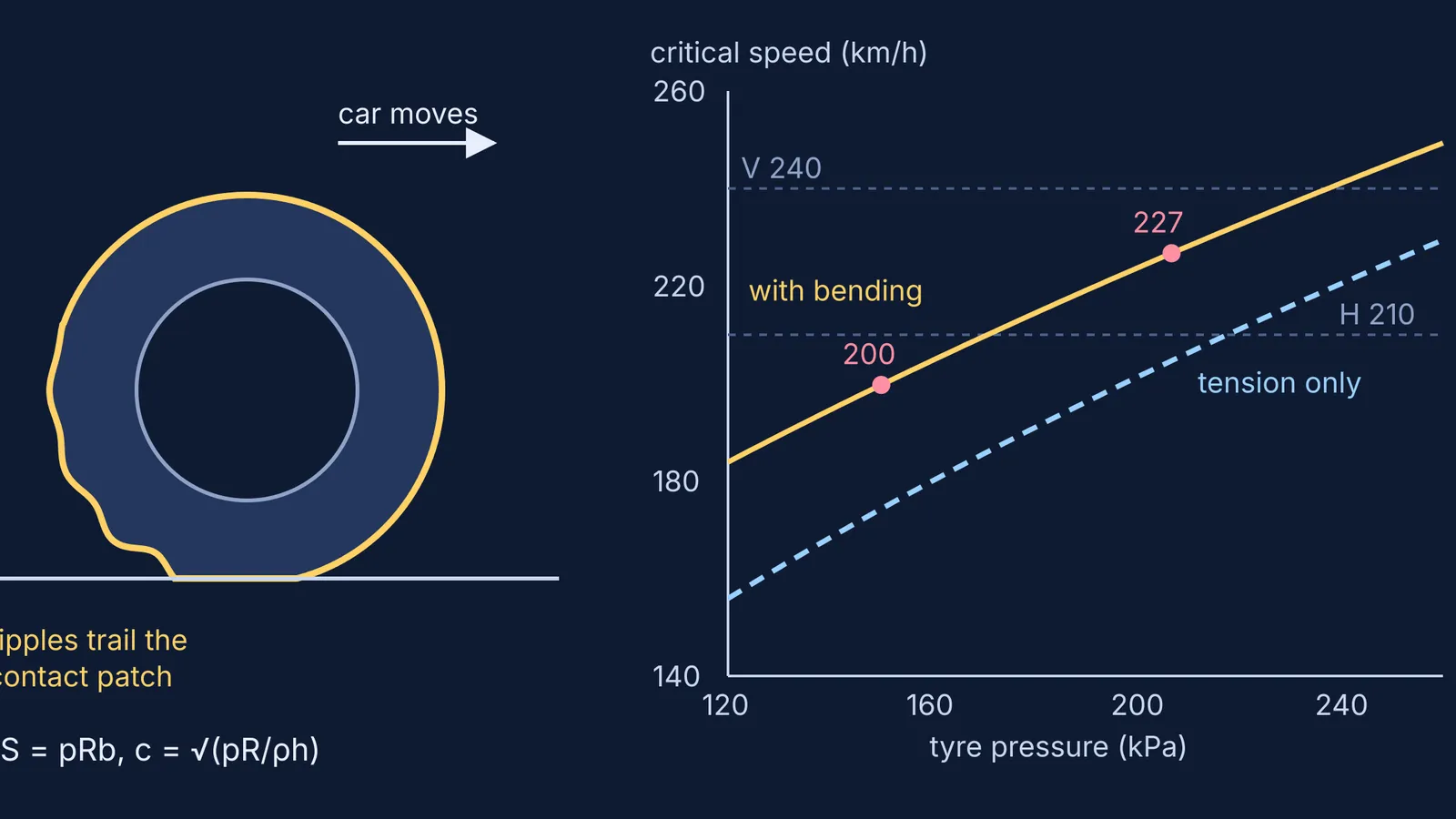
Each letter stands for a maximum speed. Continental's speed index table lists, for example, T = 190 km/h, H = 210 km/h, V = 240 km/h and W = 270 km/h. These are capabilities of the tyre, not targets. Road speed limits, the road and the car decide how fast you may drive, and on public roads that is far below these figures.
The rating also assumes the tyre is used as intended. Its pressure should always follow the figure the vehicle maker gives, usually on a sticker inside the driver's door or in the owner's manual, measured when the tyres are cold. You will see below why that figure matters for the physics.
Why does a tyre's tread behave like a stretched string?
Air pressure pushes the tread outwards. Think of the tread and its steel belt as a thin hoop of radius R and width b. Cut the hoop in half and balance the forces on one half: the air pushes on a projected area 2Rb with force p × 2Rb, and the hoop's tension S pulls at both cut ends, giving 2S. So
S = pRb
A bump pushed into this tensioned band travels round it like a pulse on a guitar string, at
c = √(S / μ)
where μ is the band's mass per metre of circumference. For a refresher, see how wave speed on a string changes with tension.
Writing μ = ρhb for a band of density ρ and thickness h, the width b cancels:
c = √(pR / ρh)
So the wave speed depends on the pressure, the radius, and how heavy the tread band is per square metre. It rises as the square root of pressure.
When does the wave stand still?
Sit in the car and watch one tyre. The contact patch stays at the bottom, and the tread band streams through it backwards at the car's speed v. Every time the band is squashed flat and released at the back of the patch, it is plucked, and a ripple starts to run along the band at speed c relative to the band.
If v is less than c, ripples can run away from the patch and spread out. If v reaches c, a ripple trying to run forward along the band is carried back by the moving band exactly as fast as it moves. Seen from the car, the ripple pattern behind the patch stays still. That is the standing wave. Energy fed in by every turn of the wheel stays in the same few ripples instead of spreading, so the tread flexes hard, gets hot, and can fail.
This is the same idea as a boat that moves faster than the waves it makes, or a source moving faster than sound. Real tyres are not only strings: the belt also resists bending, and the sidewalls hold it like springs. Krylov and Gilbert's tensioned beam theory of tyre standing waves (Journal of Sound and Vibration, 2010) includes the bending term and finds that, for a typical car tyre, the tension term is the larger one.
How do you calculate a tyre's critical speed?
Here is a worked example using the car tyre parameters from that paper: R = 0.30 m, belt width b = 0.20 m, belt thickness h = 0.016 m, density ρ = 1,200 kg/m³, and pressure p = 206,850 Pa (30 psi).
Hoop tension. S = pRb = 206,850 × 0.30 × 0.20 = 12,411 N, about 12.4 kN.
Mass per metre. μ = ρhb = 1,200 × 0.016 × 0.20 = 3.84 kg/m.
String wave speed. c = √(S / μ) = √(12,411 / 3.84) = √3,232 = 56.9 m/s.
Convert. 56.9 × 3.6 = 205 km/h.
Add bending. The paper's bending-only wave speed for this tyre is 27.09 m/s, and the two add as squares: c_crit = √(56.85² + 27.09²) = 63.0 m/s, or 227 km/h.
Check units. N / (kg/m) = (kg m/s²)(m/kg) = m²/s², so the square root is m/s.
Now let the pressure fall to 150 kPa (about 22 psi), keeping everything else the same.
String speed. c = √(150,000 × 0.30 / 19.2) = √2,344 = 48.4 m/s, where 19.2 kg/m² is ρh.
With bending. c_crit = √(48.4² + 27.09²) = 55.5 m/s, or 200 km/h.
The string part alone drops by the factor √(150 / 206.85) = 0.85, about 15%. With bending included, the critical speed falls from 227 to 200 km/h, about 12%. The paper notes that this simple model treats the sidewall stiffness as fixed, so treat these as estimates, not a tyre's tested limit.
Why do under-inflation and overloading matter?
Because c grows as √p, a soft tyre has a lower critical speed. A finite element study by Chang, El-Gindy and Streit, on how loading and inflation affect tyre standing waves (International Journal of Heavy Vehicle Systems, 2003), found that when pressure falls below the maker's recommended value and the load rises, the standing wave forms at a lower speed, and the tyre heats up faster. A soft tyre also flexes more on every turn, at any speed. That heat raises the pressure a little on a long drive, as explained in why tyre pressure rises on long drives, which is why pressure is checked when the tyres are cold.
The lesson is not about driving fast. It is that a tyre's limits are worked out for correct pressure and load, so keep the pressure at the vehicle maker's figure and do not overload the car. Water on the road is a separate problem, covered in why tyres have treads.
How does this show up in JEE problems?
JEE likes problems that join two chapters, here force balance and v = √(T/μ). Find the hidden tension and the mass per length before you touch the wave formula. To watch how tension and mass per length change a pulse's speed, try the Simulation Lab. If you are preparing for JEE Main and Advanced, Fermi Test Prep offers personalised preparation with an AI tutor, live classes, adaptive mocks, mentorship and a study plan that updates based on mastery.
Quick checklist
Hoop tension of a pressurised band: S = pRb.
Wave speed on the band: c = √(S/μ) = √(pR/ρh).
Standing wave when the car's speed reaches c; bending stiffness raises it a little.
Worked tyre at 30 psi: about 205 km/h from tension alone, about 227 km/h with bending.
Lower pressure or higher load means a lower critical speed.
Keep tyre pressure at the vehicle maker's figure, checked cold.