On this page
A pilot flying north over Delhi banks into a gentle right turn, and the magnetic compass first swings the wrong way, as if the aircraft were turning left. Fly the same turn over Thiruvananthapuram and the compass barely misbehaves. Nothing is broken. The compass card tilts with the wings, and once it tilts it starts to feel the vertical part of Earth's magnetic field. How much it feels depends on the angle of dip, which is large over north India and close to zero near the magnetic equator in Kerala.
How does an aircraft's magnetic compass work?
The standard aircraft compass is a float carrying small magnets and a printed card, sitting on a pivot in a bowl of liquid. The FAA's Pilot's Handbook of Aeronautical Knowledge, chapter 8 explains the key design choice: the centre of gravity is placed below the pivot so the card hangs like a pendulum and stays level in straight flight. That way only the horizontal component of Earth's field, H, turns it, and the downward component, Z, cannot tip it.
The catch, as the handbook says, is that the compass reads correctly only while the card is horizontal. Tilt it (the float can tilt up to about 18°) and Z starts to act, giving northerly and southerly turning errors.
If you need a refresher on the field elements, our post on angle of dip, declination and the horizontal component covers H = B cos I, Z = B sin I and Z = H tan I.
Why does the compass card tilt in a turn?
A pendulum hangs along the apparent vertical, the direction of gravity plus the inertial force. In a level, co-ordinated turn the apparent vertical tilts by the bank angle φ. So the card ends up tilted by φ, parallel to the wings.
How big is φ? Light aircraft often fly a standard-rate turn of 3° per second, which the FAA handbook defines in the same chapter. In a level turn tan φ = vω/g. At 100 knots (51.4 m/s) and ω = 3°/s = 0.0524 rad/s:
tan φ = (51.4 × 0.0524)/9.81 = 0.275, so φ ≈ 15.4°.
Airliners use similar gentle banks for the load-factor reasons in our post on why airliners turn with gentle banks.
How big is the turning error over Delhi?
Problem. An aircraft flies on a magnetic heading of north over Delhi and rolls into a 15° bank. Its pendulous compass card tilts with the wings. The angle of dip at Delhi is 45.5°. Find the error in the compass reading.
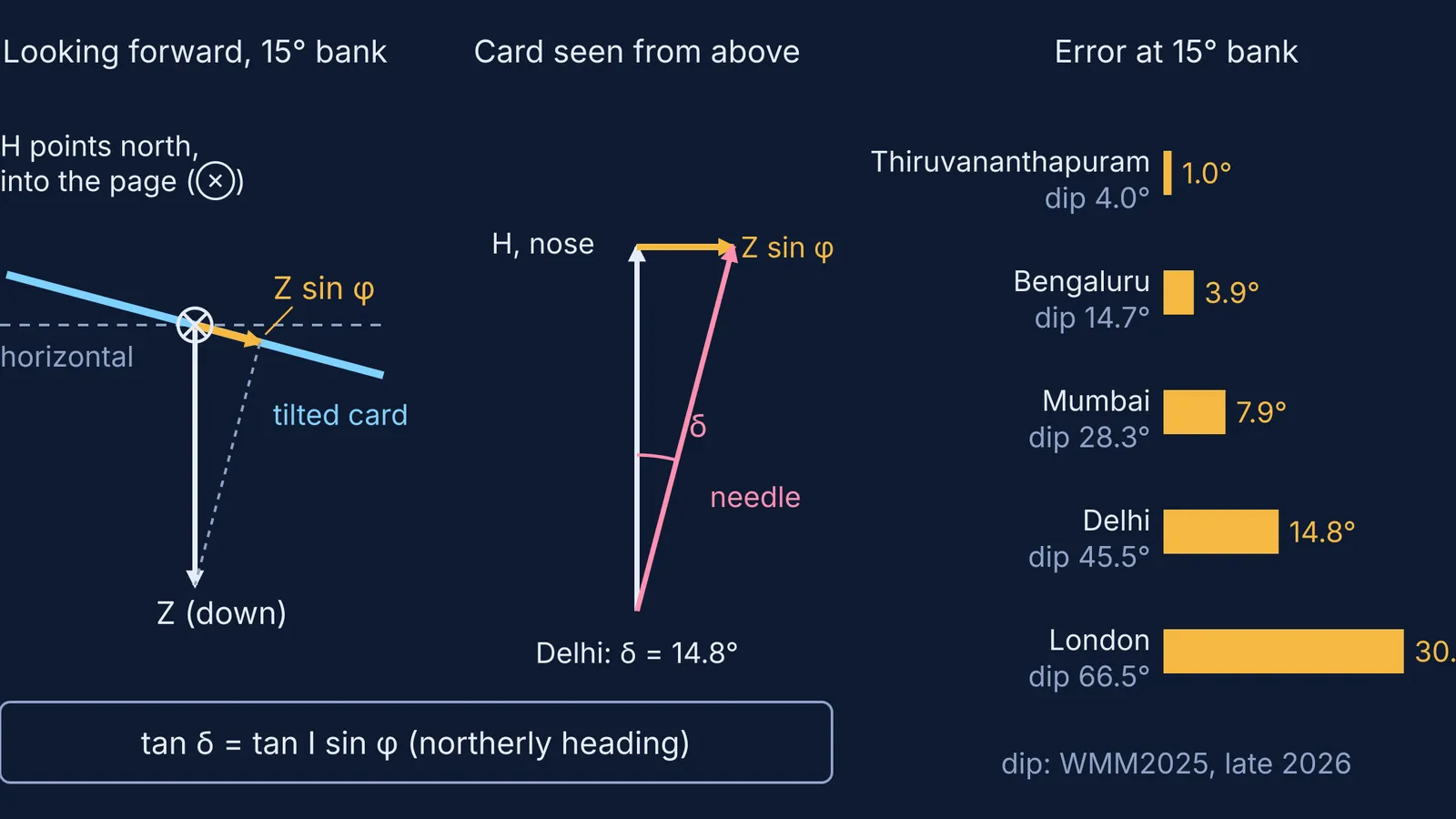
Resolve Earth's field. Take H along magnetic north (here, along the nose) and Z straight down. Z = H tan I. The NOAA World Magnetic Model calculator (model WMM2025) gives, for Delhi in late 2026, H ≈ 34,200 nT and Z ≈ 34,800 nT, so tan I ≈ 1.018 and I ≈ 45.5°.
Find what lies in the card's plane. The bank rotates the card about the nose. H lies along the nose, so H stays entirely in the card's plane. Z is now at angle φ to the card's normal, so its component in the card's plane is Z sin φ, pointing across the card towards the low wing.
Put numbers in. Z sin φ = 34,800 × sin 15° = 34,800 × 0.2588 ≈ 9,000 nT.
Find the swing. The magnets line up with the field in the card's plane: H along the nose and Z sin φ across it. So tan δ = Z sin φ / H = tan I sin φ = 1.018 × 0.2588 = 0.2635.
Answer. δ = 14.8°, about 15°. The needle swings towards the low wing, so in a right turn from north the card reads about 345° when the nose is still on 360°: it shows a turn to the left.
Checks: H and Z are both in nT, so the tangent is a pure number. If I = 0 or φ = 0, δ = 0, as it should.
The geometry is close to apparent dip outside the magnetic meridian: in both, ask which part of the field lies in the plane the needle can move in.
Why is the error almost zero over Thiruvananthapuram?
Because there is almost no Z to tilt into the card. The magnetic equator, where the dip is zero, runs across southern India. The same WMM2025 model gives these approximate dip angles for late 2026, and with them the error at a 15° bank on a northerly heading:
Thiruvananthapuram: I ≈ 4.0°, δ ≈ 1.0°
Bengaluru: I ≈ 14.7°, δ ≈ 3.9°
Mumbai: I ≈ 28.3°, δ ≈ 7.9°
Delhi: I ≈ 45.5°, δ ≈ 14.8°
London: I ≈ 66.5°, δ ≈ 30.8°
At a 25° bank the Delhi figure grows to 23.3° and the Thiruvananthapuram one only to 1.7°. Dip drifts slowly, so NOAA's World Magnetic Model is reissued every five years; use current values, not old textbook ones.
Which way does the compass go wrong, and what do pilots do?
Our formula is a steady-state estimate for a settled card. The FAA handbook gives the practical rules:
Turning towards north: stop the turn before the compass reaches the heading you want.
Turning towards south: let the compass pass the heading before you stop.
Its rule of thumb for the size is 15° plus half the latitude. That is a cockpit allowance, not something derived from tan δ = tan I sin φ, and at Delhi's latitude of 28.6° it gives about 29°.
The errors grow towards the magnetic poles. In the southern hemisphere Z points up, so tan I and δ change sign and the pattern flips.
On an east or west heading the turning error disappears, because Z sin φ then lies along the same line as the across-the-card part of H and only changes its size, not its direction. A different error appears instead. Speed up by 1 m/s² and the pendulous card tilts back by arctan(1/9.81) = 5.8°. The same algebra gives tan δ = tan I sin 5.8°, about 5.9° over Delhi and 0.4° over Thiruvananthapuram. The handbook's memory aid is ANDS: acceleration shows a turn towards north, deceleration a turn towards south.
In practice pilots steer by the gyro heading indicator, described in the same chapter, and keep the magnetic compass as the backup that needs no power.
To practise more problems where you resolve Earth's field into components, the Fermi Problem Library has a step-by-step solver that explains the reasoning. For a full plan, Fermi Test Prep offers personalised preparation for JEE Main & Advanced with an AI tutor, live classes, adaptive mocks, mentorship and a study plan that updates based on mastery.
Quick checklist
The compass card is pendulous, so it hangs level in straight flight and reads only H.
In a co-ordinated turn it tilts by the bank angle φ.
On a northerly heading the tilted card feels Z sin φ across it, beside H along the nose.
tan δ = tan I sin φ: about 15° at a 15° bank over Delhi, about 1° over Thiruvananthapuram.
The error is zero for zero dip or zero bank; check both limits.
On east and west headings the turning error vanishes and acceleration error (ANDS) takes over.