On this page
If you have done Class 12 salt analysis, you know the line: a rosy red precipitate with dimethylglyoxime (DMG) confirms Ni²⁺. That test is 121 years old. It was published in July 1905 in a three-page note in the Berichte of the German Chemical Society (volume 38, pages 2520–2522), signed "L. Tschugaeff", the German spelling of the Moscow chemist Lev Aleksandrovich Chugaev. Here is what he actually wrote, and how it matches what you learn. The quotations are our translations from the German and Russian originals.
Who was Lev Chugaev?
Two old Russian encyclopedias, both on Russian Wikisource, give the outline. The Brockhaus–Efron entry, written in March 1907, calls him a "chemist and bacteriologist", born in 1873. He graduated from Moscow University in 1895 and ran the chemical laboratory of the university's Bacteriological Institute. From 1904 he was a professor at the Imperial Moscow Technical School. His master's thesis (1903) was on terpenes and camphor, and his doctorate (1906) was "Studies in the field of complex compounds". By 1907 he had published more than 50 papers.
The Granat encyclopedia adds the rest. He lived from 1873 to 1922 and was elected professor of inorganic chemistry at St Petersburg University in 1908. He wrote about 150 papers in all. In organic chemistry he found the xanthate method, which turns alcohols into alkenes; it is now called the Chugaev elimination and is not on your syllabus. In wartime he and his co-workers developed methods for refining platinum and the metals that occur with it.
What problem did Chugaev's 1905 note solve?
The note opens with the problem: "At present no specific and at the same time sufficiently sensitive nickel reaction is known." In particular, he says, there was no usable way to detect traces of nickel next to larger amounts of cobalt.
Nickel and cobalt sit side by side in the periodic table and fall in the same group of the salt-analysis scheme. Chugaev named the most sensitive test then known, a brown colour with alkali thiocarbonates, and said even that one was badly upset by cobalt.
He found the answer "in the course of my studies on complex compounds of the α-dioximes". He had already reported those complexes at the February 1905 meeting of the Russian Physico-Chemical Society. One of the dioximes, α-dimethylglyoxime, CH₃–C(=NOH)–C(=NOH)–CH₃, turned out to be "an extraordinarily sensitive and characteristic reagent for nickel".
What did the original DMG test look like?
His description is short. First remove the excess acid with alkali, or even better add excess ammonia or sodium acetate solution. Then throw in a little powdered dioxime ("a few centigrams usually suffice") and boil briefly. Unless the solution is very dilute, "a beautiful scarlet-red precipitate" appears at once.
He also noted three details:
Very small amounts of nickel give at first only a yellowish solution. On cooling, the red compound separates within a few minutes, and it colours the excess dioxime that also crystallises out pink.
Cobalt also reacts with DMG, but gives brown compounds. With a very large excess of ammonia, cobalt salts are first oxidised to cobalt ammine complexes, and then the nickel test works on its own.
A confirmation step. The dried red solid dissolves in a boiling mixture of chloroform and alcohol, and on evaporation it gives characteristic red needles that can be checked under a microscope.
He ended by saying that, "because of its simplicity and great sensitivity", the reaction "well deserves to be introduced into analytical practice". A footnote adds that, at his request, the chemical supplier Kahlbaum had started to sell dimethylglyoxime.
What does Chugaev's formula NiD·DH₂ mean?
He wrote the red solid as NiD·DH₂, with DH₂ standing for the dioxime. It is not wrong:
DH₂ is neutral DMG with both O–H hydrogens.
D is the same molecule with both of those hydrogens removed, so it carries a 2− charge. Ni²⁺ + D²⁻ is neutral NiD.
Add one more neutral DH₂ and the total is NiD₂H₂.
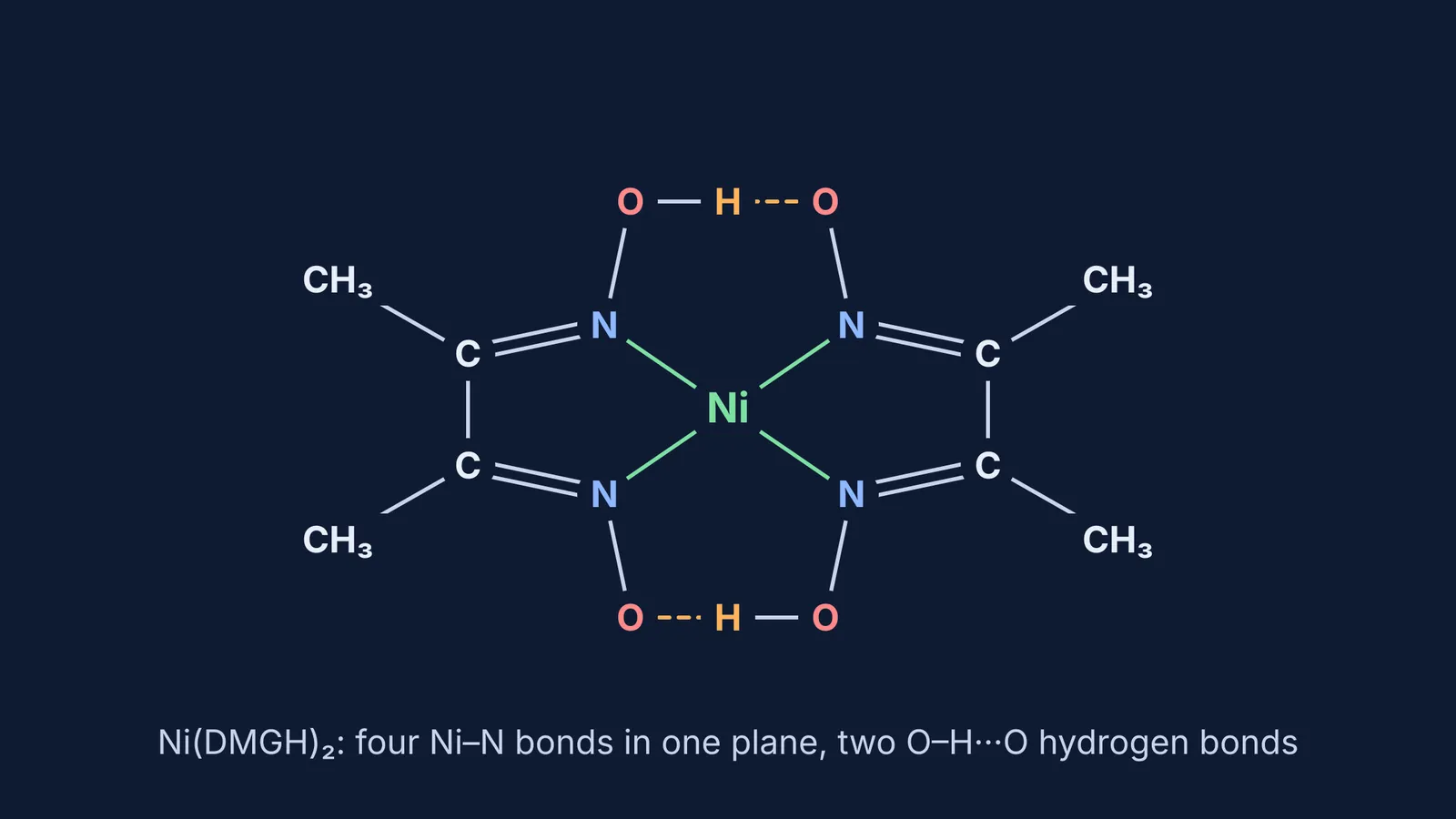
The modern formula, Ni(DMGH)₂, is two singly deprotonated ligands on one Ni²⁺. Count the atoms: it is also NiD₂H₂. So Chugaev's composition was right; only the way of splitting the hydrogens differs. The modern picture puts one hydrogen in each of two O–H···O bridges between the ligands, shown in the diagram above. How the structure fits square planar d⁸ nickel is explained in the chemistry of the DMG red precipitate, and the hybridisation logic in how Ni(CO)₄, NiCl₄²⁻ and Ni(CN)₄²⁻ hybridise.
Why did Chugaev add ammonia or sodium acetate?
Write the reaction with DMGH₂ for neutral dimethylglyoxime:
Ni²⁺ + 2DMGH₂ ⇌ Ni(DMGH)₂ + 2H⁺
Check it: 1 Ni, 8 C, 16 H, 4 N and 4 O on each side, and charge +2 on each side. Each ligand gives up one H⁺, so the solution becomes more acidic as the precipitate forms. By Le Chatelier's principle, acid pushes the equilibrium back to the left. Ammonia or acetate removes the H⁺ (NH₃ + H⁺ → NH₄⁺, CH₃COO⁻ + H⁺ → CH₃COOH), so the red solid stays. That is why your lab manual says "add NH₄OH".
Worked example: how sensitive was his test?
Use his own numbers (atomic masses: Ni 58.693, C 12.011, H 1.008, N 14.007, O 15.999).
Convert "1 part in 400,000" to ppm. 1 ÷ 400,000 = 2.5 × 10⁻⁶, which is 2.5 parts per million, or 2.5 mg of nickel per litre.
Nickel in a test portion. A 10 mL portion at that level holds 10 mL × 2.5 mg/L ÷ 1000 mL/L = 0.025 mg Ni.
Molar mass of the red solid. Ni(DMGH)₂ is C₈H₁₄N₄O₄Ni: 8(12.011) + 14(1.008) + 4(14.007) + 4(15.999) + 58.693 = 288.92 g/mol.
Largest possible mass of precipitate. 0.025 mg × 288.92 ÷ 58.693 = 0.12 mg. Too little to weigh, but enough to see as a scarlet tinge.
The cobalt ratio. 500 mg Co ÷ 0.1 mg Ni = 5000, matching his "5000-fold".
The same solid also lets you weigh nickel. The percentage of Ni in Ni(DMGH)₂ is 58.693 ÷ 288.92 × 100 = 20.31 %. So if a sample gives 0.2500 g of dried precipitate, it contained 0.2500 × 0.2031 = 0.0508 g, or 50.8 mg, of nickel. The factor 0.2031 is called a gravimetric factor. Chugaev's note does not mention weighing; that use came later.
Which parts of the syllabus does the note touch?
Four at once: salt analysis (the Group IV test for Ni²⁺), coordination compounds (a bidentate chelating ligand and a square planar d⁸ complex), equilibrium (the H⁺ released) and the mole concept (ppm and gravimetric factors). Werner's coordination theory was only twelve years old in 1905; see Alfred Werner and coordination theory.
To see chelation, hybridisation and Le Chatelier's principle explained concept by concept, try the Concept Library. For timed salt-analysis and coordination practice, Fermi Test Prep is built for JEE Main and Advanced preparation, with an AI tutor.
Quick checklist
L. Tschugaeff (Lev Chugaev, 1873–1922), Moscow, Berichte 38, 2520–2522, received 6 July 1905.
He found DMG while studying complexes of α-dioximes.
Reported: 1 part Ni in 400,000 parts water (2.5 ppm); 0.1 mg Ni beside 500 mg Co.
His NiD·DH₂ has the same composition as modern Ni(DMGH)₂, M = 288.92 g/mol, 20.31 % Ni.
Ni²⁺ + 2DMGH₂ ⇌ Ni(DMGH)₂ + 2H⁺: add NH₃ or acetate to remove H⁺.
Square planar, dsp², diamagnetic, two O–H···O hydrogen bonds.