On this page
NCERT calls it Lassaigne's test and does it with sodium. The chemist it is named after, Jean-Louis Lassaigne, used potassium. In February 1843 he sent a four-page memoir to the Paris Academy of Sciences, printed in the Comptes rendus, volume 16, pages 387–390. It explains why the metal is needed, why acid is added at the end, and which samples can fool the test. All quotations below are our translations from the French.
Who was Jean-Louis Lassaigne?
We keep this short, because we could not check the usual online dates of his life against a proper biography. What we did read: the title page of his 1829 textbook, Abrégé élémentaire de chimie, names him "professor of chemistry at the Royal Veterinary School of Alfort", near Paris. In the 1843 memoir he mentions earlier work on digestion done "in 1825, M. Leuret and I".
What problem did Lassaigne's 1843 test solve?
In 1843 nitrogen was found by burning the sample and collecting nitrogen gas, or by turning it into ammonia. Lassaigne says these work for a weighable amount but become "almost impossible, and even impracticable" when you have only "minute or almost imponderable quantities".
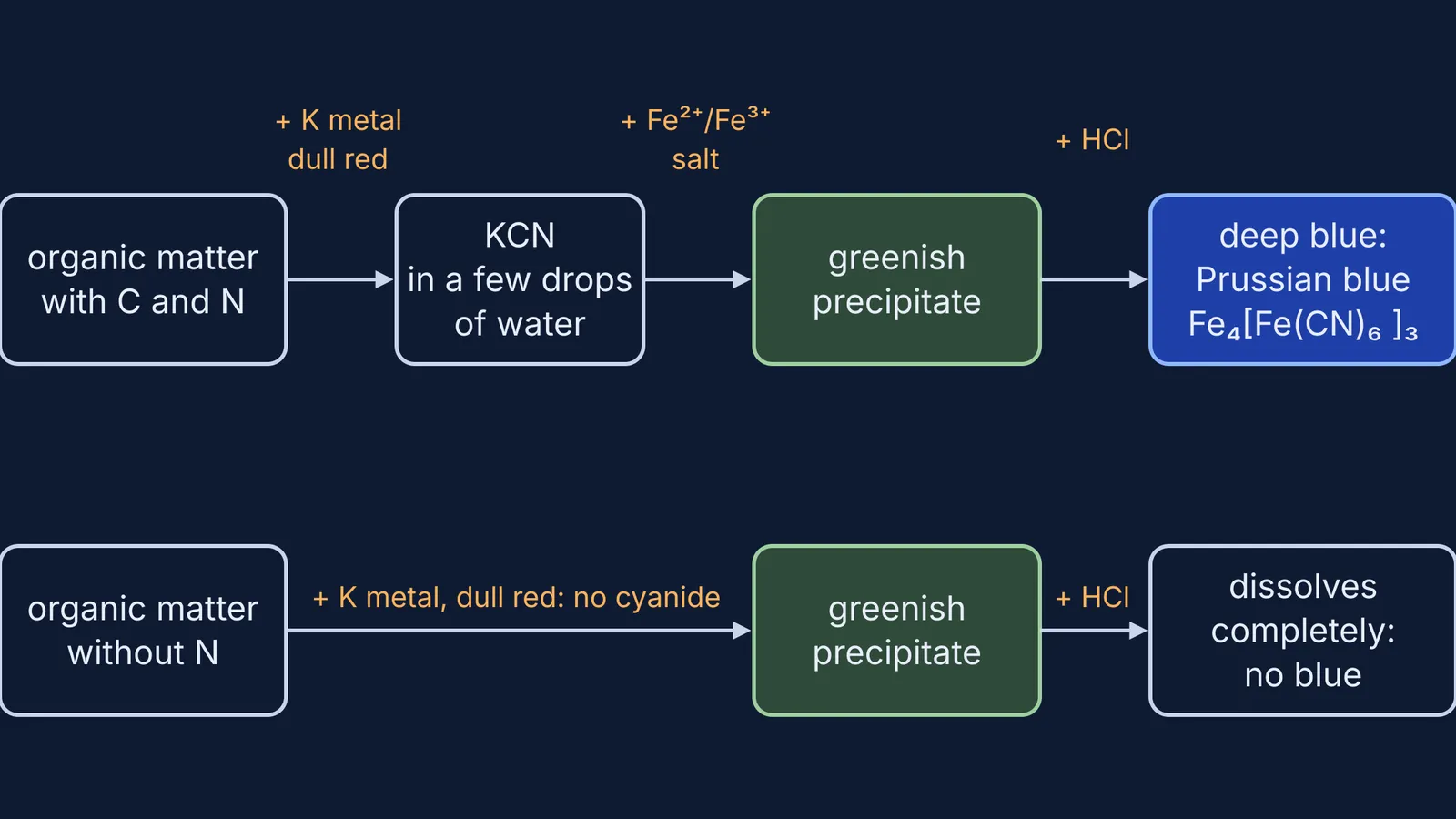
His method rests, in his words, on "the ease with which potassium cyanide forms when an excess of potassium is calcined at dull red heat, away from air, with an organic substance containing even very little nitrogen." The chemistry was known, he said, but had not to his knowledge been used for this.
What exactly did he report in 1843?
Lassaigne worked in a tiny glass tube about 1½ cm long and about 1½ mm wide, closed at one end, with a piece of potassium "about the size of a millet grain" and the sample on top. If the sample was volatile, he put it under the potassium, so that its vapours had to pass over the metal. He heated the tube in a spirit-lamp flame to dull red, let it cool, and dissolved the cyanide in four or five drops of distilled water.
Then came the iron test. He added a drop of a "ferroso-ferric" sulphate, a solution containing both iron(II) and iron(III). A "dirty greenish" precipitate formed. A drop of hydrochloric acid turned it "a deep, beautiful blue" if nitrogen was present. Without nitrogen, "the precipitate of iron oxide hydrate… redissolves entirely without producing any blue colour."
His results:
Positive for uric acid, allantoin, albumin, fibrin, dried gluten, morphine, narcotine and cinchonine, all in amounts too small for his balance.
Negative for pure sugar, starch, gum and salicin, which contain no nitrogen.
Mixtures: "at most half a milligram" of wheat, barley or dried breadcrumb was enough.
Potash would not do. Caustic potash or potassium carbonate at the same temperature gave no cyanide. Only the metal worked.
He even tested the droppings of a field mouse fed only on pure starch and sugar. They contained nitrogen, which he took as proof that the gut adds its own secretions.
Why does Lassaigne's test need acid at the end?
His own control answers it. The fusion extract is alkaline, so iron salts first throw down iron hydroxides, the greenish mud he saw. Acid dissolves those hydroxides. Prussian blue does not dissolve in dilute acid, so if cyanide was present the blue is left behind; if not, everything clears. In modern ionic equations (Lassaigne wrote none):
Fe²⁺ + 2OH⁻ → Fe(OH)₂, and Fe(OH)₂ + 2H⁺ → Fe²⁺ + 2H₂O
Fe²⁺ + 6CN⁻ → [Fe(CN)₆]⁴⁻
3[Fe(CN)₆]⁴⁻ + 4Fe³⁺ → Fe₄[Fe(CN)₆]₃
Check the last one: charge on the left is 3(−4) + 4(+3) = 0, the same as the neutral solid, and there are 7 Fe, 18 C and 18 N on each side. Lassaigne's mixed iron salt already supplied Fe³⁺. NCERT uses iron(II) sulphate and relies on heating to oxidise some Fe²⁺ to Fe³⁺. Why ferrocyanide plus Fe³⁺ gives the same blue as ferricyanide plus Fe²⁺ is explained in Prussian blue vs Turnbull's blue.
Which samples can fool the test?
Lassaigne gave a false positive himself. If a nitrogen-free substance is mixed with a little nitrate or ammonium salt, the potassium can take nitrogen from the salt and carbon from the substance and make some cyanide. He tried starch with a little potassium nitrate or an ammonium salt and did get "a very small quantity" of cyanide. So the sample must be pure.
The opposite trap is the one exams love: a compound with nitrogen but no carbon. Hydrazine, N₂H₄, cannot form CN⁻, so it gives no blue, as explained in why hydrazine fails Lassaigne's test. Both traps share one cause: the test detects cyanide, so C and N must both come from the compound.
Worked example: how little uric acid is enough?
Take Lassaigne's "half a milligram" and uric acid, C₅H₄N₄O₃ (atomic masses C 12.011, H 1.008, N 14.007, O 15.999, Fe 55.845).
Molar mass. 5(12.011) + 4(1.008) + 4(14.007) + 3(15.999) = 168.11 g/mol.
Percentage of nitrogen. 4 × 14.007 ÷ 168.11 × 100 = 33.3 %. So 0.5 mg holds about 0.17 mg of nitrogen.
Moles of nitrogen. 0.5 × 10⁻³ g ÷ 168.11 g/mol × 4 = 1.19 × 10⁻⁵ mol N.
Upper limit for cyanide. If every N atom became CN⁻, there would be 1.19 × 10⁻⁵ mol CN⁻.
Prussian blue. Fe₄[Fe(CN)₆]₃ = Fe₇C₁₈N₁₈, M = 7(55.845) + 18(12.011) + 18(14.007) = 859.24 g/mol, with 18 CN⁻ per formula unit. Moles = 1.19 × 10⁻⁵ ÷ 18 = 6.61 × 10⁻⁷ mol. Mass = 6.61 × 10⁻⁷ × 859.24 g = 5.7 × 10⁻⁴ g, about 0.57 mg.
That is about as much intensely coloured solid as the sample itself (the iron comes from the reagent), which is why half a milligram was enough. In practice only part of the nitrogen becomes cyanide, so the real amount is smaller.
What should you write in the exam?
Write the test as NCERT does, with sodium, even though Lassaigne used potassium. Later chemists switched to sodium; we could not confirm who made the change or when. In a board or JEE answer:
Na + C + N → NaCN (on fusion)
6CN⁻ + Fe²⁺ → [Fe(CN)₆]⁴⁻
3[Fe(CN)₆]⁴⁻ + 4Fe³⁺ → Fe₄[Fe(CN)₆]₃·xH₂O (Prussian blue)
Then give the reasons: covalent N becomes ionic CN⁻; acid clears the iron hydroxides. The full NCERT scheme for N, S and halogens is in Lassaigne's test for nitrogen, sulphur and halogens. Sulphur and halogens were not part of the 1843 memoir.
Fermi's AI tutor for JEE prep can work out what you already know in organic chemistry basics and build a plan for the session. For more mole-concept problems like the one above, the Fermi Problem Library has a step-by-step solver that explains the reasoning.
Quick checklist
Lassaigne, Comptes rendus 16, 387–390 (1843): nitrogen only, with potassium.
Hot alkali metal + C + N gives cyanide; potash did not work for him.
Greenish precipitate + HCl: deep blue means N; complete dissolving means no N.
False positive: nitrates or ammonium salts mixed in. False negative: no carbon, as in hydrazine.
0.5 mg uric acid can give at most about 0.57 mg Prussian blue.
In the exam, write sodium fusion and the NCERT equations.