On this page
If you have studied iron tests in coordination chemistry, you have met two blues with two names. Iron(III) plus potassium ferrocyanide gives Prussian blue; iron(II) plus potassium ferricyanide gives Turnbull's blue. Chemists once treated these as different compounds. They are not, and knowing why makes a whole family of exam questions easier.
What is the difference between Prussian blue and Turnbull's blue?
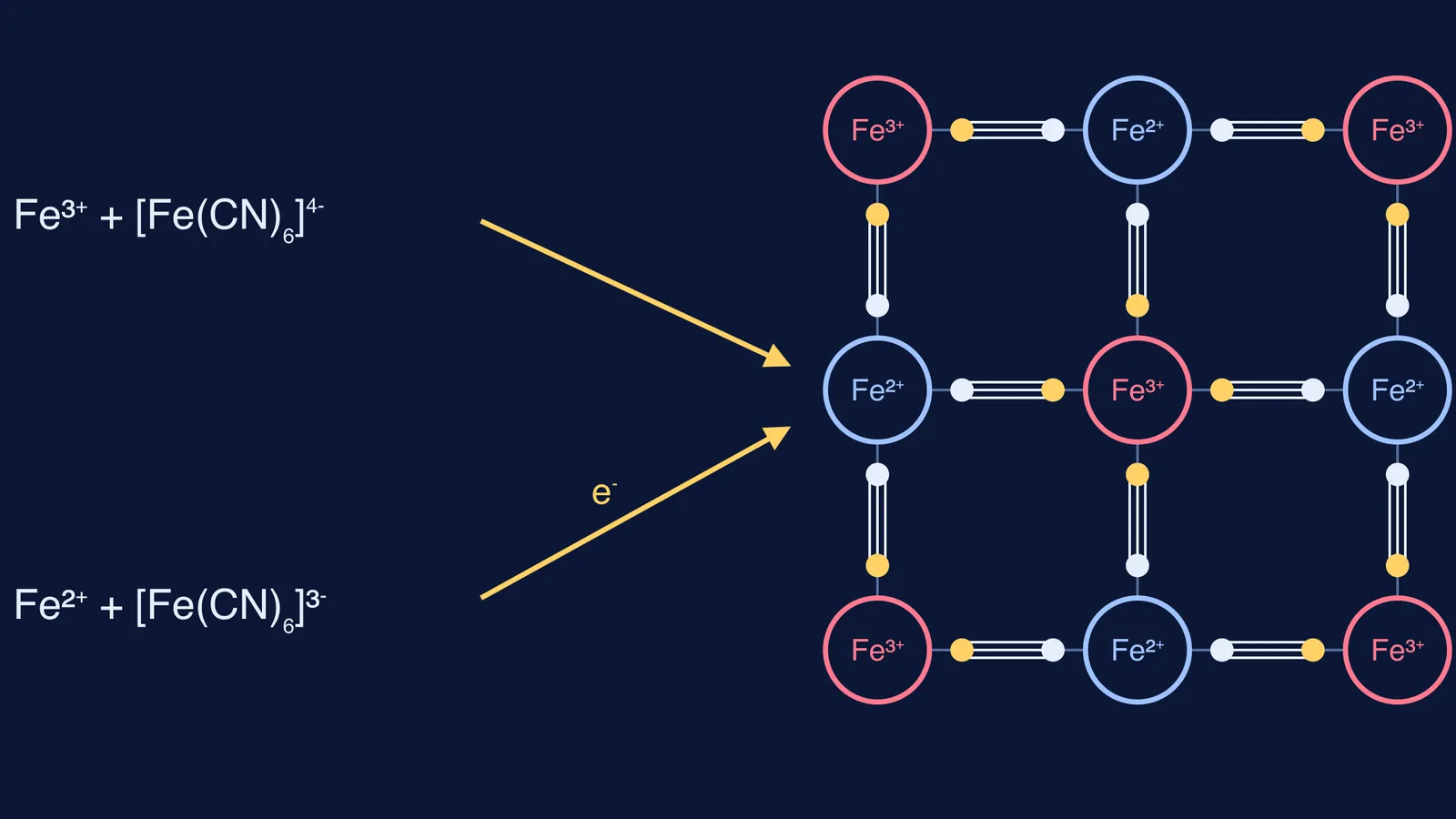
The only difference is the route; the product is the same. A 2025 review by Sonoda and colleagues in Forensic Science International: Synergy writes the two reactions side by side:
Prussian blue route: Fe³⁺ + [Fe(CN)₆]⁴⁻ → Fe(III)[Fe(II)(CN)₆]⁻
Turnbull's blue route: Fe²⁺ + [Fe(CN)₆]³⁻ → Fe(III)[Fe(II)(CN)₆]⁻
The same review states that the structure of Turnbull blue "is not ferrous ferricyanide but ferric ferrocyanide, which is the same as Prussian blue" (Sonoda et al., 2025). The old name, ferrous ferricyanide, describes the starting ions rather than what ends up in the solid.
How did scientists show the two blues are the same?
One line of evidence is Mössbauer spectroscopy of iron-57, which tells iron atoms in different oxidation and spin states apart. In 1968, A. Ito, M. Suenaga and K. Ôno at the University of Tokyo measured soluble Prussian blue, insoluble Prussian blue and Turnbull's blue, and reported in The Journal of Chemical Physics that all three are ferric ferrocyanide, with one kind of iron high-spin Fe³⁺ and the other low-spin Fe(II). They concluded that Prussian blue and Turnbull's blue have the same electronic structure.
Another is diffraction. X-ray and electron diffraction show the structures are identical; slight colour differences come from how the precipitate forms, which affects particle size and impurity content (Prussian blue, Wikipedia). The crystal structure of Prussian blue, Fe₄[Fe(CN)₆]₃·xH₂O, was published by Buser, Schwarzenbach, Petter and Ludi in 1977 in Inorganic Chemistry.
Why does Fe²⁺ plus ferricyanide end up as ferric ferrocyanide?
Because an electron moves as soon as the two ions are joined. The nitrogen end of a cyanide in [Fe(CN)₆]³⁻ binds to Fe²⁺, and the review describes an immediate inner-sphere electron transfer from Fe(II) to Fe(III) through the cyanide bridge (Sonoda et al., 2025). After that one hop, the outside iron is Fe(III) and the iron inside the cyanide cage is Fe(II). That is exactly Prussian blue.
In the crystal, low-spin Fe(II) sits in an octahedron of carbon atoms, while high-spin Fe(III) is bound mostly to the nitrogen ends, with some water where cyanide sites are empty (Prussian blue, Wikipedia). The colour comes from the same pairing: the intense blue is an intervalence charge transfer between Fe(II) and Fe(III), with peak absorption at about 700 nm, so the solid soaks up orange-red light and looks blue (Sonoda et al., 2025).
What do the other iron and cyanide combinations give?
Use a two-by-two grid: two iron ions, two cyanide complexes. The rule is that the deep blue appears only when the solid ends up with both Fe(II) and Fe(III). The review (Sonoda et al., 2025) covers all four:
Fe³⁺ + [Fe(CN)₆]⁴⁻: mixed Fe(III) and Fe(II), so Prussian blue.
Fe²⁺ + [Fe(CN)₆]³⁻: one electron transfer, then the same blue (the old Turnbull's blue).
Fe³⁺ + [Fe(CN)₆]³⁻: both iron(III), no mixed valence; this gives Prussian brown, a very strong oxidising agent.
Fe²⁺ + [Fe(CN)₆]⁴⁻: both iron(II); this gives Prussian white, which oxidises on its own to Prussian blue.
Worked example: an exam-style question
Question: Turnbull's blue is (a) ferrous ferricyanide (b) ferric ferrocyanide (c) ferrous ferrocyanide (d) ferric ferricyanide.
Write the reactants: Fe²⁺ and [Fe(CN)₆]³⁻.
Ask whether an electron can move: Fe²⁺ can give one, and the Fe(III) inside the cyanide cage can take one.
After the transfer: Fe³⁺ outside, [Fe(CN)₆]⁴⁻ inside. That is ferric ferrocyanide.
Check the colour: mixed Fe(II) and Fe(III) explains the deep blue.
Answer: (b). If an older book or answer key says (a), it is using the historical name; if you are unsure which convention your school follows, ask your teacher.
Where will you see this outside the exam hall?
In pathology and forensic labs. In Perls' Prussian blue stain, named after Max Perls, who used it in 1867, hydrochloric acid releases Fe³⁺ from haemosiderin, an iron-storage deposit in tissue, and it reacts with potassium ferrocyanide to form Prussian blue. Ferrous iron can be detected in a similar way with potassium ferricyanide, giving Turnbull blue (Sonoda et al., 2025). The same review dates the pigment itself to Johann Jacob von Diesbach in Berlin in 1706.
If coordination chemistry feels like a list of names to memorise, the Fermi Concept Library gives each chemistry concept its own lesson and its place in the map, so you can see how oxidation states, ligands and colour connect. To practise, the Fermi Problem Library has worked problems with a step-by-step solver that explains the reasoning rather than printing an answer.
Next time you see either blue, ask where the electron went, and the name follows.