On this page
At the bottom of every lift shaft, in the pit below the lowest floor, stand the buffers: squat oil-filled cylinders or springs that the car would land on if it ever ran past the bottom floor. The European lift standard sets how much travel they must have, and the rule looks like a strange constant: at least 0.067 v² metres for a rated speed v in m/s. That number is not arbitrary. It is v² = u² + 2as from Class 11, applied to a car arriving 15% too fast and stopped at one g.
What does a lift buffer actually do?
A buffer is the last line of protection at the end of travel, not the brake. In normal service the car never touches it: the drive slows the car and stops it level with the floor. Other safety devices act long before a car could reach the pit at speed. The buffer is there for the rare case where the car overruns the bottom landing anyway, and its job is to bring the car to rest at a deceleration people can take.
Many lifts use oil (hydraulic) buffers, which EN 81-20 allows at any rated speed. As the car pushes the plunger down, oil is forced through small openings, and the flow resistance turns the car's kinetic energy into heat. An ideal oil buffer pushes back with a nearly constant force all the way down, which gives a nearly constant deceleration.
Where does 0.0674 v² come from?
Stefan and Paul Vöth's review of the EN 81-20 buffer requirements (Transportation Systems in Buildings, 2025) summarises the rules for oil buffers in EN 81-20:2020. The available stroke must be at least the "gravity stopping distance" at 115% of the rated speed, written as 0.067 v². The average deceleration, with the car carrying its rated load and hitting the buffer at 115% of rated speed, must not exceed 1.0 g, and any deceleration above 2.5 g must last less than 0.04 s.
The gravity stopping distance is the distance needed to stop from a speed u at a constant deceleration of g. Put final speed 0 in v² = u² + 2as with a = −g:
d = u² / 2g
Now set u = 1.15 v for a car 15% over its rated speed:
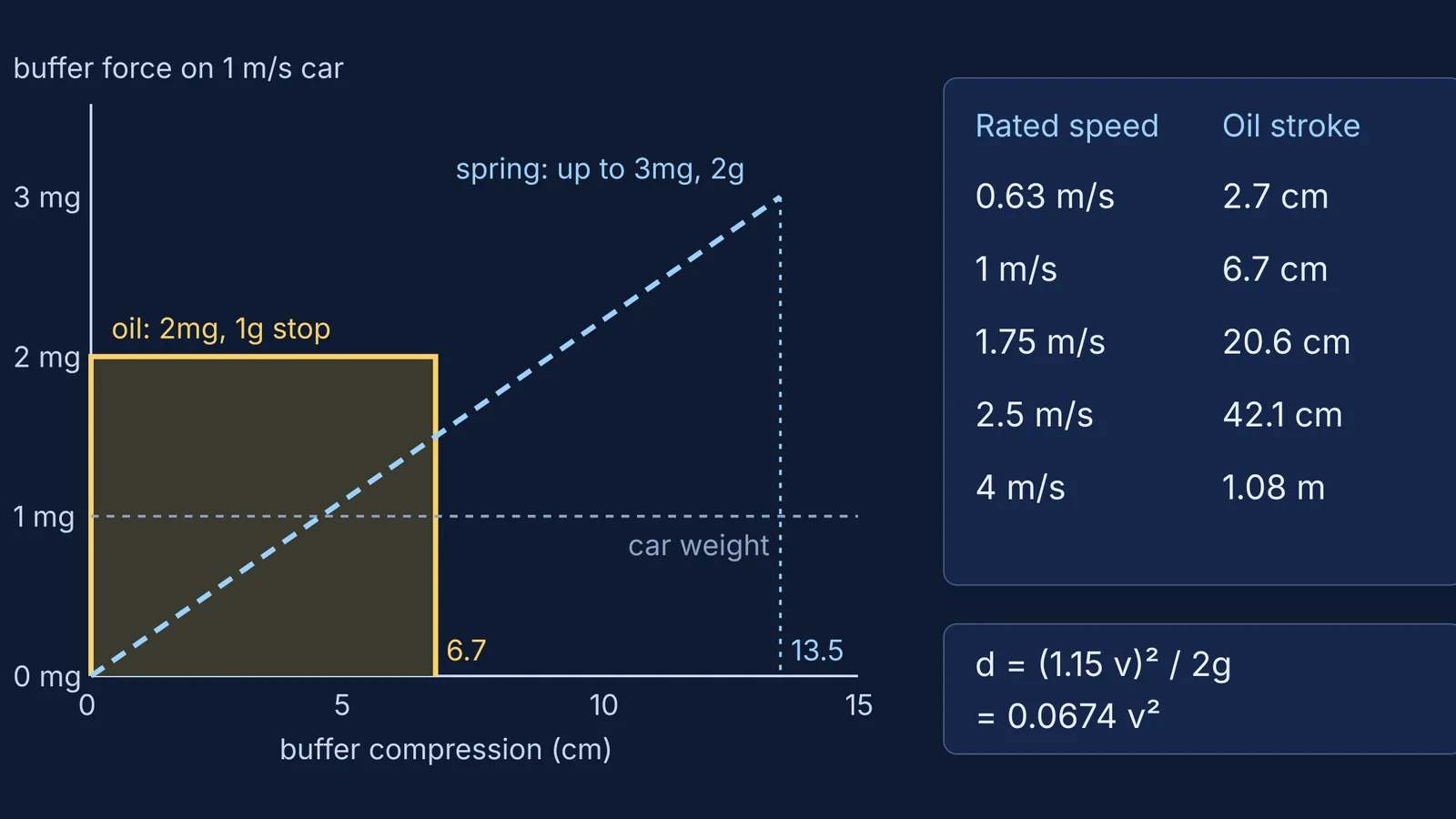
d = (1.15 v)² / (2 × 9.81) = 1.3225 v² / 19.62 = 0.0674 v²
The constant is in metres when v is in m/s. Buffer makers' data follow it. Oleo's SEB oil buffer range lists a minimum stroke of 173 mm for a 1.6 m/s buffer and 435 mm for 2.54 m/s, and 0.0674 × 1.6² = 0.173 m and 0.0674 × 2.54² = 0.435 m.
The two rules agree. With a constant deceleration, stopping in exactly d means stopping at exactly 1 g on average, which is the limit the standard allows.
How deep must the buffer be for different lift speeds?
Using d = 0.0674 v² and stopping time t = 1.15 v / g:
0.63 m/s: 2.7 cm, in 0.07 s.
1.0 m/s: 6.7 cm, in 0.12 s.
1.75 m/s: 20.6 cm, in 0.21 s.
2.5 m/s: 42.1 cm, in 0.29 s.
4.0 m/s: 1.08 m, in 0.47 s.
The stroke grows as v², so doubling the speed needs four times the buffer. For lifts above 2.5 m/s, the same review notes that the standard lets the stroke be calculated from a lower impact speed if electric safety devices monitor the slowdown at the ends of travel, but never below 0.42 m.
How hard does the buffer push on the car?
A deceleration of 1 g does not mean the buffer pushes with a force equal to the car's weight.
Here is a worked example for a car whose mass with its rated load is 1,500 kg (an illustrative figure), rated at 1.0 m/s.
Impact speed. u = 1.15 × 1.0 = 1.15 m/s.
Stroke. d = 1.15² / (2 × 9.81) = 0.0674 m, or 6.74 cm.
Time. t = u / g = 1.15 / 9.81 = 0.117 s.
Forces on the car. Weight mg acts down. The buffer force F acts up. The car is moving down and slowing, so its acceleration is upward, of size g.
Newton's second law, taking up as positive. F − mg = mg, so F = 2mg = 2 × 1,500 × 9.81 = 29,400 N, about 29.4 kN.
Energy check. The buffer does work F × d = 29,430 × 0.0674 = 1,984 J. The car brings ½mu² = ½ × 1,500 × 1.15² = 992 J of kinetic energy, and gravity does a further mgd = 1,500 × 9.81 × 0.0674 = 992 J as the car moves down. 992 + 992 = 1,984 J, so the books balance.
So the buffer must hold twice the loaded car's weight for the whole stroke. Passengers would feel this as about twice their normal weight, briefly.
Why not just use a spring?
A spring's force grows with compression, F = kx, so it starts gently and ends hard. Compare it with the oil buffer for the same 1.0 m/s car.
Same stroke, d = 6.74 cm. Energy: ½kd² = ½mu² + mgd = mgd + mgd = 2mgd, so k = 4mg/d. The peak force is kd = 4mg, and the peak deceleration is (4mg − mg)/m = 3g, against a steady 1g for the oil buffer.
Twice the stroke, 2d = 13.5 cm. ½k(2d)² = mgd + 2mgd = 3mgd, so k = 1.5mg/d. The peak force is k × 2d = 3mg, and the peak deceleration is 2g.
A spring wastes much of its stroke at low force, so it needs more room, or gives a harder peak, for the same stop. Codes have separate stroke rules for spring buffers, which we do not quote here. The physics alone shows why oil buffers suit faster lifts. Crash cushions on highways solve the same kind of problem in a different way, as in how sand-filled crash barrels stop a car.
How does this connect to JEE lift problems?
Lift questions usually stop at cable tension and apparent weight, as in how cable tension limits a lift's acceleration, or the energy saved in why lifts have a counterweight. The buffer adds a clean v² = u² + 2as step and a work-energy check with gravity included, which is exactly the kind of two-step reasoning JEE rewards. You can practise similar problems with the step-by-step solver in the Fermi Problem Library, which explains the reasoning at each step. If you are preparing for JEE Main and Advanced, Fermi Test Prep offers personalised preparation with an AI tutor, live classes, adaptive mocks, mentorship and a study plan that updates based on mastery.
Quick checklist
Gravity stopping distance: d = u²/2g.
Oil buffer stroke from 115% of rated speed: d = (1.15 v)²/2g = 0.0674 v², in metres.
1.0 m/s lift: 6.7 cm; 2.5 m/s: 42 cm. Stroke grows as v².
A 1 g stop needs a buffer force of 2mg, because gravity still acts.
Work-energy check: F d = ½mu² + mgd.
A linear spring with the same stop needs more stroke or gives a higher peak.