

On this page
At the pointed end of a highway divider, in front of a bridge pier or at a toll-plaza island, you may see a cluster of yellow plastic drums. They look like rubbish bins, but each one holds a measured load of sand, and they are placed in a fixed order: light drums at the front, heavy ones at the back. A car that runs into them is slowed by one idea from Class 11, conservation of momentum, applied again and again.
What is a sand-filled crash cushion?
It is an inertial crash cushion, also called an impact attenuator. The drums are not bolted down and have no springs. Each one simply has mass. When a car hits a drum, the sand inside must be set moving, and the only thing that can push it is the car. The car pays for that with its own momentum.
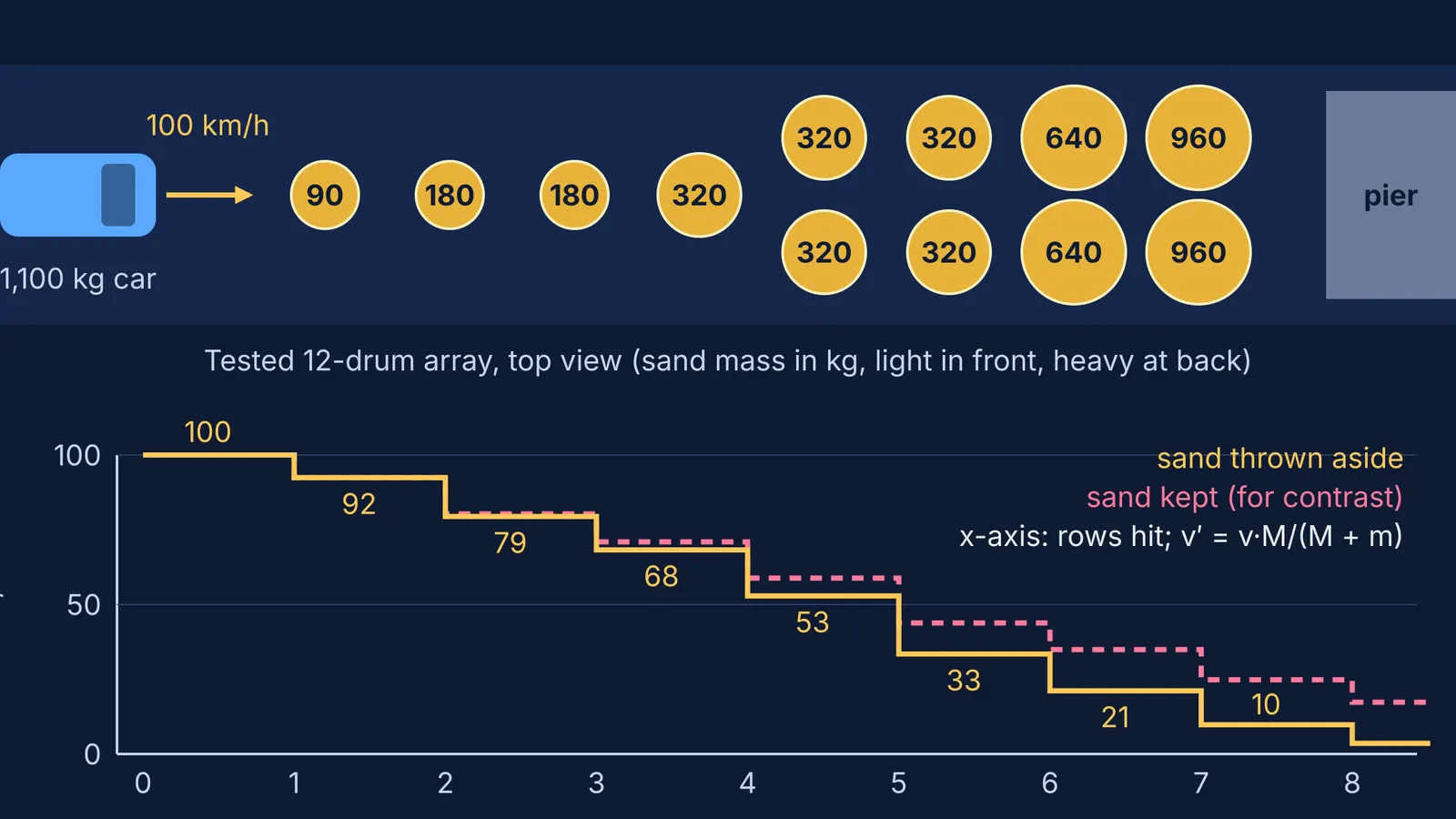
One common system, the TrafFix Big Sandy, uses drums filled to 200, 400, 700, 1,400 or 2,100 lb of sand, which is about 90, 180, 320, 640 and 960 kg. Its installation manual shows a 12-drum array that was crash-tested at 100 km/h with a 1,100 kg car and a 2,270 kg pickup truck. From the front, that array has single drums of 90, 180, 180 and 320 kg, then pairs of 320, 320, 640 and 960 kg. The manual also says that arrays for a real site must follow the local traffic engineer's plan, so treat this as one tested example, not a universal layout.
How does momentum sharing slow the car?
Treat each hit as a perfectly inelastic collision. Just after the car meets a drum, the car and the sand move together at one speed. No large outside force acts in that short time, so momentum is conserved:
Mv = (M + m)v′, which gives v′ = v × M/(M + m)
Here M is the car's mass, m is the sand it meets and v is the car's speed before the hit. Then the sand is thrown forward and sideways and leaves the car. The car carries on at v′ with only its own mass and meets the next drum.
Notice what the formula says. The speed is multiplied by a factor less than 1 at every drum. A light drum gives a factor close to 1 and a small, gentle slowdown. A heavy drum gives a much smaller factor. This is the impulse idea from how force and time decide a change in momentum: the car gets many small impulses spread over several metres instead of one huge one.
Worked example: the 12-drum array at 100 km/h
Take the 1,100 kg test car at 100 km/h hitting the tested array head-on. Assume it meets both drums of each pair.
Convert the speed. 100 km/h = 100/3.6 = 27.8 m/s.
Momentum before the first drum. p = 1,100 × 27.8 ≈ 30,600 kg m/s.
First drum, 90 kg. v′ = 27.8 × 1,100/1,190 = 25.7 m/s, or 92.4 km/h.
Kinetic energy check. Before: ½ × 1,100 × 27.8² ≈ 424 kJ. After: the car has ≈ 363 kJ, the flying sand carries ≈ 30 kJ, and about 32 kJ goes into crushing the drum and heating the sand. Momentum is conserved; kinetic energy is not.
Repeat for each row. The masses met are 90, 180, 180, 320, 640, 640, 1,280 and 1,920 kg (the last four are pairs). The speed after each row is 92.4, 79.4, 68.3, 52.9, 33.4, 21.1, 9.8 and 3.6 km/h.
Overall factor. Multiply all eight factors M/(M + m) and you get 0.036. The car has given away about 96% of its speed.
Check units. M/(M + m) is kg/kg, so it has no unit, and v′ has the same unit as v. Good.
The last few km/h are lost to the pile of sand and to road friction, which this model ignores.
Now the same array with the 2,270 kg pickup at 100 km/h. The speeds come out as 96.2, 89.1, 82.6, 72.4, 56.5, 44.0, 28.2 and 15.3 km/h. A heavier vehicle keeps more of its speed, because each factor M/(M + m) is closer to 1. That is why the back of the array holds the heaviest drums: they are there for heavy vehicles, which the light front drums barely slow.
Why must the sand be thrown aside?
Suppose the sand stayed stuck to the car. After each drum the car would be heavier, so the next drum would slow it less. With the same eight rows, the speeds would be 92.4, 80.3, 71.0, 58.8, 43.8, 34.9, 24.8 and 17.3 km/h. The car would leave the array at 17 km/h instead of under 4 km/h.
So the scattering is part of the design. Each drum takes momentum from the car and then carries it away, leaving the car as light as before for the next hit. This is the reverse of the problem in the force needed to keep a conveyor belt moving as sand falls on it, where the sand stays on the belt and keeps adding mass.
Why are the light drums at the front?
Look at the first factor for the small car: 1,100/1,190 = 0.92, an 8% loss of speed. If the 960 kg drum stood at the front instead, the factor would be 1,100/2,060 = 0.53, a 47% loss in one hit. The change in speed happens in the short time the car takes to crush one drum, so a big drop in that time means a big force on the people inside.
Starting light keeps the first hits gentle, which matters for small cars. Ending heavy makes sure a truck is also slowed to a low speed before the array runs out. The same reasoning explains why crash tests use both a small car and a heavy pickup: the array has to work across that whole range.
For how a head-on crash into a wall compares with a crash into another car, see which is worse, a head-on crash or hitting a wall. The sand array is the opposite of a wall: it turns one large impulse into many small ones.
What does this simple model leave out?
The plastic drums themselves, which have a few kilograms of mass and also crush.
The time each collision takes and the exact force, which needs details of the drum and the car's crumple zone.
Friction from the tyres and the sand pile on the road, which helps at the end.
Hits at an angle, where the car may meet only one drum of a pair.
The model still gets the main idea right, and it gives a clear reason for every design choice. If you want to practise chains of collisions like this one, the Fermi Problem Library has a step-by-step solver that explains the reasoning at each stage.
Quick checklist
Each drum is a perfectly inelastic collision: v′ = v × M/(M + m).
Multiply the factors drum by drum; never add speed drops.
Momentum is conserved in each hit; kinetic energy is not.
Sand that scatters leaves the car light, so every drum keeps working.
Light drums in front keep the first jolt small; heavy drums at the back stop heavy vehicles.
The 1,100 kg car in the tested 12-drum array: 100 km/h to about 4 km/h in this model.


