

On this page
On many building sites you will see steel beams boxed in with boards, sprayed with a grey coat or painted with a layer that swells when heated. Steel does not burn, so why wrap it? Because steel loses strength as it gets hot, and a bare beam heats up fast in a fire. How fast depends on one number engineers call the section factor. Thin sections heat several times faster than chunky ones, for a simple surface-to-volume reason.
How hot can structural steel get before it weakens?
Steel keeps its full strength up to a few hundred degrees and then weakens quickly. In the Eurocode tables for carbon steel, the effective yield strength is 100% of its room-temperature value up to 400 °C, 78% at 500 °C, 47% at 600 °C and 23% at 700 °C (ECCS, Fire Design of Steel Structures, following EN 1993-1-2). The UK steel industry's guidance puts it this way: "By 550°C the most common grades of hot rolled structural steel retain about 60% of their room temperature yield strength" (SteelConstruction.info).
That is why 550 °C is a traditional round figure for when a loaded member fails. The same guidance warns that the failure temperature is not fixed: it depends on the load the member carries and on how evenly it is heated, and 550 °C is often a very conservative choice. Eurocode 3 gives the critical temperature from the degree of utilisation μ₀ (the load in the fire as a fraction of the member's resistance at room temperature): θ_cr = 39.19 ln[1/(0.9674 μ₀^3.833) − 1] + 482 (JRC workshop slides, B. Zhao). For μ₀ = 0.6 this gives 554 °C; for μ₀ = 0.7 it gives 526 °C. We use 550 °C below as a round marker.
What is the standard fire curve?
To compare products and designs, fire tests heat a member in a furnace that follows an agreed gas temperature, the ISO 834 standard curve: T_g = 20 + 345 log₁₀(8t + 1), with T_g in °C and t in minutes (JRC workshop slides, O. Vassart). It gives 576 °C at 5 minutes, 678 °C at 10, 842 °C at 30, 945 °C at 60 and 1,049 °C at 120.
This is a test standard, not a real fire. The SteelConstruction.info guidance notes that the standard curve does not follow the general behaviour of a real fire, which cools once the fuel burns away. How real room fires grow and flash over is covered in why a room fire suddenly engulfs everything.
Why does a thin steel section heat faster than a thick one?
Steel conducts heat well, so a beam flange warms almost evenly. With a total surface heat-transfer coefficient near 240 W/m²K at fire temperatures, a 10 mm flange (5 mm to its middle) and k ≈ 45 W/m K, the Biot number is about 0.03, well below 0.1. So we can treat the steel as one lump at one temperature, as in how a sprinkler bulb heats up.
Heat enters through the surface and is stored in the volume:
ρcV × dT/dt = A × q
where q is the heat flux per square metre. Divide by V:
dT/dt = (A/V) × q / (ρc)
A/V is the section factor, the heated surface per unit volume, in m⁻¹. For a plate heated on both faces, A/V = 2/thickness, so a 10 mm plate has 200 m⁻¹ and a 40 mm plate 50 m⁻¹. Real sections run "from 17 m⁻¹ for very large sections to over 300 m⁻¹ for small, slender sections" (SteelConstruction.info, calculating section factors).
The flux q has two parts, convection and radiation. Eurocode 3 Part 1-2 uses q = 25(T_g − T) + 0.7σ[(T_g + 273)⁴ − (T + 273)⁴], in W/m², with σ = 5.67 × 10⁻⁸ W/m²K⁴, and a time step of no more than 5 seconds (JRC workshop slides, B. Zhao). The fourth-power term is Stefan's law, covered in how Josef Stefan found the fourth power radiation law.
How long does a bare beam take to reach 550 °C? A worked example
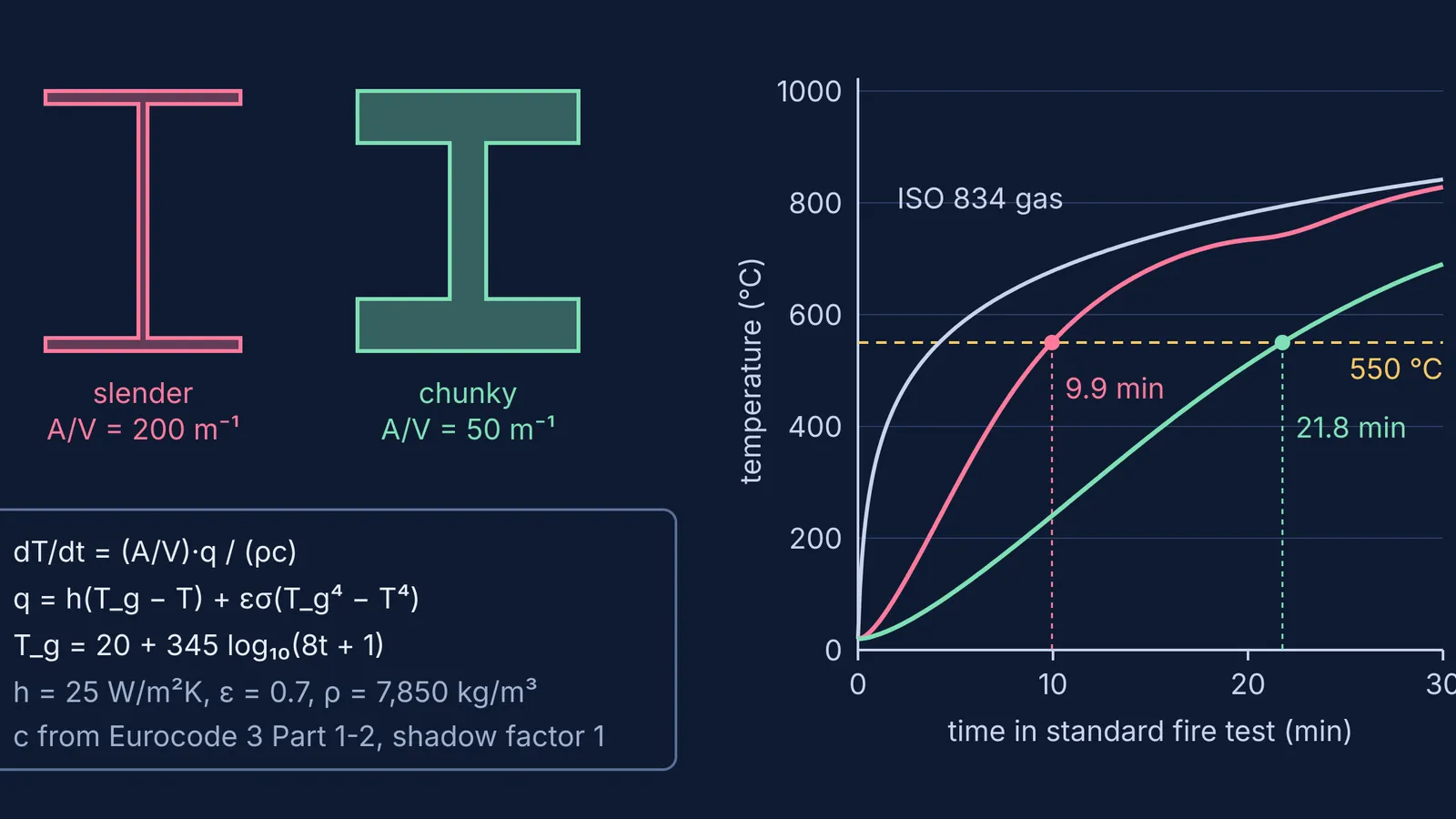
Take two plates in the standard fire: 10 mm thick (A/V = 200 m⁻¹) and 40 mm thick (A/V = 50 m⁻¹). Use ρ = 7,850 kg/m³ and Eurocode's temperature-dependent specific heat. We ignore the shadow factor (set it to 1), which slightly overstates the heating of I-sections.
Gas temperature at 5 minutes. T_g = 20 + 345 log₁₀(41) = 576 °C.
Thin plate's temperature by then. Stepping the equation forward second by second gives 291 °C.
Heat flux at that moment. Convection: 25 × (576 − 291) = 7.1 kW/m². Radiation: 0.7 × 5.67 × 10⁻⁸ × (849⁴ − 564⁴) = 16.7 kW/m². Total q = 23.8 kW/m². Radiation already gives 70% of it.
Heating rate. At 291 °C, c ≈ 561 J/kg K. dT/dt = 200 × 23,800 / (7,850 × 561) = 1.08 K/s, about 65 °C per minute.
Units. (m⁻¹ × W/m²) ÷ (kg/m³ × J/kg K) = (W/m³) ÷ (J/m³K) = K/s.
The thick plate. At the same steel temperature it would heat at a quarter of that rate, 16 °C per minute, because its A/V is a quarter. In fact at 5 minutes it is still only at 106 °C.
Time to 550 °C. Stepping on to the end: 9.9 minutes for A/V = 200 m⁻¹ and 21.8 minutes for 50 m⁻¹. For comparison, 300 m⁻¹ takes 8.1 minutes and 100 m⁻¹ takes 14.5.
These are illustrative figures from the Eurocode heating model, not ratings. They agree in scale with the guidance that the inherent fire resistance of bare steel "can be as little as 12 minutes" for small, fully loaded sections exposed on four sides, and up to 50 minutes for very large, lightly loaded sections partly shielded by a concrete floor slab (SteelConstruction.info).
How does fireproofing slow the steel down?
Fire protection puts an insulating layer between the hot gas and the steel. The flux reaching the steel is now limited by conduction through that layer, roughly k_p(T_g − T)/d_p, which is far smaller than the bare-surface flux. Boards form a box round the section; sprays and intumescent coatings follow its profile (SteelConstruction.info, calculating section factors). Thicker protection is needed for a higher section factor and a longer required period, and the thickness comes from each product's tested data, not from a hand sum. If you want the conduction side, see heat conduction and thermal resistance.
How long must the steel hold out? That is set by building regulations. As one example from UK guidance, an office building over 30 m tall requires 120 minutes' fire resistance plus a life safety sprinkler system (SteelConstruction.info). Bare slender steel, at around 10 minutes in our example, is far short of periods like that.
To revise heat flux, radiation and lumped heating together, the Concept Library explains each idea with diagrams.
Quick checklist
Steel loses strength fast above about 400 °C; 550 °C is a traditional, often conservative, failure marker.
Standard test fire: T_g = 20 + 345 log₁₀(8t + 1); real fires differ.
Lumped heating: dT/dt = (A/V) × q / (ρc). A/V is the section factor.
In our model a bare 200 m⁻¹ section reaches 550 °C in about 10 minutes, a 50 m⁻¹ one in about 22.
Protection adds thermal resistance; its thickness comes from tested product data.


