On this page
Respiration in plants is listed under Unit 4 (Plant Physiology) in the Biology section of the NEET (UG) 2026 syllabus. The NEET (UG) 2026 information bulletin allots Biology 90 of the paper's 180 questions; each right answer earns +4, each wrong one costs 1 mark.
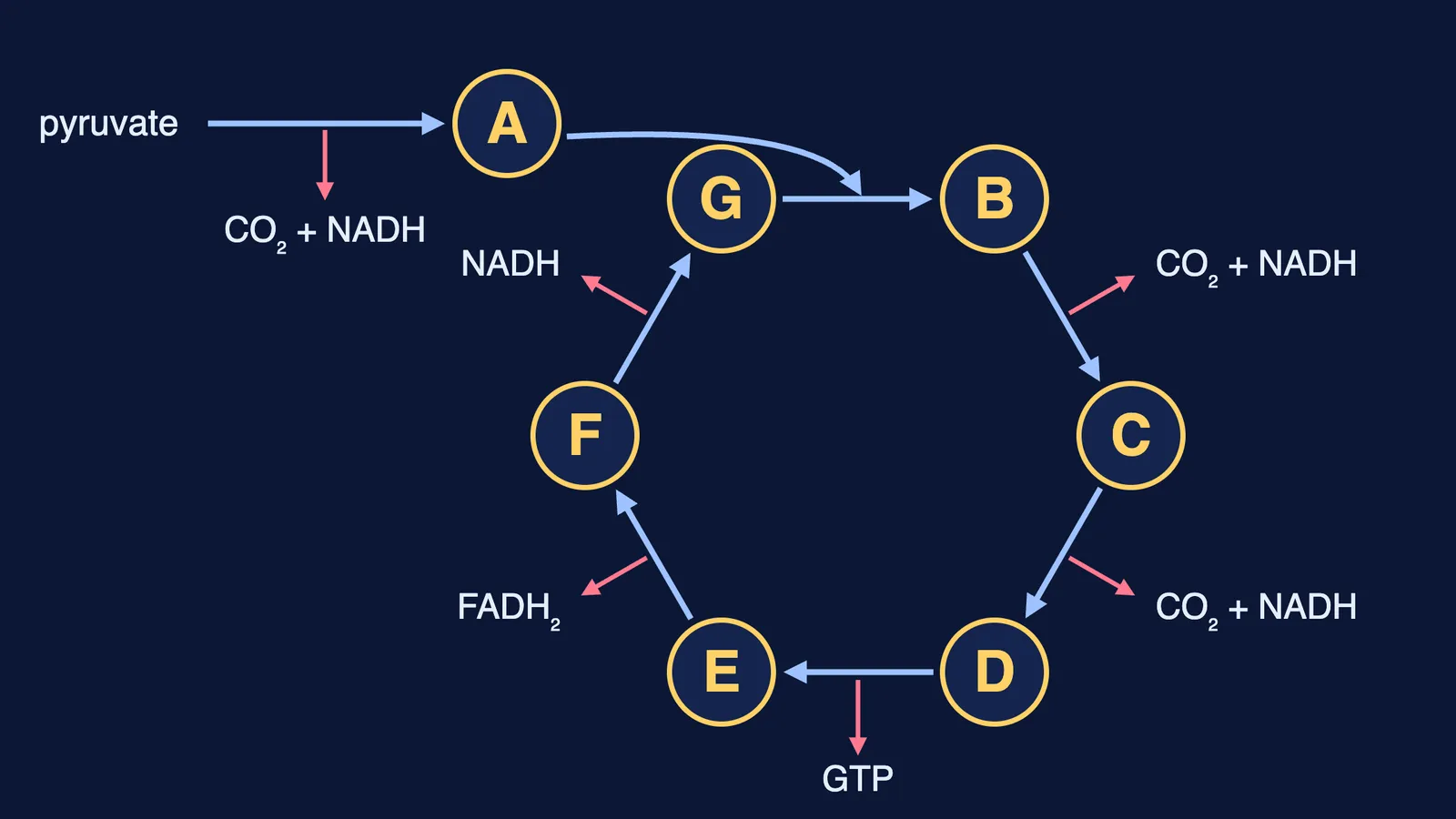
These 13 questions are our own, not past-paper items or predictions. Every answer follows NCERT Class 11 Biology, Chapter 12: Respiration in Plants (Reprint 2026-27). Q1 to Q6 use our lettered citric acid cycle; Q7 to Q13 describe other figures in words.
What should you check before naming a lettered part?
Read the arrows leaving the ring before the circles. Each CO₂ arrow takes one carbon away; each NADH or FADH₂ arrow marks hydrogen being removed. Start from the compound entering from pyruvate and follow the arrows.
For statement pairs, use these codes: (1) I alone is correct (2) II alone is correct (3) I and II are both correct (4) I and II are both wrong.
Can you name the compounds A to G in the cycle?
Q1. Which letter marks the compound that joins with A and water, in the step catalysed by citrate synthase? (1) B (2) E (3) G (4) F
Q2. Match each arrow with what happens there. List-I: K. B to C; L. D to E; M. E to F; N. G plus A to B List-II: (i) FAD+ reduced; (ii) GTP made by substrate-level phosphorylation; (iii) isomerisation, then decarboxylation; (iv) condensation, CoA released (1) K-iii, L-i, M-ii, N-iv (2) K-iii, L-ii, M-i, N-iv (3) K-iv, L-ii, M-i, N-iii (4) K-ii, L-iii, M-iv, N-i
Q3. Statement I: Two molecules of CO₂ leave the cycle between B and D. Statement II: FAD+ is reduced at the F to G arrow.
Q4. Which lettered compound must be replenished for the cycle to keep oxidising acetyl CoA? (1) B (2) C (3) E (4) G
Q5. Which option lists two lettered compounds that are both four-carbon acids? (1) B and C (2) A and G (3) B and G (4) E and F
Q6. Statement I: The phosphorylation at the D to E arrow happens on ATP synthase in the inner membrane. Statement II: The coenzyme reduced at the E to F arrow gives 2 ATP when oxidised in the ETS.
Answer key for the lettered diagram, A to G
A: acetyl coenzyme A. B: citric acid. C: α-ketoglutaric acid. D: succinyl-CoA. E: succinic acid. F: malic acid. G: oxaloacetic acid (OAA).
Q1: (3). Citrate synthase condenses the acetyl group with OAA and water to give citric acid.
Q2: (2). Citrate isomerises to isocitrate before decarboxylation; succinyl-CoA to succinic acid yields GTP.
Q3: (1). Two successive decarboxylations give α-ketoglutaric acid, then succinyl-CoA; F to G reduces NAD+, not FAD+.
Q4: (4). NCERT calls OAA the first member of the cycle and says it must be replenished.
Q5: (4). Figure 12.3 marks succinic and malic acid 4C; citric acid is 6C, acetyl CoA 2C.
Q6: (2). The GTP step is substrate-level; one FADH₂ gives 2 ATP.
How do you handle a respiration figure that is only described?
Sketch it in ten seconds: a column for glycolysis, a fork for fermentation, a membrane line for the ETS. Mark where ATP, NADH or water appears.
Q7. In the glycolysis chart, where does NADH + H+ form? (1) Glucose to glucose-6-phosphate (2) Fructose-6-phosphate to its 1,6-bisphosphate form (3) Phosphoenolpyruvate to pyruvic acid (4) PGAL to BPGA
Answer: (4). Two hydrogen atoms pass from PGAL to NAD+.
Q8. In the same chart, which two steps make ATP directly? (1) Glucose to glucose-6-phosphate, and fructose-6-phosphate to its bisphosphate (2) PGAL to BPGA, and PEP to pyruvic acid (3) BPGA to 3-phosphoglyceric acid, and PEP to pyruvic acid (4) 2-phosphoglycerate to PEP, and BPGA to 3-phosphoglyceric acid
Answer: (3). The first two steps spend ATP; PGAL to BPGA makes NADH; water leaves before PEP.
Q9. In a figure where pyruvic acid becomes either lactic acid or ethanol plus CO₂, which molecule is the reducing agent in both branches? (1) FADH₂ (2) NADH + H+ (3) ATP (4) Acetyl CoA
Answer: (2). It is reoxidised to NAD+ in both processes.
Q10. On the ETS figure, Statement I: Electrons from NADH made in the matrix enter the chain at complex I, NADH dehydrogenase. Statement II: Ubiquinol passes its electrons straight to complex IV.
Answer: (1). Ubiquinol passes electrons to cytochrome c via complex III.
Q11. In the ATP synthesis figure, protons pass through F0 from: (1) matrix to intermembrane space (2) cytoplasm to matrix (3) matrix to cytoplasm (4) intermembrane space to matrix
Answer: (4). They move down the proton gradient into the matrix.
Q12. Match each part of the ETS and ATP synthesis figures with its description. List-I: K. F1 headpiece; L. Ubiquinone; M. Cytochrome c; N. Complex IV List-II: (i) cytochromes a and a3, two copper centres; (ii) peripheral complex holding the ATP-making site; (iii) small protein on the membrane's outer surface, linking complexes III and IV; (iv) carrier located within the inner membrane (1) K-i, L-iv, M-iii, N-ii (2) K-ii, L-iv, M-iii, N-i (3) K-ii, L-iii, M-iv, N-i (4) K-iv, L-ii, M-i, N-iii
Answer: (2). Section 12.4.2 describes each part this way.
Q13. A figure shows where food molecules enter respiration. Which statement matches NCERT? (1) Carbohydrates are usually converted to glucose before respiration (2) Pure fats are often the only substrate respired (3) Proteins enter only at glycolysis' first step (4) The pathway is purely catabolic
Answer: (1). Glucose is the favoured substrate, and the pathway is amphibolic, not purely catabolic.
Which misses tell you what to redraw?
Q1 to Q6: redraw the cycle from memory with carbon counts.
Q7 to Q9: rebuild the glycolysis column, marking ATP and NADH steps.
Q10 to Q12: draw the inner membrane with complexes I to V.
Q13: list where each food type enters.
For text-only practice, try the respiration statement and match-the-list set. For the full chapter, read our Respiration in Plants notes, or try the photosynthesis diagram-based questions.
Not sure which figure trips you up? Fermi's AI tutor works out what you already know and builds a plan for the session.