On this page
Pour a litre of molten steel into a sand mould shaped as a cube and it takes minutes to freeze. The same litre as a thin plate freezes in under half that time; as a ball, it takes longest. Foundries predict these times with a one-line formula called Chvorinov's rule, and they use it every day to size the risers that stop castings from shrinking hollow.
What is Chvorinov's rule?
Chvorinov's rule says that the time a casting takes to solidify in a sand mould is
t = B (V/A)²
where V is the casting's volume, A is the surface area through which it loses heat to the mould, and B is the mould constant. The ratio V/A is called the modulus, M, and has units of length. So t = B M².
B depends on the metal (its density, latent heat, specific heat, freezing temperature and how much it is superheated when poured) and on the mould (the sand's conductivity, density and specific heat). It is measured for each metal and mould, not looked up from a universal table. Foundry engineers write the rule in exactly this form, t = c·M², when they design feeders; see, for example, this study of riser design for ductile iron castings in Archives of Foundry Engineering.
Why does solidification time depend on V/A squared?
Molten metal must give up its superheat and then its latent heat of fusion before it is solid. That heat grows with the amount of metal, V.
In a sand mould the slow step is not the metal but the sand. Sand is a poor conductor, so the metal surface stays close to its freezing temperature while the sand next to it slowly warms. The warmed layer of sand spreads outwards with time, and its thickness grows as √t, just like the depth to which heat soaks into any thick, poorly conducting wall. The heat stored in that warmed layer, which is the heat the metal has lost, is proportional to the contact area times the layer's thickness: A√t.
Set heat lost equal to heat that must be removed:
V ∝ A√t, so √t ∝ V/A, so t ∝ (V/A)².
You have met a √t law before: the thickness of ice forming on a pond grows as √t for a similar reason, because heat must cross a conducting layer that keeps getting thicker.
This is different from cooling hot solid spheres in air, where the time grows in proportion to size; that linear rule is the one Buffon used to time cooling iron spheres.
How long do a cube, a plate and a sphere of the same volume take to freeze?
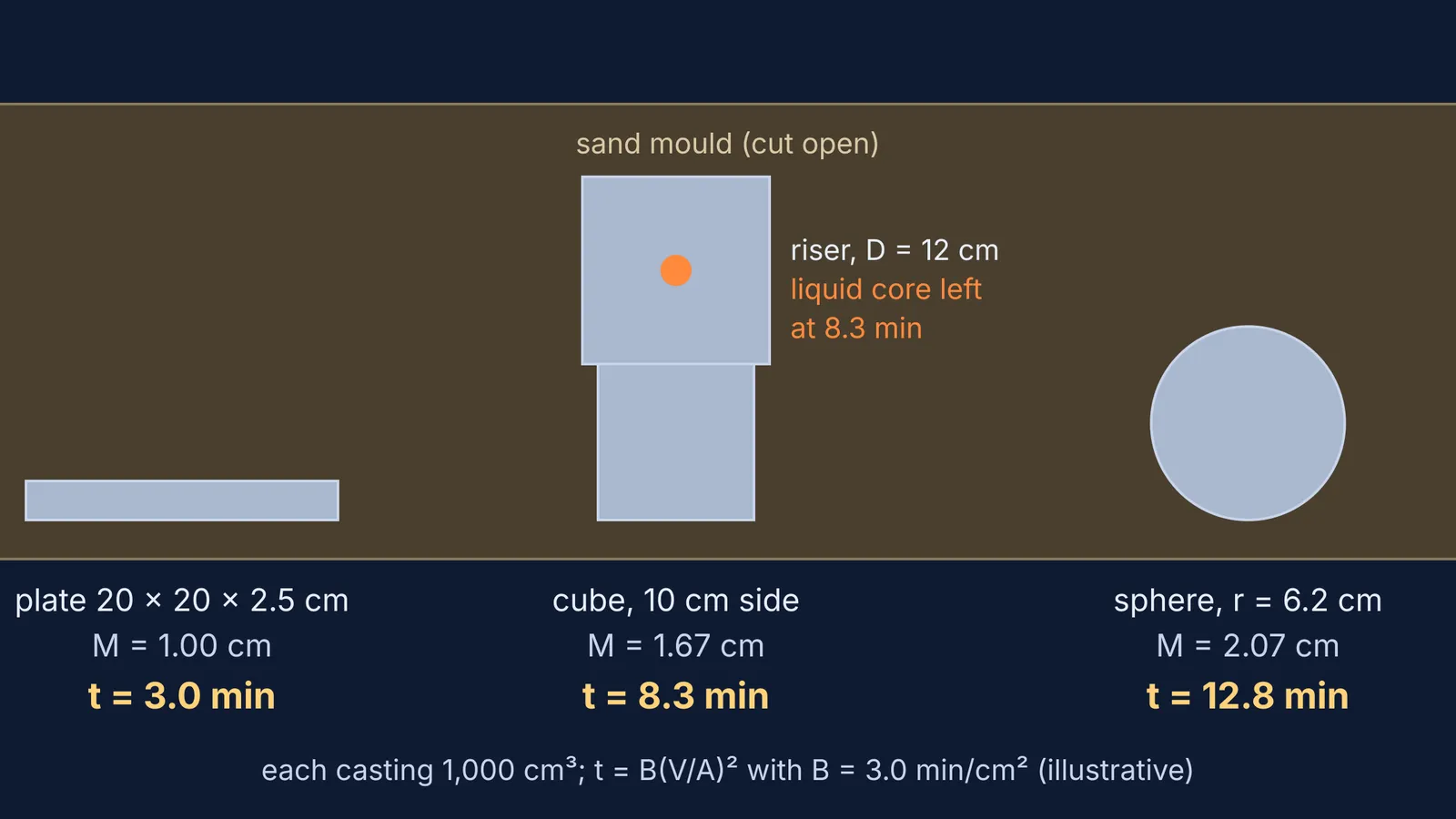
Take 1,000 cm³ (one litre) of steel and an illustrative mould constant B = 3.0 min/cm². This is a round value chosen for the example, not a measured constant for any particular steel or sand. Every time below scales with B, but the ratios between shapes do not.
Cube, 10 cm side. V = 1,000 cm³. A = 6 × 10² = 600 cm². M = 1,000/600 = 1.67 cm. t = 3.0 × 1.67² = 8.3 min.
Plate, 20 × 20 × 2.5 cm. V = 1,000 cm³. A = 2(20×20 + 20×2.5 + 20×2.5) = 1,000 cm². M = 1.00 cm. t = 3.0 × 1.00² = 3.0 min.
Sphere. Radius r = (3V/4π)^(1/3) = 6.20 cm. For a sphere M = r/3 = 2.07 cm. t = 3.0 × 2.07² = 12.8 min.
Check the units: min/cm² × cm² = min. The sphere is slowest because a sphere has the smallest surface area for a given volume, so it has the largest modulus. The plate is fastest because almost all of its metal is close to a surface.
The sphere's modulus is about twice the plate's, so its time is more than four times longer.
What is a riser, and how big must it be?
Steel shrinks as it freezes, by a few per cent of its volume. If the casting freezes from the outside in with no supply of fresh liquid, the last region to freeze is left with a shrinkage cavity inside it. A riser (also called a feeder) is a reservoir of extra molten metal attached to the casting. As the casting shrinks, liquid metal flows from the riser into it.
For that to work, the riser must still be liquid after the casting has frozen. By Chvorinov's rule, that means the riser needs a larger modulus than the casting. A common design rule, Wlodawer's modulus method, takes the riser's modulus as 1.2 times the casting's, as described in the same foundry study. This 1.2 is a design rule with a safety margin, not a law of physics; in that study, the riser that gave a completely sound 40 mm casting had a modulus nearly 1.5 times the casting's.
Worked example: sizing a riser for the cube
Size a cylindrical riser, with height equal to its diameter D, to feed the 10 cm steel cube. Treat all the riser's surfaces as cooling surfaces, which is a simplification.
Modulus of a cylinder with H = D. V = πD²/4 × D = πD³/4. A = πD × D + 2 × πD²/4 = 1.5πD². M = (πD³/4) / (1.5πD²) = D/6.
Required modulus. M_riser = 1.2 × M_cube = 1.2 × 1.67 = 2.0 cm.
Diameter. D/6 = 2.0 cm, so D = 12 cm.
Riser volume. V = π × 12³/4 = 1,357 cm³. The riser holds more metal than the casting it feeds.
Riser freezing time. t = 3.0 × 2.0² = 12 min, compared with 8.3 min for the cube. The ratio is 1.2² = 1.44, whatever B is.
That is why foundries remelt cut-off risers and use insulating or exothermic sleeves to keep risers hot with less metal.
The squared dependence is the reverse of what heat-sink fins exploit. Fins add area to cool faster; a riser is shaped to have as little area per unit volume as possible so it cools slowly.
Where does the rule stop working?
It is for sand and other insulating moulds. In a metal mould (die casting, permanent moulds) heat leaves much faster and the interface, not the mould, often limits the rate, so the time follows a different law.
It gives the time to solidify, not the time to cool to room temperature.
B is empirical. It changes with pouring temperature, sand type and moisture, and measured exponents can differ somewhat from 2. Foundries calibrate it from their own castings.
If you want to revise latent heat, conduction and specific heat before trying more of these, the Concept Library explains each idea step by step.
Quick checklist
Chvorinov's rule: t = B(V/A)², with M = V/A called the modulus.
The (V/A)² comes from the sand: heat soaks in to a depth that grows as √t.
Same volume, different shape: plate 3.0 min, cube 8.3 min, sphere 12.8 min (B = 3.0 min/cm², illustrative).
A riser must freeze after the casting; a common design rule makes its modulus 1.2 times larger.
A cylinder with H = D has M = D/6, so the cube needs a 12 cm riser.
Use it for sand moulds only, and treat B as a measured constant.