On this page
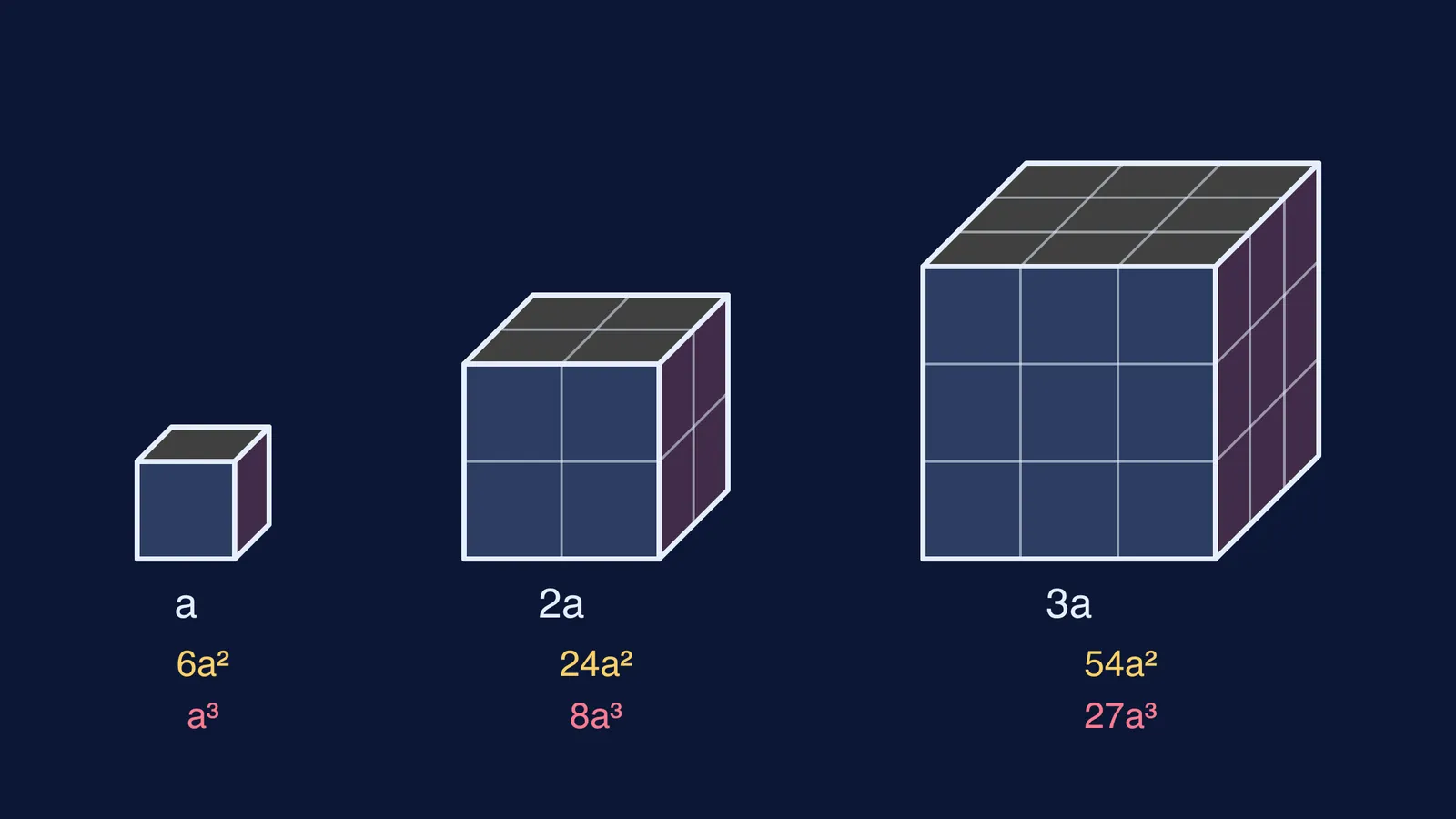
Look behind a fridge, inside a laptop or at the front of a car and you will find the same shape: thin metal plates standing in rows. They are fins, and they exist for one reason. A hot object can only hand heat to the air through its surface, so more surface means faster cooling. Here you predict how much fins help, then find where more fins stop helping.
Why do heat sinks and radiators have fins?
Heat leaving a surface by convection follows Newton's law of cooling, q = hAΔT, where A is the surface area, ΔT is the temperature gap between surface and air, and h is the convective heat transfer coefficient (Engineering ToolBox). If you want more heat out, you can raise ΔT, raise h, or raise A.
A hotter chip is what you are trying to avoid, and a higher h needs a fan or pump. Raising A is often cheapest, and that is what a fin does: fins are surfaces that extend from an object to increase heat transfer by increasing convection (Fin (extended surface), Wikipedia)). The same page lists car radiators and computer CPU heat sinks as common uses.
If you want the exact law first, our explainer on Newton's law of cooling and its average-rate shortcut walks through it.
How much do fins actually help?
Take a 5 cm by 5 cm aluminium block, 2 cm thick, at 80 °C in still air at 30 °C. Assume only its top face loses heat and, for illustration, take h = 10 W/m²K (a value we chose, not a measurement).
Predict first. Write down a guess: if you add eight fins, each 3 cm tall, 5 cm long and 1.5 mm thick, how many times faster does the block lose heat?
Bare block. A = 25 cm² = 0.0025 m², so q = 10 × 0.0025 × 50 = 1.25 W.
Fin area. Each fin has two faces of 5 cm × 3 cm, so 30 cm². Eight fins give 240 cm², and they cover 6 cm² of the top face, leaving 19 cm² bare.
Fin efficiency. A fin's tip is cooler than its base, so it works less hard. Fin efficiency is the fin's heat flow divided by what it would carry if it were all at the base temperature (Wikipedia)). For a fin with an insulated tip it is tanh(mL)/mL, with m = √(hP/kAc), where P is the fin's perimeter and Ac its cross-section. Using k = 200 W/mK, within the 166-201 W/mK quoted for common heat-sink aluminium alloys (Heat sink, Wikipedia), mL ≈ 0.25 and the efficiency is about 0.98.
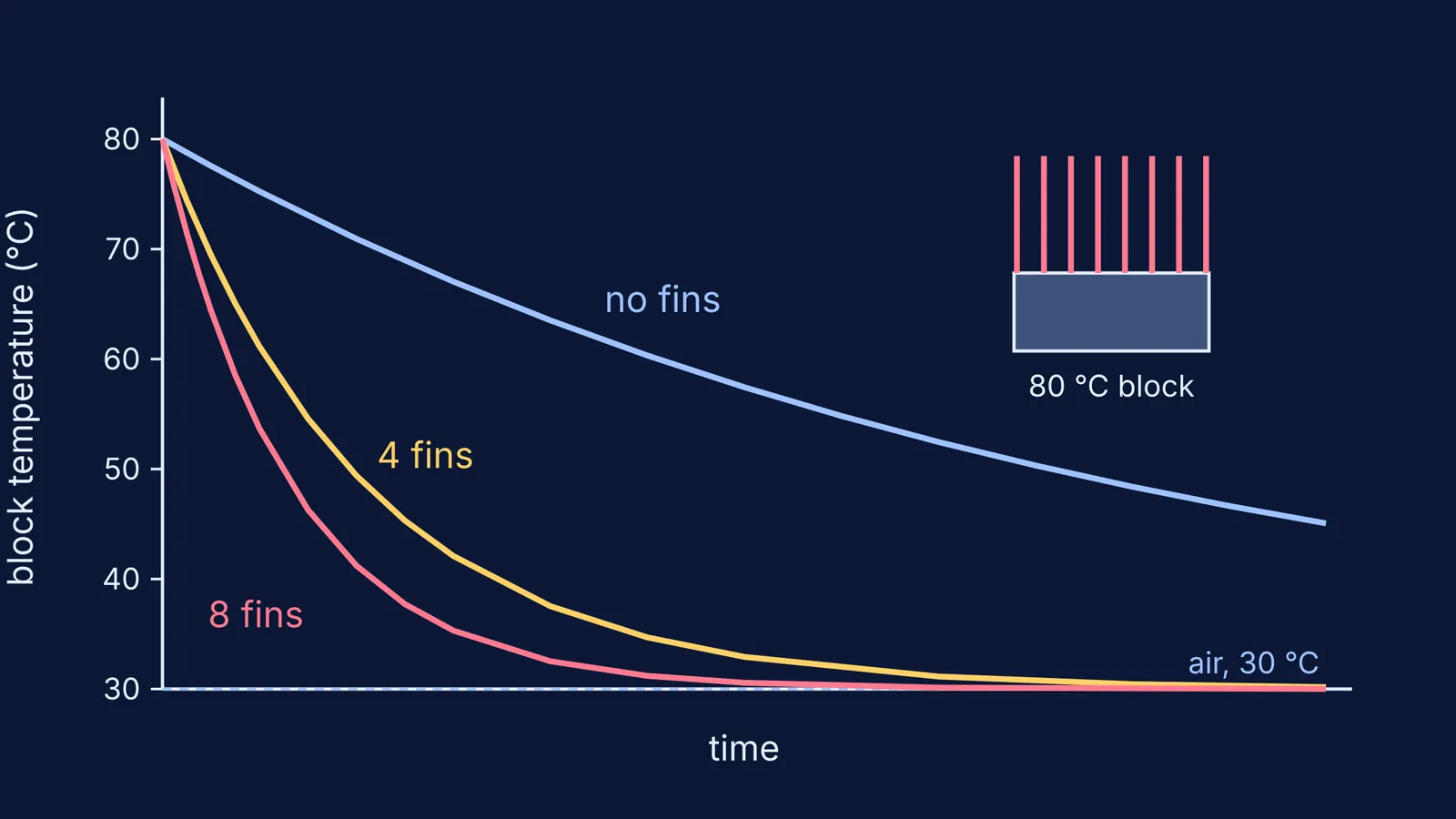
Finned block. q ≈ 10 × 50 × (0.0019 + 0.98 × 0.024) ≈ 12.7 W, about ten times the bare block. With four fins the same steps give about 7 W.
The fins also add a little metal, about 36% more for eight fins, so the block's cooling time constant falls to roughly 0.13 of the bare value.
The copper comparison comes from the same heat sink overview, which gives about 400 W/mK for pure copper.
Can too many fins make cooling worse?
Yes, especially without a fan. Natural convection needs air to flow freely between the fins, and if fins are too close together the heat sink's efficiency declines (Heat sink, Wikipedia). Bar-Cohen and Rohsenow worked out thermally optimum spacings for vertical parallel plates cooled by natural convection, a model they applied to electronics cooling (Journal of Heat Transfer, 1984).
Try it on our block. Eight fins leave gaps of about 5.4 mm. Sixteen fins leave about 1.7 mm. The simple formula, which keeps h fixed, says sixteen fins nearly double the heat flow again. In still air, h falls as the gaps close, so the gain shrinks and can reverse. That is one reason a laptop, which packs fins tightly, uses a fan, as our post on why laptops need cooling fans explains.
How can you test this yourself?
Use predict, test, explain. Write each prediction down before you check it.
Fin count: 0, 4, 8, 16. Does 16 beat 8 in still air?
Fin height: 1 cm, 3 cm, 6 cm. Does doubling height double the heat flow?
Material: aluminium, copper, then plastic. Which change matters most for tall fins?
Airflow: still air, then a fan. Does the best spacing change when h rises?
Track the block's temperature every minute and plot it; a faster fall means a shorter time constant. The same area-to-heat-capacity idea explains why a smaller sphere cools faster than a larger one.
The Fermi Simulation Lab has interactive simulations for ideas that are easier to see than to read. If the fin formula itself is the sticking point, the Fermi Concept Library gives each physics concept its own lesson.