

On this page
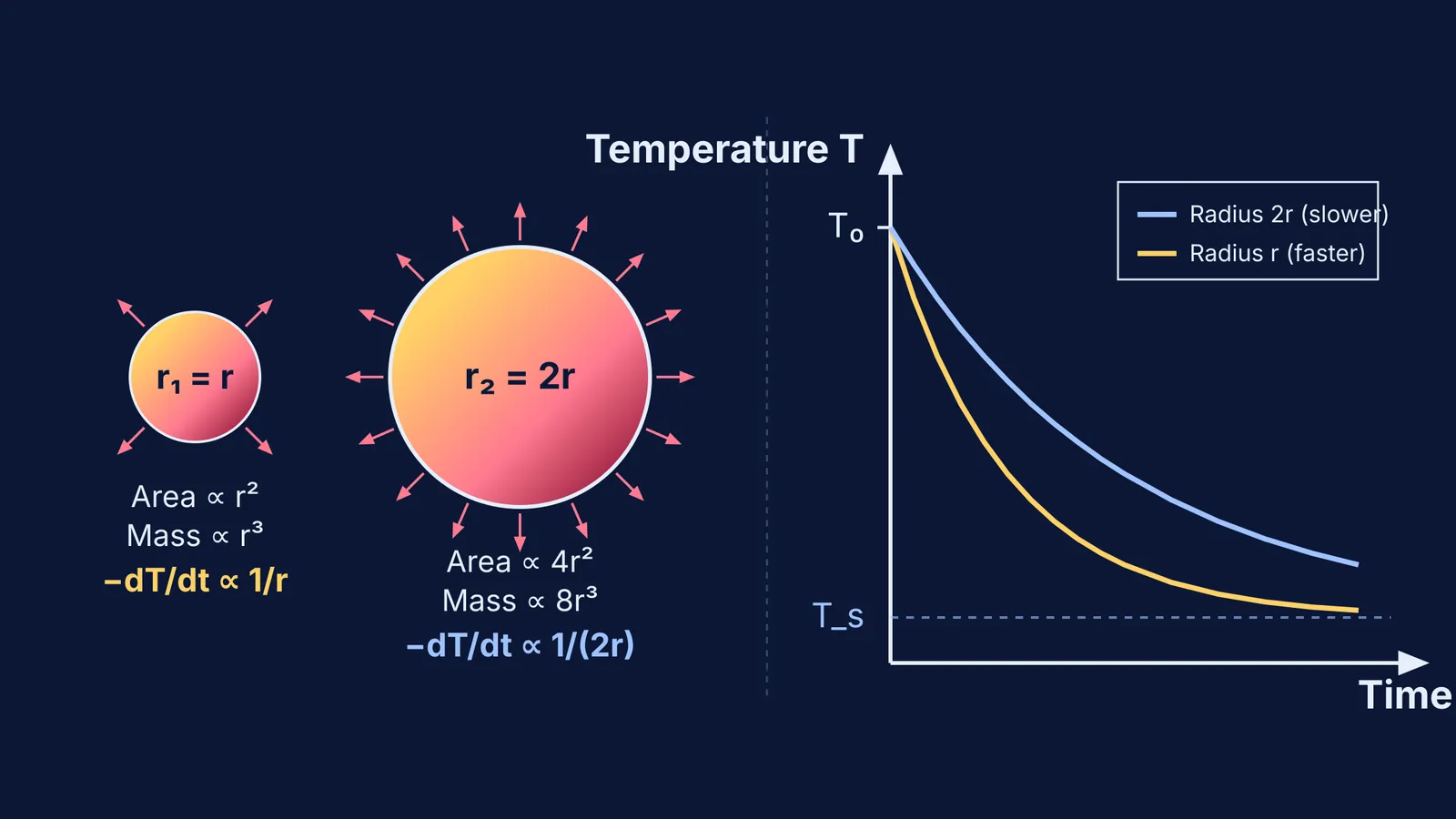
Suppose you take two solid spheres forged from the same metal—one with radius r and the other with radius 2r—heat them to an identical initial temperature, and place them in an identical cooler environment. Which one cools faster?
Many students intuitively pick the larger sphere. After all, having four times the surface area, it radiates substantially more energy every second. Yet if you insert a thermometer into each sphere, the smaller sphere's temperature drops twice as rapidly.
Understanding this outcome requires untangling a widespread confusion in thermal physics between the rate of heat loss and the rate of cooling.
Why does a smaller sphere cool faster than a larger sphere?
The reason a smaller sphere cools faster lies in how geometry governs heat storage versus heat release. While heat leaves a body only through its exterior surface, thermal energy is stored across its entire interior bulk.
According to OpenStax University Physics Volume 2 Section 1.4, the heat Q required to change an object's temperature by dT is Q = m c dT, where c is specific heat capacity in J/(kg · K). The thermal energy required to change its temperature by 1 K is its heat capacity, mc. For a solid sphere of radius r and density ρ, mass equals volume times density:
m = (4/3)πr³ ρ
Because mass scales with the cube of the radius (r³), a sphere with twice the radius holds 2³ = 8 times as much thermal energy at the same temperature. However, radiant heat transfer escapes only across the surface area, which scales with the square of the radius (4πr²).
A larger sphere therefore carries far more heat energy behind every square centimetre of its surface. As heat radiates outward, the smaller sphere depletes its internal reservoir much faster per degree of temperature change, causing its temperature to plunge more swiftly.
How do you derive the 1/r cooling formula from Stefan's law?
We can demonstrate this relationship quantitatively using the laws of radiation and calorimetry.
According to the NIST Reference on Constants, Units, and Uncertainty, the Stefan-Boltzmann constant is σ = 5.670374419... × 10⁻⁸ W m⁻² K⁻⁴. As detailed in OpenStax University Physics Volume 2 Section 1.6, the net rate of heat loss dQ/dt radiated by a body of surface area A and emissivity e at absolute temperature T to surroundings at T_s is:
dQ/dt = e σ A (T⁴ − T_s⁴)
For a solid sphere of radius r, substituting surface area A = 4πr² yields:
dQ/dt = 4πr² e σ (T⁴ − T_s⁴)
From calorimetry and specific heat capacity, the heat lost over an interval dt produces a temperature drop dT:
dQ/dt = −m c (dT/dt)
Equating the two expressions for dQ/dt:
−m c (dT/dt) = 4πr² e σ (T⁴ − T_s⁴)
Substitute mass m = (4/3)πr³ ρ:
−(4/3)πr³ ρ c (dT/dt) = 4πr² e σ (T⁴ − T_s⁴)
Solving for the rate of temperature decrease (−dT/dt):
−dT/dt = [4πr² e σ (T⁴ − T_s⁴)] / [(4/3)πr³ ρ c]
−dT/dt = [3 e σ (T⁴ − T_s⁴)] / (ρ c r)
Because both spheres share the same material, emissivity e, density ρ, and specific heat c are identical. At any given temperature T:
−dT/dt ∝ 1/r
The rate of cooling is inversely proportional to radius. When you need to trace how radiation laws connect with thermodynamics, the Fermi Concept Library includes every concept in physics, chemistry, biology, mathematics and computing, each with its own lesson and its place in the map.
What is the difference between rate of cooling and rate of heat loss?
The confusion between these two quantities is one of the most frequent traps in competitive exams like JEE Main and NEET-UG.
The two quantities measure entirely different physical processes:
Rate of heat loss (dQ/dt): The total thermal energy radiated per unit time, measured in Joules per second (Watts). It is proportional to surface area: dQ/dt ∝ r². The larger sphere has the higher rate of heat loss.
Rate of cooling (−dT/dt): The time rate of temperature decrease, measured in Kelvins per second (K/s) or degrees Celsius per second (°C/s). It equals radiated power divided by heat capacity: −dT/dt = (dQ/dt)/(m c) ∝ r²/r³ = 1/r. The smaller sphere has the higher rate of cooling.
When temperature differences are moderate, radiation simplifies to Newton's law of cooling and its linear approximation, where the cooling rate remains proportional to 1/r.
Worked example: comparing spheres of radius 1 cm and 2 cm
Consider two solid copper spheres suspended in an evacuated chamber. Sphere 1 has radius r₁ = 1 cm, and Sphere 2 has radius r₂ = 2 cm. Both are heated to 400 K and cool in surroundings at 300 K.
Ratio of radii: r₁/r₂ = 1/2.
Ratio of surface areas: A₁/A₂ = (r₁/r₂)² = (1/2)² = 1/4.
Ratio of rates of heat loss: (dQ₁/dt) / (dQ₂/dt) = A₁/A₂ = 1/4. Sphere 2 radiates 4 times as much energy per second as Sphere 1.
Ratio of masses and heat capacities: m₁/m₂ = (r₁/r₂)³ = (1/2)³ = 1/8. Sphere 2 holds 8 times as much heat energy as Sphere 1.
Ratio of rates of cooling: (−dT₁/dt) / (−dT₂/dt) = (dQ₁/dt · m₂c) / (dQ₂/dt · m₁c) = (1/4) × (8/1) = 2/1.
Sphere 1 drops in temperature twice as fast as Sphere 2.
To master recognizing these ratio relationships under timed conditions, the Fermi Problem Library provides worked problems with a step-by-step solver that explains the reasoning rather than printing an answer.
What happens if the spheres are hollow?
The 1/r dependence holds strictly for solid spheres. If the spheres are thin hollow shells of identical thickness d and radius r, their mass is m = 4πr² d ρ.
In that case, mass scales with surface area (r²) rather than volume (r³). Dividing radiated power (proportional to r²) by heat capacity (also proportional to r²) yields a cooling rate that is independent of radius. Both hollow shells cool at the exact same rate.
Whether analysing hollow shells or solid conductors, tracking how heat distributes across geometry—as seen in radial heat flow through shells—ensures you always set up the correct proportionality.


