On this page
Put a bucket of hot water next to a bucket of cold water and pour one into the other, and you get lukewarm water and nothing else. Run an ideal heat engine between them instead, and you get work out, and the water ends up slightly cooler than the mixed bucket would have been. This is a favourite JEE Advanced-style thermodynamics problem because it tests whether you really understand entropy, not just the Carnot formula. Here is how to solve it, with 1 kg at 90 °C and 1 kg at 10 °C.
Why can't you just use the Carnot efficiency?
The Carnot efficiency η = 1 − T_c/T_h assumes reservoirs: bodies so large that their temperatures do not change as heat flows. That is the setup in Sadi Carnot's analysis of heat engines, and in problems with two Carnot engines in series between fixed temperatures.
A bucket of water is not a reservoir. As the engine draws heat from the hot bucket, its temperature falls. As the engine dumps heat into the cold bucket, its temperature rises. The efficiency of the next small cycle is lower than the last, and the engine stops producing work when the two buckets reach the same temperature. So you cannot multiply one efficiency by one amount of heat. You need a different idea.
How does entropy give the final temperature?
The key fact: a reversible engine creates no entropy. Over each cycle the working substance returns to its starting state, so its entropy does not change. The only entropy changes are in the two buckets, and for a reversible process they must add to zero.
For a body of heat capacity C going from T₁ to T_f, the entropy change is ΔS = C ln(T_f/T₁). Apply this to both buckets, each with heat capacity C:
C ln(T_f/T₁) + C ln(T_f/T₂) = 0
ln(T_f²/(T₁T₂)) = 0
T_f = √(T₁T₂)
The final temperature is the geometric mean of the two starting temperatures, in kelvin.
How much work does the engine deliver?
Energy is conserved. The hot bucket gives out heat Q_h = C(T₁ − T_f). The cold bucket takes in heat Q_c = C(T_f − T₂). The difference is the work:
W = Q_h − Q_c = C(T₁ + T₂ − 2T_f)
Because the geometric mean is always less than the arithmetic mean, √(T₁T₂) < (T₁ + T₂)/2, this W is always positive. It is the largest work any engine can get from these two bodies. A real engine creates entropy, ends at a higher common temperature and delivers less.
Worked example: 1 kg at 90 °C and 1 kg at 10 °C
Take c = 4,186 J/kg K for water, so each bucket has C = 4,186 J/K.
Convert to kelvin. T₁ = 90 + 273.15 = 363.15 K. T₂ = 10 + 273.15 = 283.15 K.
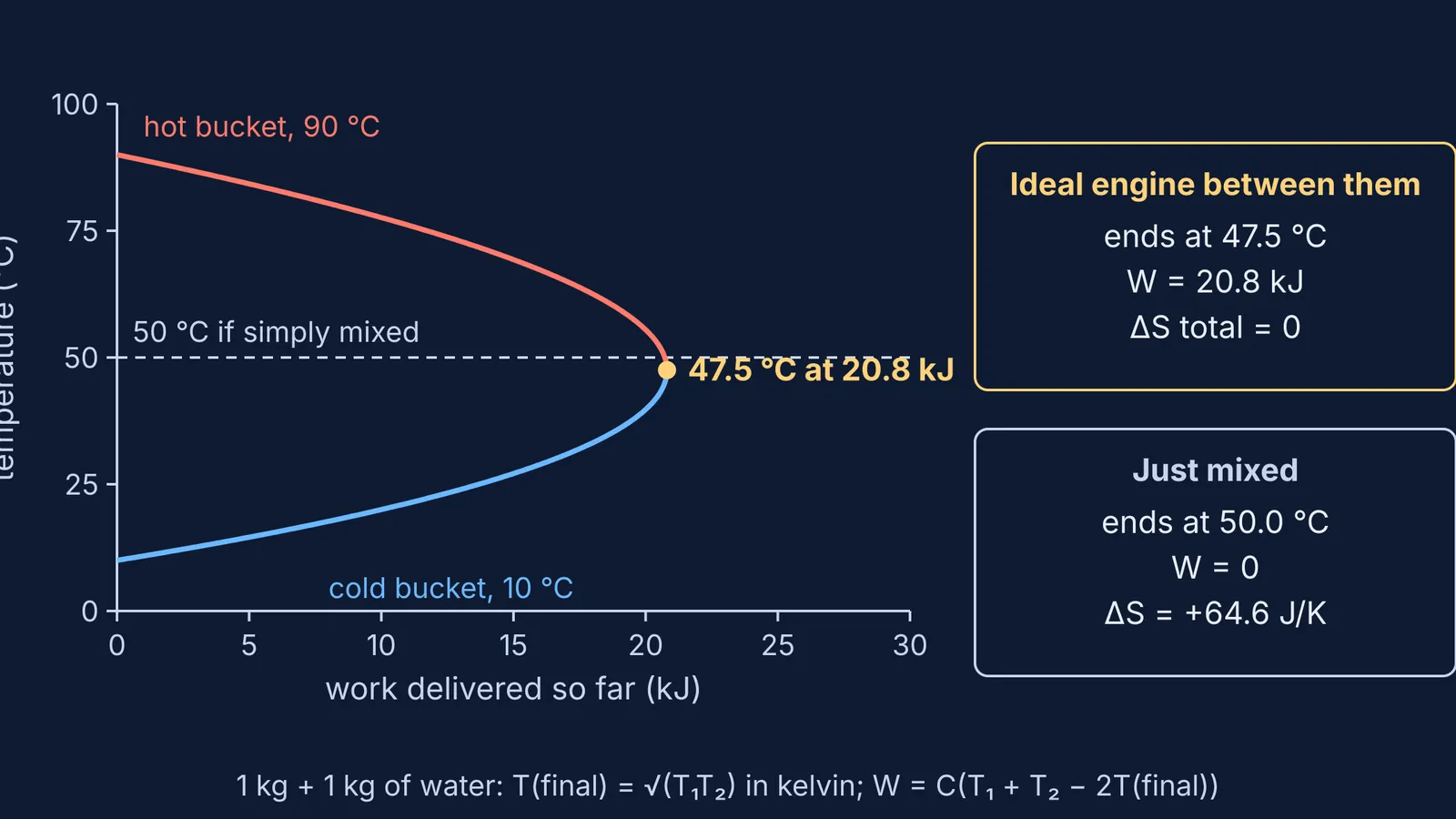
Final temperature. T_f = √(363.15 × 283.15) = 320.66 K = 47.5 °C.
Heat out of the hot bucket. Q_h = 4,186 × (363.15 − 320.66) = 177.8 kJ.
Heat into the cold bucket. Q_c = 4,186 × (320.66 − 283.15) = 157.0 kJ.
Work. W = 177.8 − 157.0 = 20.8 kJ.
Overall efficiency. W/Q_h = 20.8/177.8 = 11.7%.
Compare with fixed reservoirs. A Carnot engine between reservoirs held at 90 °C and 10 °C would have η = 1 − 283.15/363.15 = 22.0%.
Check the entropy. 4,186 × [ln(320.66/363.15) + ln(320.66/283.15)] = 0, as it should be for a reversible process.
The overall efficiency, 11.7%, is about half the fixed-reservoir value. That makes sense: the first cycles run between 90 °C and 10 °C at 22%, but the last cycles run between two temperatures near 47.5 °C at almost zero efficiency.
Units check: J/K × K = J. The final temperature has units of K because it is the square root of K × K.
What changes if you just mix the buckets?
Pour them together and the final temperature is the plain average, 50 °C, because no energy leaves as work. No work is done, and entropy is created:
ΔS = 4,186 × [ln(323.15/363.15) + ln(323.15/283.15)] = +64.6 J/K
The heat death of the universe post looks at this kind of mixing entropy on a cosmic scale. Here the comparison is small and concrete: the engine leaves the water at 47.5 °C, the mixed bucket sits at 50 °C. Those 2.5 degrees across 2 kg of water are exactly the 20.8 kJ that became work: 2 × 4,186 × (323.15 − 320.66) = 20.8 kJ.
So the energy that mixing "wastes" is not destroyed. It stays in the water as a slightly higher temperature, where it can no longer be turned into work because there is no temperature difference left to drive an engine.
What if the buckets are not the same size?
The method is the same, but the heat capacities differ. Set the total entropy change to zero:
C₁ ln(T_f/T₁) + C₂ ln(T_f/T₂) = 0
This gives a weighted geometric mean: T_f = T₁^(C₁/(C₁+C₂)) × T₂^(C₂/(C₁+C₂)).
For 2 kg at 90 °C and 1 kg at 10 °C, C₁ = 8,372 J/K and C₂ = 4,186 J/K:
ln T_f = (2 ln 363.15 + ln 283.15)/3, so T_f = 334.24 K = 61.1 °C.
W = 8,372 × (363.15 − 334.24) − 4,186 × (334.24 − 283.15) = 28.1 kJ.
Simple mixing would give (2 × 90 + 10)/3 = 63.3 °C, higher than the engine's 61.1 °C, as expected.
The same idea works for any two bodies with constant heat capacities: metal blocks, a hot brick and a cold room, or two tanks of gas at constant volume. If C changes with temperature, the logarithms become integrals of C dT/T, but the rule ΔS_total = 0 still sets T_f.
How do you set up this problem in the exam?
Write ΔS for each body as C ln(T_f/T_initial).
Set the total to zero for a reversible engine, and solve for T_f in kelvin.
Use energy conservation: W = heat lost by the hot body − heat gained by the cold body.
For "maximum work", always assume a reversible engine. For "mixing", use calorimetry and expect ΔS > 0.
To practise more problems of this pattern with full working, the Fermi Problem Library has a step-by-step solver that explains the reasoning. If you are building a full JEE plan, Fermi Test Prep offers personalised preparation for JEE Main & Advanced with an AI tutor, live classes, adaptive mocks, mentorship and a study plan that updates based on mastery.
Quick checklist
Finite bodies change temperature, so the single Carnot efficiency does not apply.
Reversible engine: total entropy change of the two bodies is zero.
Equal heat capacities: T_f = √(T₁T₂), in kelvin.
Maximum work: W = C(T₁ + T₂ − 2T_f).
1 kg at 90 °C and 1 kg at 10 °C: T_f = 47.5 °C, W = 20.8 kJ, overall efficiency 11.7%.
Simple mixing: 50 °C, no work, ΔS = +64.6 J/K.