On this page
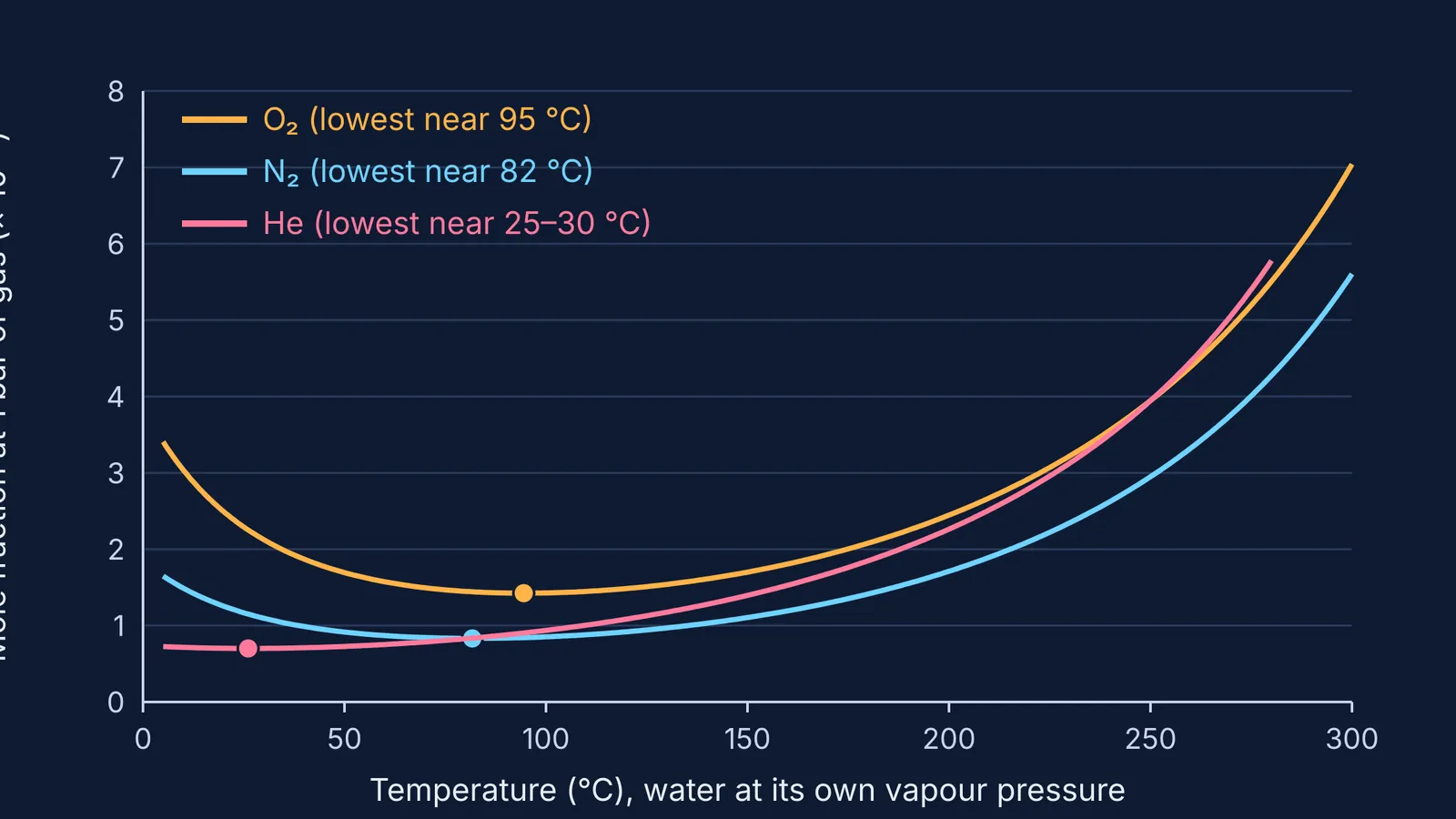
Every student learns that gases dissolve less as water warms. The rule is right for the temperatures you meet in the lab and in exam questions, but not for all temperatures. For all 14 gases in the international reference data, solubility falls to a lowest value and then rises again in hotter water. For oxygen and nitrogen the turning point is between about 80 and 100 °C. For helium it is near room temperature.
What does NCERT say about gas solubility and temperature?
The NCERT Class 12 Solutions chapter says: "Solubility of gases in liquids decreases with rise in temperature." It explains that dissolving is like condensation, so heat is given out, and then applies Le Chatelier's principle: "As dissolution is an exothermic process, the solubility should decrease with increase of temperature." Its Table 1.2 backs this up with Henry's law constants for N₂ and O₂ that are larger at 303 K than at 293 K.
Both steps are correct near room temperature. The hidden assumption is that the heat of solution stays negative at every temperature. It does not.
If you need a refresher on p = KH x and why a larger KH means a less soluble gas, read Henry's law and the solubility of gases, with worked problems first.
Where does the data on hot water come from?
The International Association for the Properties of Water and Steam (IAPWS) publishes a fitted equation for Henry's constant of 14 gases in water, from about 0 °C to well above 250 °C: IAPWS Guideline G7-04, based on the 2003 review by Fernández-Prini, Alvarez and Harvey. We coded its equation (3) and checked it against the guideline's own test table; it matches every listed value, for example ln(kH/GPa) = 1.5024 for O₂ at 300 K.
Two things to know about these numbers:
kH is defined for water in equilibrium with its own vapour. Above 100 °C that means water under pressure, as in a pressure cooker or a boiler, not an open pan.
IAPWS notes that precise low-temperature data are in the original papers, so treat room-temperature values below as good to a few per cent.
At what temperature is gas solubility lowest?
Solubility at a fixed gas pressure is proportional to 1/kH, so the solubility minimum is where kH is largest. From the IAPWS fits:
Helium: about 26 °C (older sources put it nearer 30 °C, so say about 25–30 °C)
Neon: about 57 °C
Hydrogen: about 61 °C
Nitrogen: about 82 °C
Methane: about 94 °C
Oxygen: about 95 °C
Argon: about 97 °C
Carbon dioxide: about 159 °C
Oxygen's kH in kbar: 43.6 at 25 °C, 70.2 at its maximum near 95 °C, 40.9 at 200 °C. Nitrogen: 85.6 at 25 °C, 120.0 at 82 °C, 58.4 at 200 °C.
So at 200 °C, at the same gas pressure, water holds about 1.7 times as much O₂ and about 2.05 times as much N₂ as at their minimums. Above about 193 °C, pressurised water holds more oxygen than water at 25 °C.
NCERT's O₂ value at 303 K (46.82 kbar) agrees with IAPWS (47.1); its 293 K value is about 13% lower. Sources differ a little, so use the value your question gives.
Why does solubility rise again in hot water?
Le Chatelier's principle still works. What changes is the sign of the heat of solution. From the van 't Hoff relation, ΔsolH = R × d(ln kH)/d(1/T), and the slope of the IAPWS curve gives (in kJ/mol):
O₂: −11.8 at 25 °C, about 0 at 95 °C, +8.6 at 150 °C, +15.9 at 200 °C
N₂: −10.0 at 25 °C, +3.0 at 100 °C, +10.9 at 150 °C
He: −0.1 at 25 °C, +7.9 at 100 °C, +13.3 at 150 °C
Below the minimum, dissolving is exothermic and heating pushes gas out. Above it, dissolving is endothermic, so by the same principle heating pulls more gas in.
ΔsolH climbs because dissolving a small non-polar gas has a large positive heat-capacity change, about +180 J K⁻¹ mol⁻¹ for O₂ and N₂ at 25 °C from the same curve. The usual explanation is that cold water tightens its hydrogen bonds around a dissolved gas molecule, which releases heat. In hot water that extra structure is already broken up, so less heat is released, and eventually dissolving costs heat. Helium dissolves with almost no heat change at 25 °C, which is why its minimum sits at room temperature.
Worked example: oxygen in water at 25, 95 and 200 °C
Find how much O₂ dissolves per kilogram of water at an O₂ partial pressure of 1 bar, at 25 °C, 95 °C and 200 °C (the last under pressure).
Write Henry's law. x(O₂) = p/kH. With p = 1 bar and kH in bar, x = 1/kH.
Use the IAPWS kH values. 43,600 bar at 25 °C, 70,200 bar at 95 °C, 40,900 bar at 200 °C.
Mole fractions. x = 2.29 × 10⁻⁵ at 25 °C, 1.42 × 10⁻⁵ at 95 °C and 2.45 × 10⁻⁵ at 200 °C.
Convert to moles per kilogram. 1 kg of water is 1000/18.015 = 55.51 mol. For such small x, moles of O₂ ≈ x × 55.51. That gives 1.27, 0.79 and 1.36 mmol per kg.
Convert to mass. Multiply by 32.00 g/mol: about 41 mg, 25 mg and 43 mg of O₂ per kg of water.
Answer: solubility falls by about 38% from 25 °C to 95 °C, then rises, and at 200 °C it is slightly above the 25 °C value. Extending the room-temperature rule would predict far less oxygen at 200 °C than at 95 °C. The real answer is about 1.7 times more.
This is at a fixed O₂ pressure. In an open pan, water vapour displaces the air above the water as it nears boiling, so the O₂ pressure itself drops and the gas leaves. For the warm-pond range that matters to living things, see why fish die in ponds during hot summers.
For the van 't Hoff and Le Chatelier ideas behind this, the Concept Library has a lesson for each concept and shows where it fits with the rest of chemistry.
What mistakes should you avoid?
Saying gas solubility "always" decreases with temperature. It decreases up to a minimum, which for O₂ and N₂ is near 80–100 °C.
Thinking the minimum breaks Le Chatelier's principle. The principle holds; ΔsolH changes sign.
Using kH values above 100 °C for an open vessel. They apply to water held at its vapour pressure.
For board and JEE answers on gases in liquids, the Fermi Test Prep platform for JEE Main and Advanced preparation has an AI tutor that checks your reasoning as you write.
Quick checklist
p = KH x, so solubility at fixed pressure is proportional to 1/KH.
Near room temperature, KH rises with temperature and solubility falls.
KH passes through a maximum (solubility minimum): He about 25–30 °C, N₂ about 82 °C, O₂ about 95 °C.
Below the minimum ΔsolH < 0; above it ΔsolH > 0.
At 200 °C under pressure, water holds about 1.7× more O₂ than at its minimum.
In exams, write "near room temperature" and keep the NCERT reason.