On this page
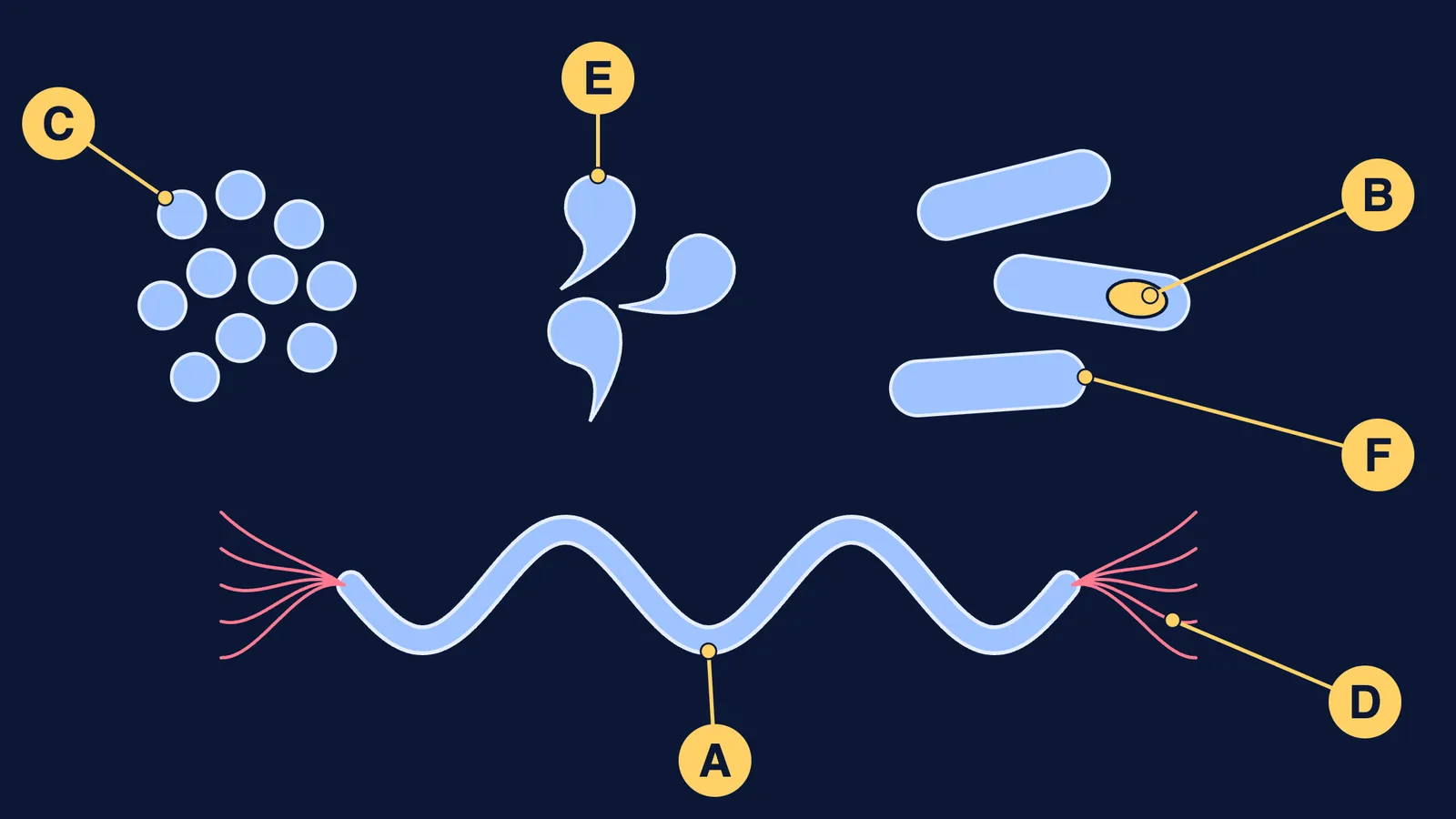
The schematic above tags six bacterial forms with letters, not names. The first six questions ask about them; the other eight describe the chapter's remaining figures in words.
Which NEET unit tests the five kingdoms?
The NEET (UG) 2026 syllabus notice places Whittaker's five kingdoms, the groups within Monera, Protista and Fungi, plus lichens, viruses and viroids, under Unit 1 of Biology, Diversity in Living World.
We drew each reason from NCERT Class 11 Biology, Chapter 2 (Reprint 2026-27) and used only its six figures, 2.1 to 2.6. We wrote all 14 questions ourselves; none predicts the paper. For a chapter summary first, see our Class 11 comparison of the five kingdoms.
How do you read a figure of whole microbes?
This chapter draws whole organisms, so the outline is your first clue.
Judge the silhouette: ball, rod, comma or coil for bacteria; plates, slipper or blob for protists; threads or an umbrella for fungi.
Ask whether the label points at the whole cell, something inside it, or something sticking out.
Name the kingdom, then test each option against it.
Codes for every statement pair: (1) I stands, II falls (2) II stands, I falls (3) both stand (4) both fall.
Q1 to Q6: what are bacteria A to F?
Name every letter first; in the pairing item, lock your surest letter and strike codes that disagree.
Q1. Which letter marks a bacillus? (1) C (2) E (3) F (4) A
Answer: (3). F is a plain rod; NCERT calls rod-shaped bacteria bacilli.
Q2. Pair each letter with a shape: (i) A (ii) C (iii) E (iv) F. Shapes: (p) spherical (q) comma-shaped (r) spiral (s) rod-shaped. (1) i-s, ii-p, iii-r, iv-q (2) i-q, ii-p, iii-r, iv-s (3) i-p, ii-r, iii-q, iv-s (4) i-r, ii-p, iii-q, iv-s
Answer: (4). Spiral, spherical, comma and rod: spirillum, coccus, vibrio, bacillus.
Q3. The oval body B forms inside some bacteria when: (1) conditions turn unfavourable (2) the cell is splitting by fission (3) DNA is passing to another bacterium (4) light is plentiful
Answer: (1). NCERT says bacteria sometimes produce spores under unfavourable conditions.
Q4. Statement I: A thread like D is present in eubacteria that are motile. Statement II: The walls of the cells drawn here are made of cellulose.
Answer: (1). Motile eubacteria have a flagellum; Table 2.1 gives Monera a noncellulosic wall.
Q5. Every cell in the schematic lacks: (1) a cell membrane (2) DNA (3) a nuclear membrane (4) cytoplasm
Answer: (3). Table 2.1 marks the nuclear membrane absent in prokaryotic Monera.
Q6. Statement I: NCERT names the form at E "Spirillum". Statement II: Bacteria are the only members of Kingdom Monera.
Answer: (2). E is the comma-shaped Vibrium (plural vibrio); A is the spiral Spirillum.
Answer key for the lettered diagram: bacteria A to F
A: spirillum (spiral bacterium)
B: spore
C: coccus (spherical bacterium)
D: flagellum
E: vibrio (comma-shaped bacterium)
F: bacillus (rod-shaped bacterium)
Can you answer protist, fungus and virus figures from words alone?
Sketch the stem, then name the organism before reading options.
Q7. A drawing shows a beaded, coiled filament of a blue-green alga. The layer wrapping the whole filament is labelled: (1) pellicle (2) silica shell (3) capsid (4) mucilaginous sheath
Answer: (4). Figure 2.2 of *Nostoc* labels this layer the mucilaginous sheath.
Q8. A bacterium pinching into two is labelled cell wall, cell membrane and DNA. Statement I: It shows fission, the main way bacteria reproduce. Statement II: The DNA label points to a nucleus enclosed by a membrane.
Answer: (1). Fission is the main route; prokaryotes have no nuclear membrane.
Q9. Pair each protist drawing with a feature. Drawings: (i) a cell armoured with wall plates (ii) a spindle-shaped green cell with a long flagellum (iii) an irregular spreading mass (iv) a slipper-shaped cell fringed with cilia. Features: (p) pigments identical to those of higher plants (q) fruiting bodies whose spores travel on air currents (r) rows of cilia steer food-laden water into a gullet (s) mostly marine, with red forms causing red tides. (1) i-s, ii-q, iii-p, iv-r (2) i-s, ii-p, iii-q, iv-r (3) i-r, ii-p, iii-q, iv-s (4) i-p, ii-s, iii-q, iv-r
Answer: (2). Figure 2.4 shows a dinoflagellate, *Euglena*, a slime mould and *Paramoecium*.
Q10. Figure 2.5 shows (a) a cottony mould, (b) a stalk ending in a head of spore chains and (c) an umbrella-shaped fruiting body. Which genus shares a class with (b)? (1) *Rhizopus* (2) *Ustilago* (3) *Neurospora* (4) *Trichoderma*
Answer: (3). (b) is *Aspergillus*, an ascomycete, as is *Neurospora*.
Q11. About fungus (c). Statement I: It spreads mainly by asexual conidia. Statement II: Its class commonly reproduces vegetatively by fragmentation.
Answer: (2). (c) is *Agaricus*, a basidiomycete; asexual spores are generally absent, and fragmentation is common.
Q12. Fungus (a) belongs to a class found in water and on damp decaying wood, and also as: (1) obligate parasites on plants (2) coprophilous sac fungi on dung (3) gilled mushrooms on soil (4) the only fungal partner of lichens
Answer: (1). (a) is *Mucor*, a phycomycete; NCERT adds obligate parasites on plants to its habitats.
Q13. A virus is drawn as a rod: a helical strand inside, wrapped by many small identical units. Statement I: The strand is RNA, the genetic material plant viruses generally carry. Statement II: The small coat units are stacked in a helical form, one of the two arrangements NCERT gives for them.
Answer: (3). This is TMV (Figure 2.6a); capsomeres sit in helical or polyhedral forms.
Q14. Which label appears on NCERT's bacteriophage drawing but not on its TMV drawing? (1) capsid (2) RNA (3) protein coat (4) collar
Answer: (4). Collar appears only on Figure 2.6b; Figure 2.6a labels RNA and capsid.
Which wrong answers should send you back to NCERT?
Q1, Q2 or Q6: redraw the four bacterial shapes from memory, plurals beside them.
Q3 to Q5, Q7 or Q8: reread sections 2.1 and 2.1.2 with Table 2.1 open.
Q9 to Q12: write one line per protist group and fungal class.
Q13 or Q14: compare the labels of Figures 2.6a and 2.6b.
Next, try the same format on lettered cell figures from Chapter 8.
Which kingdom's figures still feel shaky to you? Fermi's AI tutor works out what you already know and builds a plan for the session.