

On this page
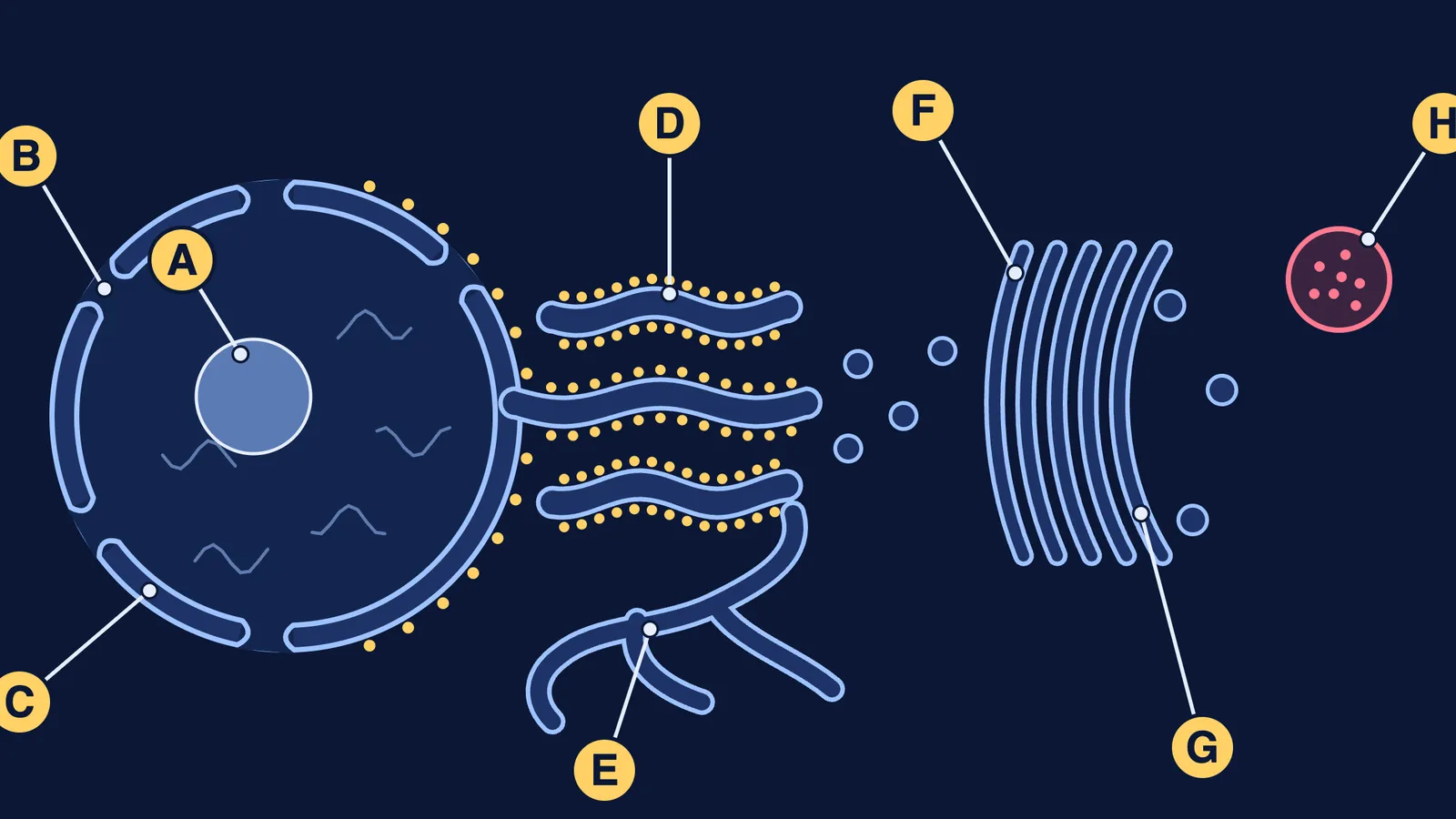
The NEET (UG) 2026 syllabus places this chapter in Unit 3 of Biology, Cell Structure and Function. All 13 questions below are original and rest on facts from NCERT Class 11 Biology, Chapter 8, 2026-27 reprint. None is copied from an earlier exam or offered as a forecast. Q1 to Q6 rely on the letters in our schematic, while Q7 to Q13 put other chapter figures into words.
How should you tackle a lettered cell diagram?
Begin with the part whose shape nothing else shares, then let its neighbours follow. Next, read the verb: "made in", "passes through" and "released from" usually point to three different parts.
Can you name parts A to H on the cell schematic?
In the match item, fix your surest letter and strike every code that disagrees. In statement pairs, judge each line alone first.
Q1. Which lettered part makes the lipid-like steroidal hormones of animal cells? (a) D (b) E (c) H (d) A
Q2. Match the letters in List-I with List-II. List-I: P. A Q. B R. D S. H List-II: (i) Hydrolases active at acidic pH (ii) Site of active ribosomal RNA synthesis (iii) Passage for RNA and proteins in both directions (iv) Plentiful in cells that make and secrete protein (a) P-ii, Q-iii, R-iv, S-i (b) P-iii, Q-ii, R-iv, S-i (c) P-ii, Q-iv, R-iii, S-i (d) P-i, Q-iii, R-iv, S-ii
Q3. Statement I: The membrane on the cytoplasm side of C usually runs on into D and carries ribosomes. Statement II: Through B, RNA can leave the nucleus, but proteins cannot enter it. (a) Both I and II are true (b) I is true, II is false (c) I is false, II is true (d) Both are false
Q4. Statement I: Face F is convex and is the forming face of the stack. Statement II: Proteins made on D are modified in the stack and then leave it through face F. (a) Both I and II are true (b) I is true, II is false (c) I is false, II is true (d) Both are false
Q5. Which set contains only lettered parts that NCERT groups in the endomembrane system? (a) D, E, G and H (b) A, B and C (c) A, D and H (d) B, C and G
Q6. Which lettered part is larger and more numerous in cells actively making proteins? (a) H (b) E (c) A (d) C
Answer key for the lettered diagram
A: nucleolus. B: nuclear pore. C: perinuclear space. D: rough endoplasmic reticulum. E: smooth endoplasmic reticulum. F: cis (forming) face of the Golgi apparatus. G: trans (maturing) face. H: lysosome.
Q1: (b). Lipid synthesis, steroidal hormones included, happens mainly in the smooth ER.
Q2: (a). Each pairing follows NCERT sections 8.5.3 and 8.5.10.
Q3: (b). The outer nuclear membrane joins the ER and bears ribosomes; pores pass RNA and protein both ways.
Q4: (b). The convex cis face forms; modified proteins are released from the concave trans face, G.
Q5: (a). NCERT lists the ER, Golgi complex, lysosomes and vacuoles; no nuclear part.
Q6: (c). Protein-making cells have larger, more numerous nucleoli.
Which other Chapter 8 figures can be asked in words?
Picture the figure before reading the options. One wrong word makes a whole statement false.
Q7. Which group is labelled in NCERT's plant cell drawing but not in its animal cell? (a) Cell wall, middle lamella, plasmodesmata and chloroplast (b) Golgi apparatus, ribosomes and lysosome (c) Centriole and microvilli (d) Nucleolus and nuclear envelope
Q8. Fluid mosaic model. Statement I: Phospholipids form a bilayer, polar heads facing outward and hydrophobic tails inward. Statement II: The quasi-fluid lipid lets proteins drift sideways in the bilayer; this is measured as fluidity. (a) Both I and II are true (b) I is true, II is false (c) I is false, II is true (d) Both are false
Q9. Match parts of a mitochondrion (lengthwise section) with List-II. List-I: P. Outer membrane Q. Crista R. Matrix S. Space between the two membranes List-II: (i) Contains 70S ribosomes and one circular DNA molecule (ii) The outer compartment (iii) The continuous limiting boundary (iv) An infolding that raises surface area (a) P-iii, Q-i, R-iv, S-ii (b) P-ii, Q-iv, R-i, S-iii (c) P-iii, Q-iv, R-i, S-ii (d) P-iv, Q-iii, R-ii, S-i
Q10. In a sectional view of a chloroplast, flat membranous tubules link the thylakoids of different grana. They are: (a) stroma lamellae (b) cristae (c) cisternae (d) plasmodesmata
Q11. In the drawing of a cilium in cross-section, what joins neighbouring peripheral doublets to each other, and what joins the central sheath to each doublet? (a) Linkers; radial spokes (b) Radial spokes; linkers (c) Central sheath; linkers (d) Basal body; radial spokes
Q12. In the figure of chromosome types, one has its centromere close to a tip, leaving a tiny arm beside a long one. It is: (a) metacentric (b) sub-metacentric (c) acrocentric (d) telocentric
Q13. A chromosome figure shows a disc-shaped structure on each side of the centromere. These discs are: (a) satellites (b) kinetochores (c) nucleoli (d) centrioles
Answers and reasons for Q7 to Q13
Q7: (a). Cell walls and plastids mark plant cells; the organelles in (b) appear in both drawings.
Q8: (a). Both follow NCERT section 8.5.1.
Q9: (c). The matrix fills the inner compartment; cristae are inner-membrane folds.
Q10: (a). Cristae are mitochondrial; cisternae belong to the ER and Golgi.
Q11: (a). Linkers connect the doublets; one radial spoke runs from the sheath to each doublet, nine in all.
Q12: (c). Telocentric means a terminal centromere; near the end is acrocentric.
Q13: (b). Kinetochores flank the centromere; a satellite comes from a secondary constriction.
How should you review this set?
Tag each miss: wrong part (misnamed structure) or wrong job (right structure, wrong function).
Redraw the schematic with names instead of letters; check it against NCERT sections 8.5.3 and 8.5.10.
For text-only formats, try our Cell: The Unit of Life statement and match-the-list set. To fix the picture in memory, use our routine for drawing NCERT figures from memory.
Which part of this chapter needs your time first? Fermi's AI tutor works out what you already know and builds a plan for the session.


