On this page
A bottle of ferric nitrate or ferric chloride solution in the school lab is yellow to orange-brown. NCERT's Table 4.8 in Class 12 Unit 4, The d- and f-Block Elements, lists the aquated Fe³⁺ ion (3d⁵) as yellow, and salt-analysis tables say the same. Yet the ion that table describes, [Fe(H₂O)₆]³⁺, is very pale violet. The yellow belongs to other iron species that form in the same beaker. This post shows which ones, how much of each there is, and what to write in an exam.
What colour is the Fe³⁺ ion really?
Crystals of iron(III) nitrate nonahydrate contain the [Fe(H₂O)₆]³⁺ ion, and Wikipedia's iron(III) nitrate entry describes them as colourless to pale violet. The table in its metal aquo complex article lists [Fe(H₂O)₆]³⁺ itself as pale violet. Chemguide's page on the acidity of hexaaqua ions calls it "a very pale lilac colour" and adds that it is easiest to see in solids.
Dissolve those pale crystals in water and the solution turns yellow. Add concentrated nitric acid and, as Chemguide explains, the extra H⁺ pushes the equilibrium back so you can see the colour of the hexaaqua ion again. A colour that comes and goes with acid cannot belong to Fe³⁺(aq) alone. Something else in the solution is doing the absorbing.
Why is high-spin d⁵ Fe³⁺ almost colourless?
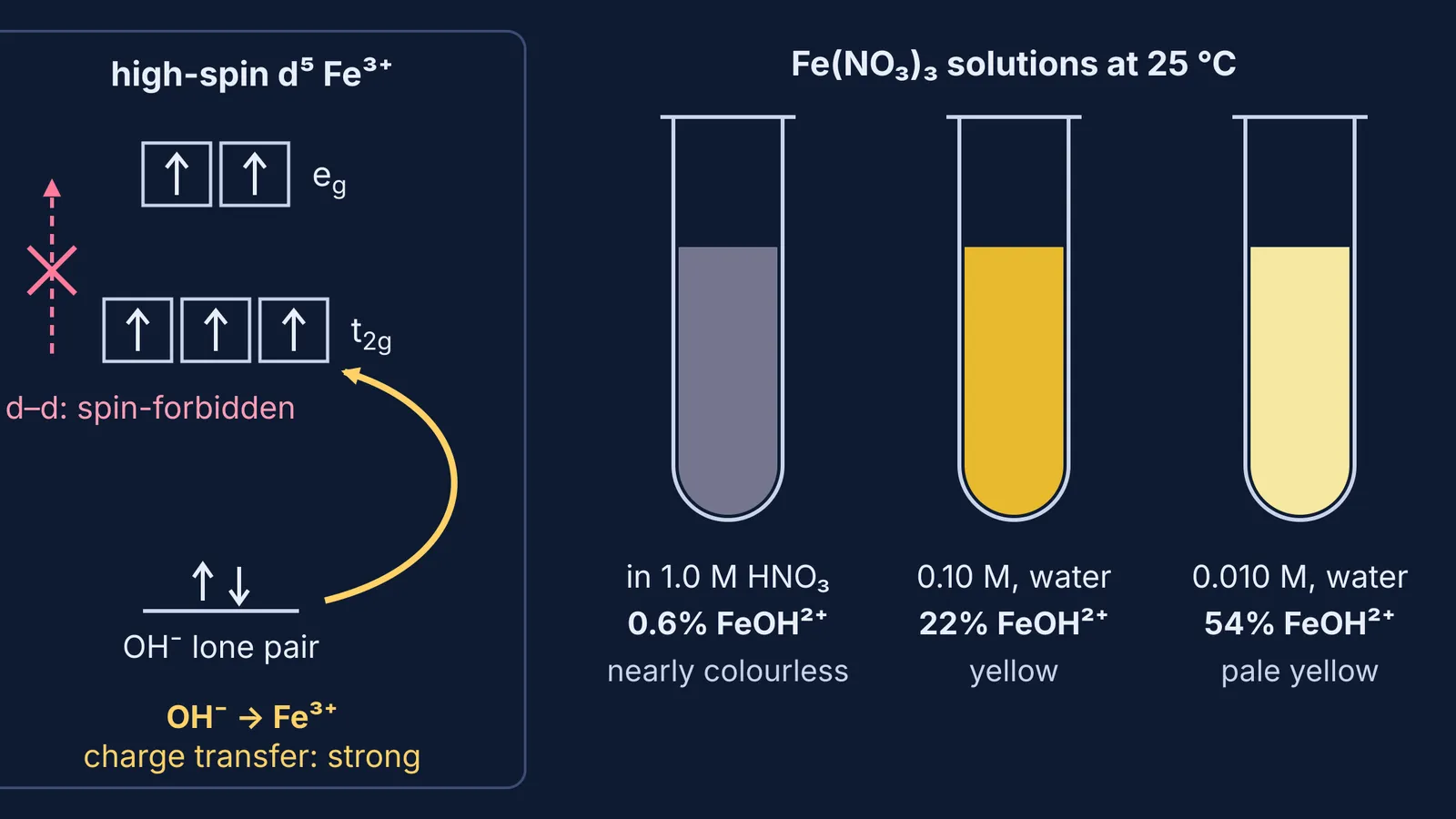
Fe³⁺ is [Ar] 3d⁵. Water is a weak-field ligand, so [Fe(H₂O)₆]³⁺ is high spin: one electron in each of the three t₂g and two e_g orbitals, all five spins parallel. For any d–d jump, the electron has to enter an orbital that already holds an electron of the same spin, so it must flip its spin. Every d–d transition is therefore spin-forbidden. In an octahedral ion with a centre of symmetry they are also Laporte-forbidden. The absorption is extremely weak.
This is the same argument that explains Mn²⁺, the other common high-spin d⁵ ion. We worked it through with molar absorptivity numbers in why Mn²⁺ salts are so pale pink. Fe³⁺ is the other half of that story: same electron count, same rule, same near-absence of colour. NCERT's section 4.3.10 explains the colours in Table 4.8 by d–d excitation, and for a high-spin d⁵ ion that mechanism cannot give a strong yellow.
Where does the yellow in ferric solutions come from?
It comes from hydrolysis. The small, highly charged Fe³⁺ pulls electron density out of its water ligands, and one of them gives up a proton:
[Fe(H₂O)₆]³⁺ + H₂O ⇌ [Fe(H₂O)₅(OH)]²⁺ + H₃O⁺
Check it: 1 Fe, 7 O and 14 H on each side, and a total charge of +3 on each side. Written short, it is Fe³⁺ + H₂O ⇌ FeOH²⁺ + H⁺. Why this makes the solution acidic is covered in why aluminium and ferric chloride solutions are acidic. Here the point is colour.
OH⁻ is a far better electron donor than H₂O. Light can move an electron from the OH⁻ ligand onto Fe³⁺. This is ligand-to-metal charge transfer (LMCT), and it is not blocked by the spin and Laporte rules, so it absorbs strongly. Stefánsson and Seward (Chemical Geology, 2008) measured these strong charge-transfer bands of iron(III) hydroxo complexes below 400 nm. The bands peak in the ultraviolet, and the long-wavelength edge reaches the violet and blue end of the visible. Take away some violet and blue, and what is left looks yellow. It is the same kind of transition that makes MnO₄⁻ purple, as explained in why KMnO₄ is purple when manganese has no d electrons.
Two more species add to the colour in real solutions:
In more concentrated solutions, iron also forms the dimer [Fe₂(OH)₂]⁴⁺ (2Fe³⁺ + 2H₂O ⇌ Fe₂(OH)₂⁴⁺ + 2H⁺), another species with Fe–OH bonds.
In FeCl₃ solution, chloride ions bind to iron as well, giving chloro complexes such as FeCl²⁺. So the FeCl₃ bottle is a different case, and the acid test below uses a nitrate, not a chloride.
How much Fe³⁺ is hydrolysed? A worked example
For Fe³⁺ + H₂O ⇌ FeOH²⁺ + H⁺ at 25 °C, log K = −2.19 (Baes and Mesmer, The Hydrolysis of Cations, 1976, as listed in the COST hydrolysis-constant compilation for iron; Brown and Ekberg, 2016, give −2.20 ± 0.02, and Stefánsson and Seward give −2.18 ± 0.01). So Ka = 10⁻²·¹⁹ = 6.5 × 10⁻³.
(a) 0.10 M Fe(NO₃)₃ in water. Let x = [FeOH²⁺] = [H⁺].
Ka = x²/(0.10 − x) = 6.5 × 10⁻³.
Ka/C = 0.065, too large for the shortcut x = √(KaC). Solve x² + 6.5 × 10⁻³ x − 6.5 × 10⁻⁴ = 0.
x = 0.022 M, so pH ≈ 1.65 and about 22% of the iron is FeOH²⁺. The solution is yellow.
(b) The same solution made 1.0 M in HNO₃. Now the acid fixes [H⁺] ≈ 1.0 M.
From Ka, [FeOH²⁺]/[Fe³⁺] = Ka/[H⁺].
Fraction hydrolysed = Ka/(Ka + [H⁺]) = 6.5 × 10⁻³/1.0065 = 0.0064, about 0.6%.
Over 99% of the iron is [Fe(H₂O)₆]³⁺, and the solution is nearly colourless. At [H⁺] = 0.10 M the fraction is about 6%. Acid removes the colour; adding base brings it back.
(c) 0.010 M Fe(NO₃)₃ in water.
x²/(0.010 − x) = 6.5 × 10⁻³ gives x = 5.4 × 10⁻³ M.
About 54% of the iron is hydrolysed, and pH ≈ 2.27.
Dilution raises the hydrolysed fraction, just as dilution raises the degree of dissociation of a weak acid. But there is less iron overall, so the solution is paler: Chemguide notes that dilute iron(III) solutions can be pale yellow and concentrated ones much more orange. Without added acid, hydrolysis keeps going towards insoluble hydrated iron(III) oxide, which is why ferric solutions are made up in dilute acid.
Treat these numbers as "about". The constants are for infinite dilution, and the real value shifts at the ionic strength of a 0.1 M salt. Including the dimer (log K = −2.95 in the same compilation) changes part (a) to roughly 29% hydrolysed and pH ≈ 1.5. The conclusion does not change: the yellow tracks the hydrolysed iron, not Fe³⁺(aq).
What should you write in the exam?
There are two different questions, and they need different answers.
"Colour of aquated Fe³⁺" (table or matching question): write yellow. That is NCERT's Table 4.8 answer.
"Fe³⁺ is d⁵, so why are its solutions coloured?" or "Why does Fe(NO₃)₃ solution turn colourless in HNO₃?": write that [Fe(H₂O)₆]³⁺ is high-spin d⁵, its d–d transitions are spin-forbidden, so the hexaaqua ion is very pale. The yellow comes from hydrolysed species such as [Fe(H₂O)₅(OH)]²⁺ (and chloro complexes in chloride solutions), which absorb by ligand-to-metal charge transfer. Excess H⁺ shifts the hydrolysis equilibrium back and the colour fades.
If crystal field splitting and selection rules still feel shaky, the Concept Library gives each chemistry concept its own lesson and shows where it sits in the map. For equilibrium numericals like parts (a) to (c) in your JEE preparation, Fermi's AI tutor for JEE prep works through them with you and checks your understanding as it goes.
Quick checklist
[Fe(H₂O)₆]³⁺ is very pale violet; ferric solutions are yellow because of hydrolysis.
High-spin d⁵: every d–d jump is spin-forbidden, the same rule as Mn²⁺.
FeOH²⁺ absorbs by OH⁻ → Fe³⁺ charge transfer, which is strong.
Ka ≈ 6.5 × 10⁻³ (pKa ≈ 2.19): 0.10 M is about 22% hydrolysed, pH about 1.65.
Acid suppresses the colour; FeCl₃ also has chloro complexes.
In a table question write yellow; in a "why" question write hydrolysis and charge transfer.