On this page
Manganese(II) sulphate crystals are faintly pink, and their solution looks almost like water. NCERT's Class 12 table of aquated ions, in section 4.3.10 of Unit 4, The d- and f-Block Elements, lists Mn²⁺ (3d⁵) as pink and Cu²⁺ (3d⁹) as blue. It does not say why the pink is so faint. The answer is a rule about electron spin.
Why are Mn²⁺ salts almost colourless?
The colour of a transition-metal ion usually comes from a d-d transition. An electron absorbs visible light and jumps from a lower d level to a higher one, and you see the complementary colour of the light that was absorbed, as the NCERT chapter explains.
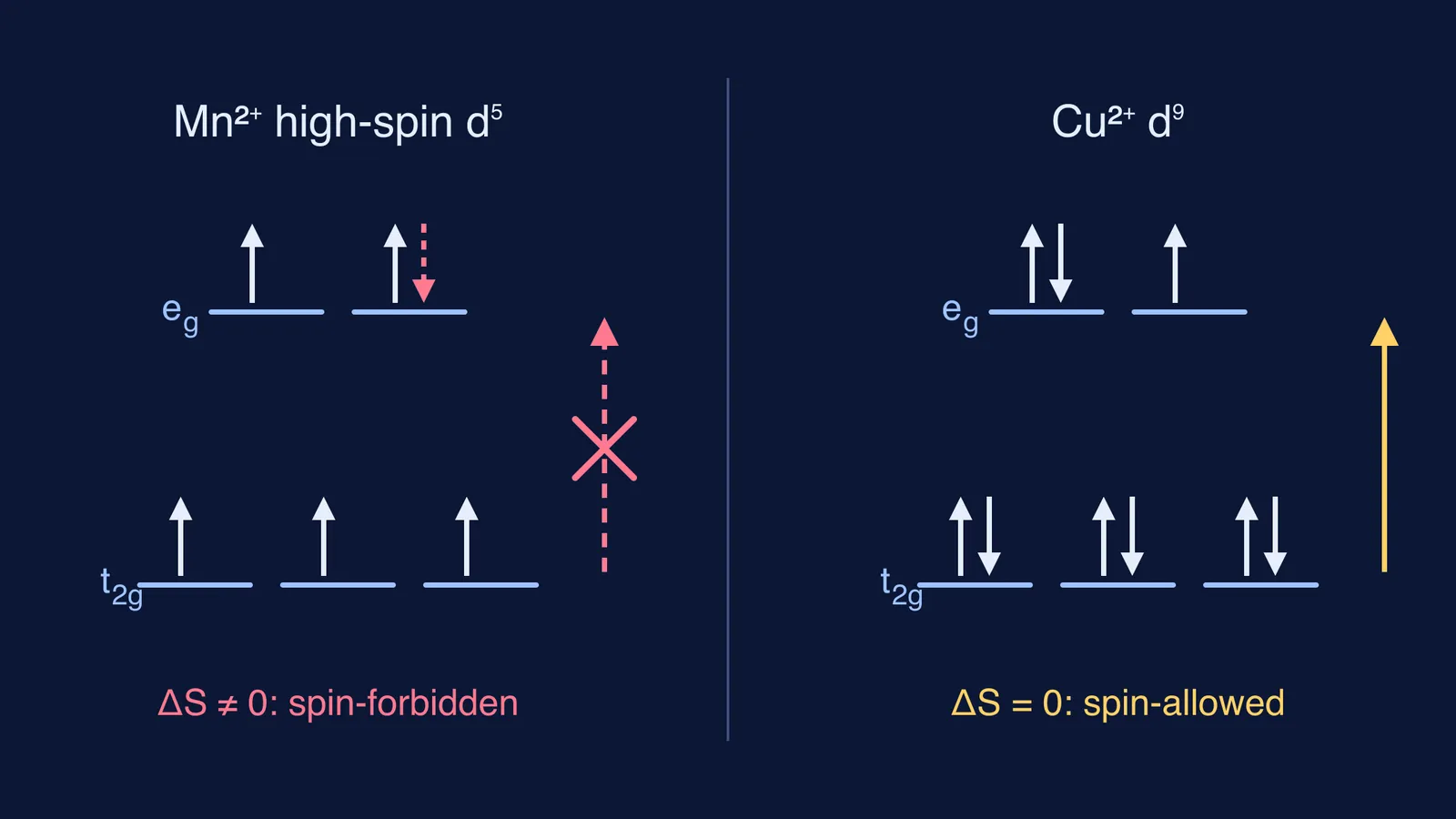
In water, Mn²⁺ is surrounded by six water molecules in an octahedron. Its d orbitals split into three lower t₂g orbitals and two higher e_g orbitals. [Mn(H₂O)₆]²⁺ is a high-spin d⁵ complex (IIT Kanpur CHM102 notes): one electron in each of the five orbitals, all five spins pointing the same way.
Each e_g orbital already holds an electron with that spin, so a promoted t₂g electron can only enter by pairing, which means flipping its spin and changing the ion's total spin. The IIT Kanpur notes call any transition with a change in spin "strongly forbidden". They add that the d-d transition of [Mn(H₂O)₆]²⁺ is also Laporte-forbidden, so it is doubly forbidden and "extremely weak".
What does spin-forbidden actually mean?
Two selection rules matter here:
Spin rule (ΔS = 0): the total spin must not change during the jump.
Laporte rule: in an ion with a centre of symmetry, such as an octahedral complex, a d to d jump is forbidden because both orbitals have the same parity.
Forbidden does not mean impossible. Vibrations briefly destroy the centre of symmetry, so Laporte-forbidden jumps still happen weakly, and the IIT Kanpur notes point out that some rules are "more forbidden than others". Their table of typical molar absorptivities (ε, in dm³ mol⁻¹ cm⁻¹, the same as L mol⁻¹ cm⁻¹) puts numbers on it:
Spin-forbidden d-d bands, with [Mn(H₂O)₆]²⁺ as the example: below 1.
Spin-allowed but Laporte-forbidden d-d bands in centrosymmetric complexes: 1 to 10.
Fully allowed charge-transfer bands: 1,000 to 50,000.
Wikipedia's Laporte rule entry agrees that breaking both rules gives "particularly low extinction coefficients", citing the faintness of even concentrated octahedral Mn(II) solutions.
Why is Cu²⁺ blue when Mn²⁺ is not?
Cu²⁺ is d⁹: six electrons in t₂g and three in e_g, so one e_g place is empty. An electron from t₂g can move into that gap without changing its spin. The jump is still Laporte-forbidden, but it is spin-allowed, so it belongs to the stronger class in the table above. Even so, the IIT Kanpur notes describe [Cu(H₂O)₆]²⁺ as "a rather pale blue" next to the "intense dark blue" of [Cu(NH₃)₄]²⁺.
To see what a small change in ε does, use the Beer-Lambert law A = εcl from the same notes for a 0.1 mol/L solution in a 1 cm tube:
With ε = 0.5 (a spin-forbidden value), A = 0.5 × 0.1 × 1 = 0.05. Since transmitted light is 10⁻ᴬ of the incoming light, about 89% gets through at the absorbed wavelength, so the solution looks nearly clear.
With ε = 10 (the top of the centrosymmetric spin-allowed range), A = 1. Only 10% gets through, and you see a definite colour.
For how the splitting decides which colour you see, read our post on predicting the colours of transition metal complexes.
How does this fit the d⁰ and d¹⁰ colourless rule?
NCERT's table lists Sc³⁺ and Ti⁴⁺ (3d⁰) and Zn²⁺ (3d¹⁰) as colourless (NCERT Unit 4). With no d electron, or no empty d place, there is no d-d transition at all. Mn²⁺ is the middle case: d-d transitions exist, but all are spin-forbidden. The IIT Kanpur notes explain that MnO₄⁻ is d⁰ yet intensely coloured because of charge transfer from oxygen to Mn(VII), not d-d. For the full colourless list, see why Sc³⁺, Ti⁴⁺, Zn²⁺ and Cu⁺ ions are colourless.
Use this three-question check on any ion:
Count the d electrons. If it is d⁰ or d¹⁰, there is no d-d colour; look for charge transfer if it is an oxoanion such as MnO₄⁻.
Ask whether any d-d jump keeps the spin. For high-spin d⁵ such as Mn²⁺, none does, so expect very pale.
Check for a centre of symmetry. Octahedral complexes are Laporte-limited; tetrahedral ones have no centre, and the IIT Kanpur notes say ε for tetrahedral complexes is generally about 100 times that for octahedral ones.
If the splitting picture feels shaky, the Fermi Concept Library has a lesson for every concept in chemistry, so you can revisit crystal field theory first. To practise, the Fermi Problem Library has worked problems with a step-by-step solver that explains the reasoning rather than printing an answer.