On this page
When finding an inverse by elementary operations, pick one lane and stay in it. Write A = IA and use only row operations, or write A = AI and use only column operations. Switch halfway and you can get a matrix that looks like an inverse but is not one. Here is why, with a 2×2 example.
Why does A = IA allow only row operations?
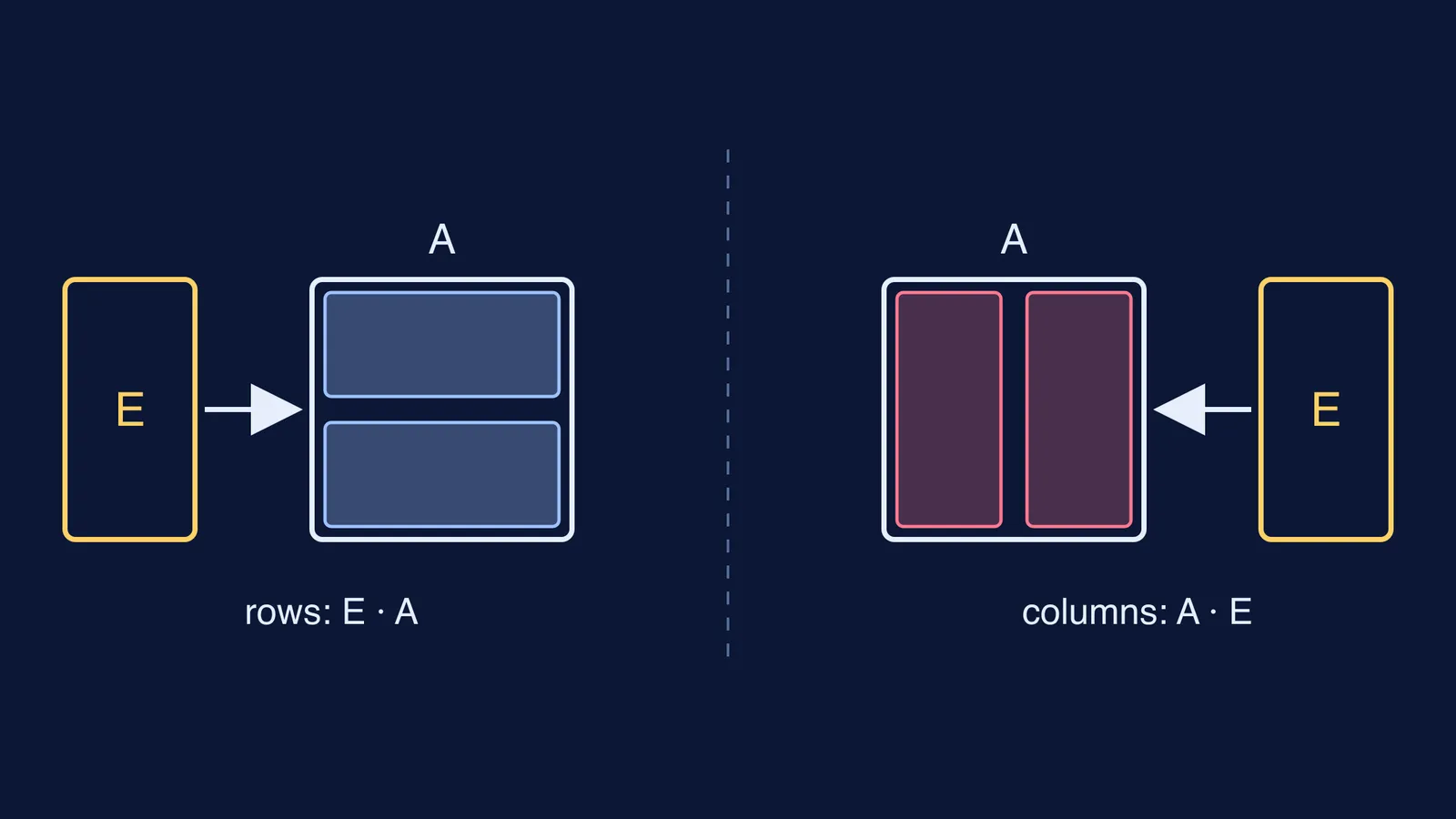
An elementary matrix E is what you get by applying one row operation to the identity matrix, and doing that row operation on any matrix A gives the same result as the product EA (LibreTexts, A First Course in Linear Algebra/02:_Matrices/2.08:_Elementary_Matrices)). Left multiplication by an elementary matrix performs a row operation, and right multiplication performs the matching column operation (Wikipedia: Elementary matrix).
Now look at A = IA. A row operation multiplies both sides by E on the left, giving EA = (EI)A. The left side changes, the I in front changes, and the A at the end of the right side stays untouched. That is why you apply each row operation to the A on the left and to the front matrix on the right. Keep going until the left side is I. You then have I = BA, and B is the inverse.
Why does A = AI allow only column operations?
It is the mirror image. A column operation is carried out by post-multiplying, that is, multiplying on the right by an elementary matrix (Statlect: Elementary column operations). So a column operation turns A = AI into AE = A(IE). This time the A at the front of the right side stays fixed and the I at the end absorbs every step. Finish with I = AB and B is the inverse. A column operation on A = IA would have to act on the trailing A, which must stay exactly as it is.
What goes wrong if you mix them?
Take the matrix A whose rows are (2, 1) and (1, 1). Writing rows separated by semicolons, A = [2 1; 1 1]. Its determinant is 2 × 1 − 1 × 1 = 1, so A has an inverse.
The correct route, rows only:
Start: [2 1; 1 1] = [1 0; 0 1]A.
R1 → R1 − R2: [1 0; 1 1] = [1 −1; 0 1]A.
R2 → R2 − R1: [1 0; 0 1] = [1 −1; −1 2]A.
So the inverse is [1 −1; −1 2]. Check: the first row of the inverse times A gives (2 − 1, 1 − 1) = (1, 0), and the second gives (−2 + 2, −1 + 2) = (0, 1).
Now the tempting shortcut. After step 2 the left side is [1 0; 1 1]. One column operation, C1 → C1 − C2, turns it straight into I. A student applies the same column operation to the front matrix [1 −1; 0 1], which becomes [2 −1; −1 1], writes I = [2 −1; −1 1]A, and boxes it.
Check it: the first row of [2 −1; −1 1] times A is (4 − 1, 2 − 1) = (3, 1), not (1, 0). The answer is wrong, and it is the true inverse with its two diagonal entries swapped, so it looks plausible.
The column operation multiplied the left side by E on the right. To keep the equation true, the right side must also be multiplied by E on the right, and that E lands after the trailing A: I = [1 −1; 0 1]AE. That is no longer of the form I = BA, so you cannot read an inverse off it.
The column-only route works too. From A = AI, C1 → C1 − C2 gives [1 1; 0 1] = A[1 0; −1 1]. Then C2 → C2 − C1 gives I = A[1 −1; −1 2]. Same inverse.
For the determinant side of the topic, see simplifying a determinant with row operations.
How can you check your inverse before you box it?
A quick routine:
Write the starting equation (A = IA or A = AI) at the top and circle R or C.
Label every step R… or C…. If the letter changes, stop.
For rows, change the left side and the front matrix. For columns, change the left side and the back matrix.
Multiply one row of your answer by A. Anything other than a 1 and 0s means a step broke.
For a 2×2, compare with the swap-and-negate shortcut for 2×2 inverses.
For a full rows-only walkthrough on a 3×3 matrix, read our guide to finding a matrix inverse with elementary row operations.
If you keep landing on a nearly right inverse, the Fermi Problem Library has worked problems with a step-by-step solver that explains the reasoning rather than printing an answer, so you can compare its steps with yours. To revise why the order of matrix products matters, the Fermi Concept Library gives each concept in mathematics its own lesson and its place in the map.