On this page
A plant in soil with too much manganese can look as if it is starving. That sounds backwards, but it is a neat cause-and-effect chain from Class 11 plant physiology, and it suits assertion-reason questions that test whether you understand the mechanism or have only memorised symptoms.
What does NCERT say about manganese toxicity?
The passage sits in section 12.2.4, Toxicity of Micronutrients, of the NCERT Class 11 Biology chapter Mineral Nutrition (2021-22 edition). It starts with a general rule: micronutrients are needed in low amounts, a moderate decrease causes deficiency and a moderate increase causes toxicity, so the useful range is narrow.
NCERT defines a toxic level in one line: any mineral ion concentration in tissues that reduces the dry weight of tissues by about 10 per cent is considered toxic (NCERT, Mineral Nutrition, 12.2.4).
It adds that excess of one element may inhibit the uptake of another, and uses manganese as the example.
You can see that change in the contents pages of the current NCERT Class 11 Biology textbook. The idea still appears in older papers and question banks.
Why does excess manganese cause iron, magnesium and calcium deficiency?
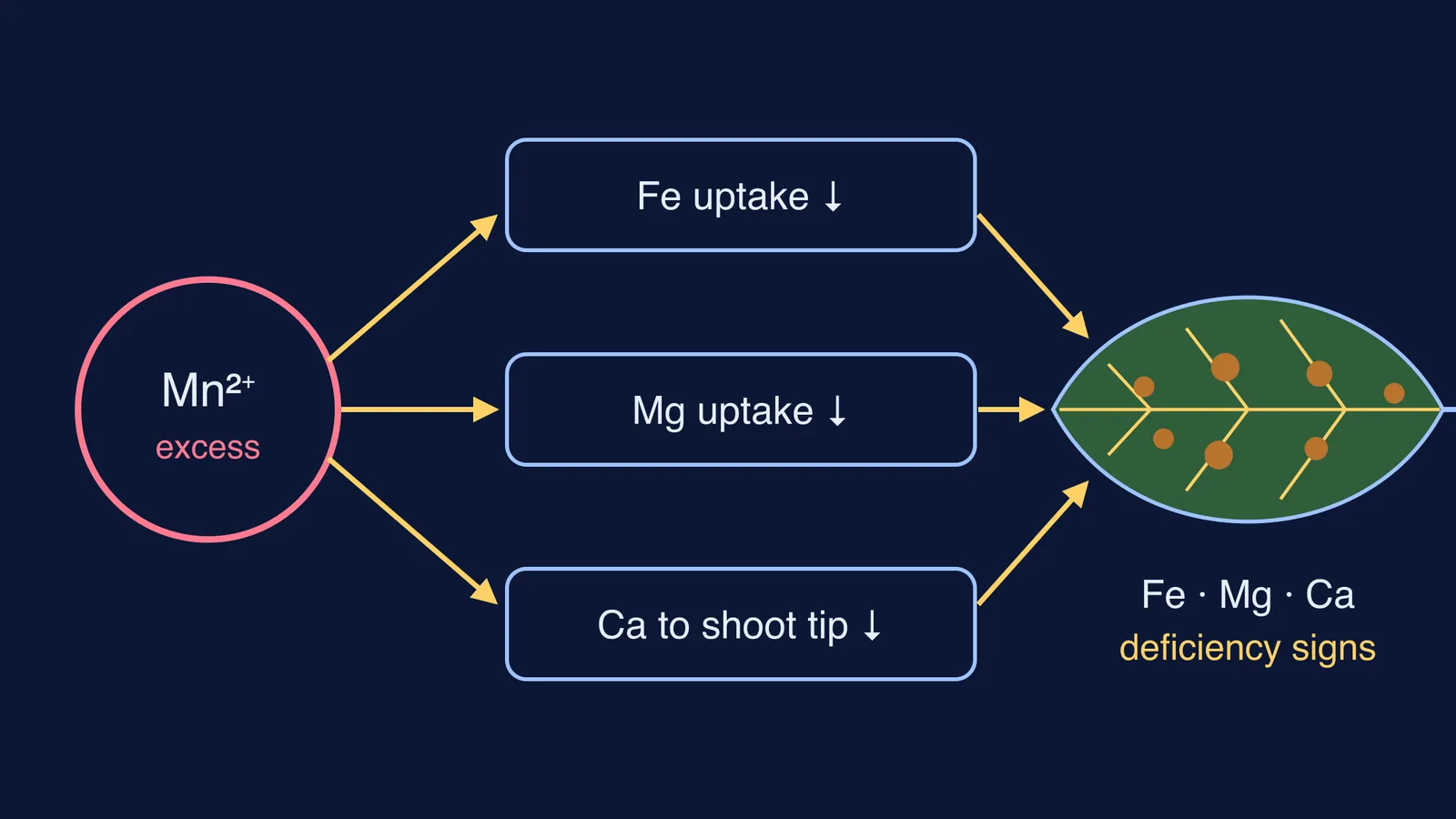
NCERT gives three mechanisms, which between them affect three nutrients. Here is the chain as a cause-and-effect chart, with the NCERT reason for each step (NCERT, Mineral Nutrition, 12.2.4):
Cause: too much manganese (Mn2+) available to the roots.
Effect on iron: manganese competes with iron for uptake, so less iron gets in.
Effect on magnesium: manganese competes with magnesium for uptake and for binding with enzymes, so less magnesium gets in and less of it binds to the enzymes it activates.
Effect on calcium: manganese inhibits calcium translocation in the shoot apex, so the growing tip can run short of calcium.
Result: the plant may show deficiency symptoms of iron, magnesium and calcium, on top of the brown spots surrounded by chlorotic veins that NCERT calls the prominent symptom of manganese toxicity.
NCERT's conclusion is the line examiners like: what appears as symptoms of manganese toxicity may actually be the deficiency symptoms of iron, magnesium and calcium.
Notice that calcium is different: iron and magnesium lose out at uptake, calcium at translocation in the shoot apex. The precise answer names translocation for calcium.
This ties into where symptoms appear. Magnesium is mobile, so its deficiency shows first in older leaves, while calcium is structural and not easily released, so it shows first in young tissue. We cover that rule in why deficiency symptoms show first in older leaves and in mineral deficiency in plants: why old leaves yellow first.
Where does manganese toxicity happen in real soils?
A 2020 review in Frontiers in Plant Science by Alejandro and colleagues, Manganese in Plants: From Acquisition to Subcellular Allocation, says manganese toxicity occurs on poorly drained and acidic soils in which high amounts of manganese are rendered available. It explains that waterlogging, most likely by lowering oxygen in the soil, reduces manganese oxides and raises plant-available Mn2+ in the soil solution up to toxic levels.
The review also notes that excess manganese can prevent the uptake and translocation of other essential elements such as calcium, magnesium, iron and phosphorus. So the NCERT example is consistent with what plant scientists describe.
How do you answer a manganese toxicity question in an exam?
A common form is assertion-reason. Here is a worked example built from the NCERT lines.
Assertion: The prominent symptom of manganese toxicity is brown spots surrounded by chlorotic veins.
Reason: Excess manganese may induce deficiencies of iron, magnesium and calcium.
Both statements are true, because both are NCERT lines. The harder step is deciding whether the reason explains the assertion: the brown spots are the toxicity symptom itself, while the induced deficiencies explain why the plant also shows other symptoms. Answer keys can differ on this, so check the one your question bank uses.
Before you mark an answer, run this quick check:
Did the question say toxicity or deficiency? Excess manganese gives deficiency of other elements, not of manganese.
Did you name the right step for each element: uptake for iron and magnesium, enzyme binding for magnesium, translocation for calcium?
Did you keep the 10 per cent dry-weight definition for toxic concentration separate from critical concentration, which is the level below which growth is retarded?
If the uptake-versus-translocation difference still feels fuzzy, the Fermi Concept Library gives each concept its own lesson and its place in the map. For practice, the Fermi Problem Library has worked problems with a step-by-step solver that explains the reasoning rather than printing an answer.
Redraw the five-step chart from memory once today and once next week; if you can explain step 4 without looking, you have the topic.