
On this page
In 1936, the plant physiologist Mikhail Khristoforovich Chailakhyan gave a name to something botanists suspected but could not hold in a test tube: a flowering signal made in the leaves that travels to the buds. He called it florigen, the "flower-former". It took about 70 years, as a 2007 rice study in Science notes, to pin down what that signal is. Here is how his experiments worked and how to use them in revision.
Who proposed florigen, and what did his experiment show?
Chailakhyan set out the hormonal theory of flowering in three papers in 1936, based on experiments run from 1932 to 1934 near Leningrad and in 1935-1936 in Moscow, according to a 2006 review in the Russian Journal of Plant Physiology by Aksenova, Milyaeva and Romanov. He built on photoperiodism, which Garner and Allard discovered in 1920. He picked plants with strong day-length responses: the same review reports that his short-day species had flowering promoted by a short 10-hour day and sharply delayed in a 16-18 hour day.
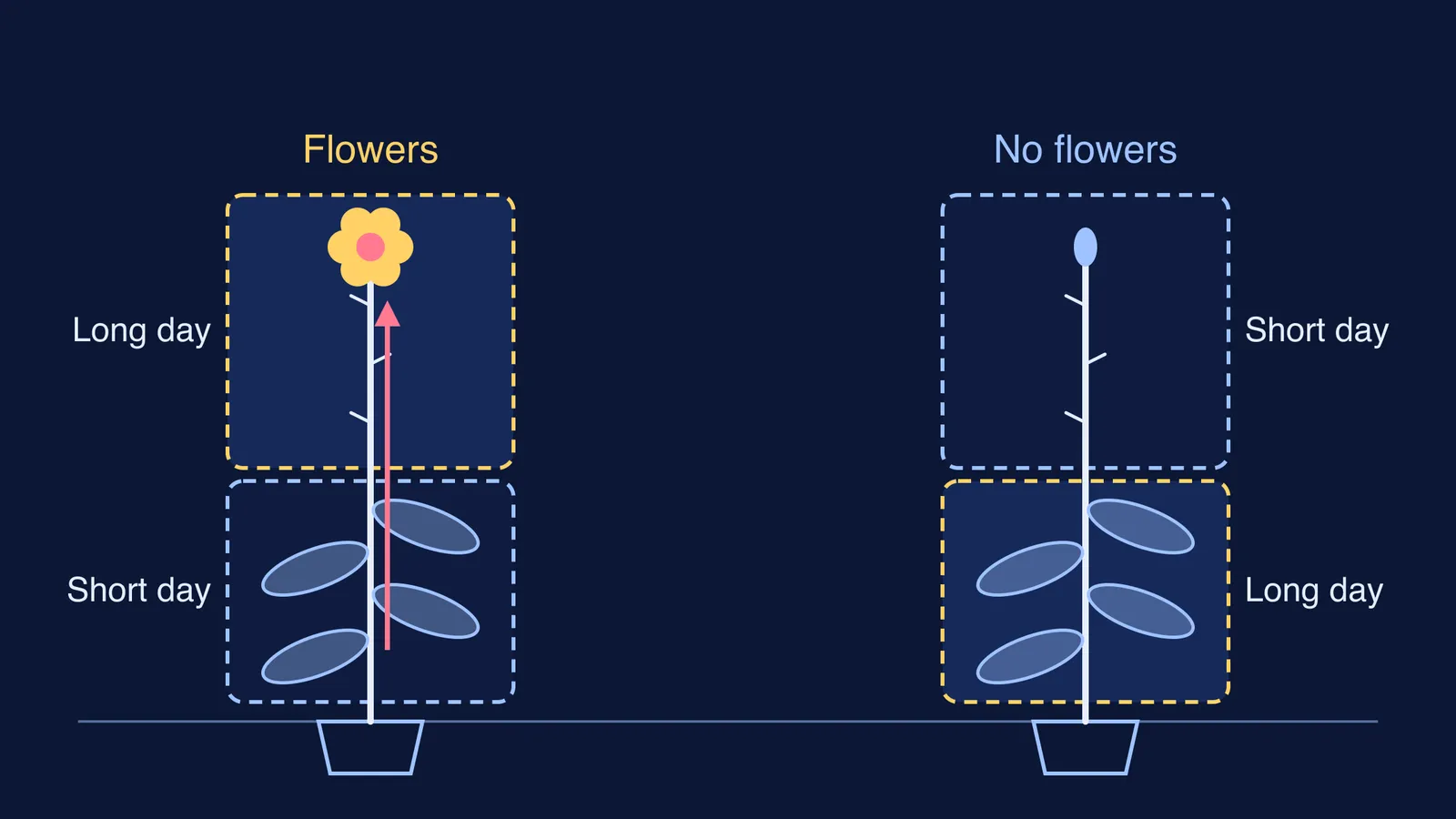
He lit leaf blades and partly defoliated shoots separately, giving parts of one plant different day lengths. The plants flowered only when the leaves got the favourable day length, the review reports. Chailakhyan concluded that "the processes that are evoked by the change in the day length and induce plant flowering take place in leaf tissues", and that their effects then pass to the shoot tips (as translated in that review).
Florigen, as Chailakhyan defined it in 1936, means specific substances with a regulatory function that cause flowers to form, explains a 2006 review by Jan Zeevaart in The Plant Cell. Zeevaart also notes that Knott had reported in 1934 that day length is sensed by leaves while flowers form at the shoot apical meristem. For more on that sensing step, read our explainer on which part of a plant senses day length.
How did grafting show the signal could travel?
The Aksenova review describes what Chailakhyan's lab found:
Girdling the stem, or cutting off induced leaves at different times after light treatment, showed the stimulus moves both up and down the stem, most probably in the phloem.
The stimulus passed through a graft from a flowering partner and made a non-induced partner flower, even under unfavourable day length.
Jerusalem artichoke, a short-day plant, flowered under long days when grafted onto day-neutral sunflower, so the signal was not specific to one species, at least among related plants.
When compared with auxin, florigen behaved differently, so it was not auxin.
What is florigen made of?
For decades nobody could isolate it; Zeevaart describes florigen as long remaining "a physiological concept rather than a chemical entity". The answer came from genes.
In 1999, Kardailsky and colleagues in Science isolated the Arabidopsis gene *FLOWERING LOCUS T* (*FT*), which acts partly downstream of *CONSTANS*, a gene that promotes flowering in long days. In 2005, Abe and colleagues reported that *FT* is expressed in leaf veins, and that FD, a bZIP protein found mainly at the shoot apex, works with FT there to promote flowering by switching on *APETALA1*.
The final step came in 2007. Corbesier and colleagues found that *FT* mRNA is needed only briefly in the leaf, while tagged FT protein made in phloem cells moves to the apex and even between grafted plants; they concluded that FT protein acts as the long-distance flowering signal. In the same issue, Tamaki and colleagues showed that Hd3a, the rice version of FT, moves from leaf to shoot apical meristem and induces flowering, and suggested Hd3a may be the rice florigen.
So Chailakhyan's florigen is now widely identified with FT protein and its relatives: made in the leaf phloem, carried to the shoot apex, and paired there with FD to switch on flowering genes.
How do you write florigen into a NEET-UG answer?
Learn it as one chain, in this order:
Leaves sense day length (Knott, 1934; Chailakhyan, 1936).
In Arabidopsis, *CONSTANS* in the leaf promotes *FT*.
FT protein travels in the phloem to the shoot apex.
At the apex, FT partners with FD.
FT and FD switch on *APETALA1*, and the apex starts making flowers.
Worked example. A short-day plant has its leaves kept on short days while its leafless shoot tip gets long days. A second plant gets the reverse. Which one flowers? Day length is sensed in the leaves, and only the first plant's leaves are induced. So the first plant flowers; the second does not.
Common traps:
Florigen is not auxin.
Hd3a is the rice FT, not a separate hormone.
Sensing happens in leaves; flowering happens at the apex.
The short-day and long-day plants explainer covers the night-length rules that this question type rests on.
If photoperiodism still feels like a list of letters, the Fermi Concept Library gives every concept in biology its own lesson and its place in the map, so you can see how it connects to plant hormones. For practice, the Fermi Problem Library has worked problems with a step-by-step solver that explains the reasoning rather than printing an answer.
That leaf-to-bud arrow began as Chailakhyan's 1936 idea.