On this page
A plant flowers at its shoot tip, so you might guess the tip is where it measures the day. It isn't. Experiments from the 1930s showed that the leaves do the sensing and send a signal up to the tip. That signal was named florigen decades before anyone knew what it was made of.
Which part of a plant perceives photoperiod?
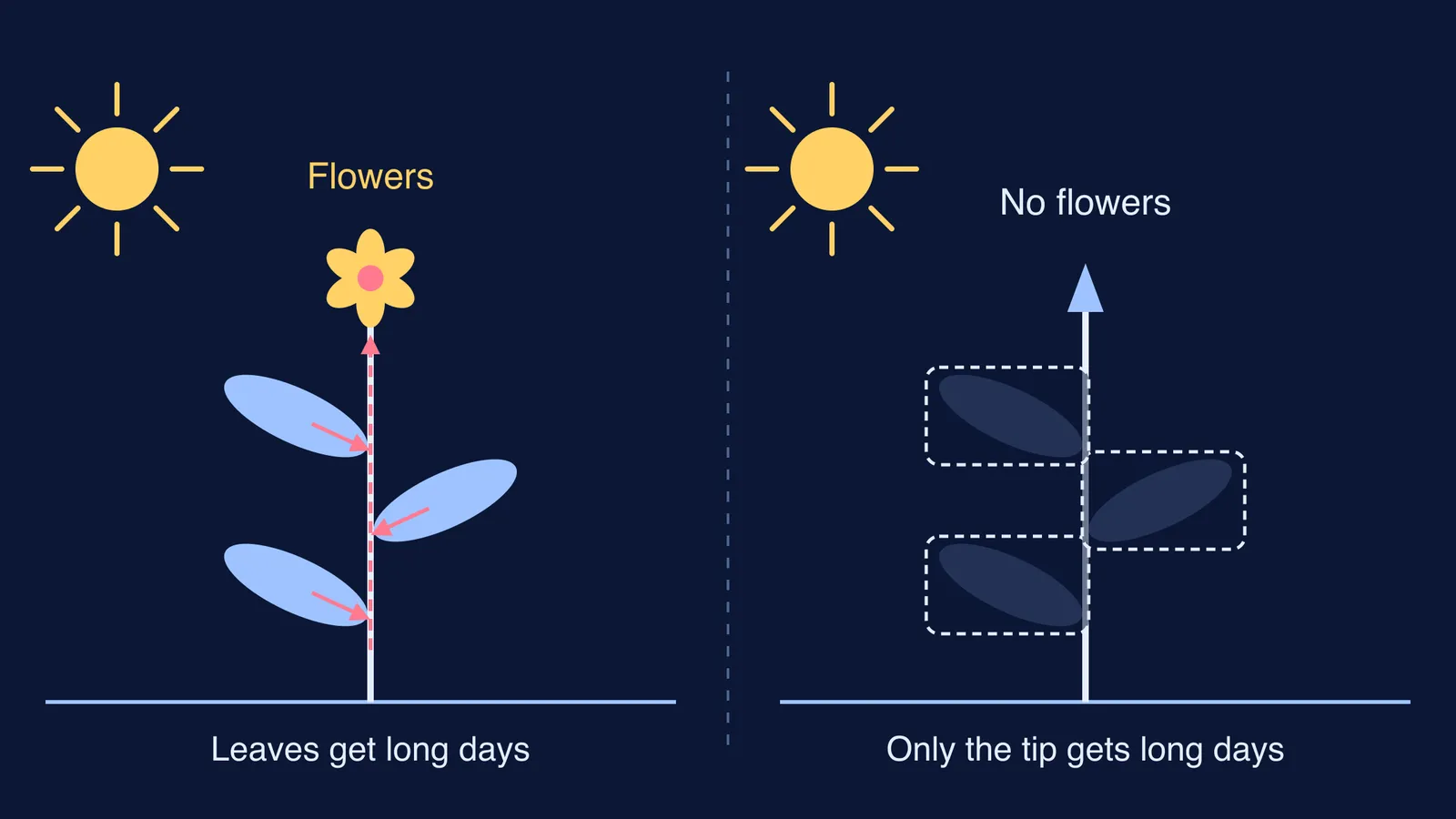
The leaves. A 2021 review in Frontiers in Plant Science says Knott first showed this in 1934, in spinach, a long-day plant. When the leaves were exposed to long days, flower buds formed at the shoot apex. When the shoot apex alone got long days, the plant stayed vegetative.
The clever part is the design. Knott gave long days to one part of the plant at a time, so each setup tested one possible sensor. If the tip were the sensor, treating only the tip should have caused flowering. It did not, while treating the leaves did, so the leaves are the sensor. Our post on why experiments need a control group in biology walks through this kind of comparison.
How did grafting experiments point to florigen?
The leaves sense the day, but the flower appears at the tip, so something must travel between them. According to the same Frontiers review, the botanist Chailakhyan proposed in 1936 that leaves induced by photoperiod make florigen, which moves to the shoot apex and triggers flowering.
Grafting tested this idea. The review describes Zeevaart's experiments with the short-day plants Perilla and Xanthium: a leaf given short days, grafted onto a plant of the same species growing under long days, made the receiving plant flower. The receiving plant itself was kept in long days; only the grafted leaf had been given short days. So the leaf was making something that could travel and act elsewhere.
What is florigen, and was it ever found?
Florigen is the mobile signal that moves from an induced leaf to the shoot apex and causes flowering, as defined by Tamaki and colleagues in Science. For about 70 years nobody could identify it. Two papers published together in Science in May 2007 gave strong evidence that it is a protein.
In Arabidopsis, Corbesier and colleagues found that FT messenger RNA is needed in the leaf only briefly, and that FT fusion proteins made in phloem cells move to the apex and even between grafted plants. They concluded that FT protein acts as a long-distance flowering signal.
In rice, Tamaki and colleagues showed that the protein made by Hd3a, the rice version of FT, moves from the leaf to the shoot apical meristem and induces flowering. They suggested Hd3a protein may be the rice florigen.
Is photoperiodism in the NEET syllabus?
Check before you spend revision time on it. NCERT's list of rationalised content for Class XI, published in May 2022, lists sections 15.5 Photoperiodism and 15.6 Vernalisation as dropped from the Biology chapter "Plant Growth and Development". The NEET (UG)-2026 syllabus, finalised by the National Medical Commission and published by NTA in January 2026, lists that unit as seed germination, phases of growth, conditions of growth, differentiation and growth regulators (auxin, gibberellin, cytokinin, ethylene, ABA). It does not name photoperiodism. Check each new syllabus on the NMC website when it is released.
What that means in practice:
Give lists of short-day and long-day plants low priority for NEET unless a newer official syllabus adds them back.
Older question banks may still carry florigen questions. Mark those as outside the current syllabus, but keep the rest of the chapter.
If your board exam still teaches photoperiodism, learn it for that exam. Our explainers on short-day and long-day plants and vernalisation in winter wheat cover the rest.
Keep the reasoning. A signal made in one organ that acts in another is also how many plant growth regulators work, and experiment-based questions reward the same logic.
How do you answer a "which organ senses it?" question?
Use the leaf-and-tip experiment as a template. Lay out the setups and ask what each result rules out.
Organ A gets the stimulus, organ B does not, and the plant responds: A can sense it.
B gets the stimulus, A does not, and there is no response: B cannot sense it alone.
A treated organ A is grafted onto an untreated plant, and that plant responds: A makes something that travels.
Write one sentence naming the sensor, the responder and the messenger.
Try it on a new case. A short-day plant grows under long days, but one leaf is wrapped each evening so that leaf alone gets short days. The plant flowers. Step 1 says that leaf sensed the short days. Step 4: sensor, the wrapped leaf; responder, the shoot apex; messenger, a signal sent from the leaf.
If the jump from experiment to conclusion is where you get stuck, the Fermi Concept Library gives each biology concept its own lesson and its place in the map. For practice, the Fermi Problem Library has worked problems with a step-by-step solver that explains the reasoning rather than printing an answer.