On this page
A yellow leaf tells you two things if you know where to look: which leaves are affected (old or young) and what the damage looks like (yellow, or dead and brown). Get those two right and most deficiency questions answer themselves.
What do chlorosis and necrosis mean?
Chlorosis is the yellowing of normally green plant tissue because it has less chlorophyll, according to Purdue Extension's illustrated definitions of plant problems. Necrosis is the death of tissue, usually in one area that turns brown or black, in the same Purdue guide.
Purdue also names two patterns worth learning. Marginal chlorosis is yellowing at the edge of the leaf. Interveinal chlorosis is yellowing between the veins while the veins stay green. Where the symptom sits on the plant and which pattern it shows are your two clues.
Why do mobile nutrients show deficiency in old leaves first?
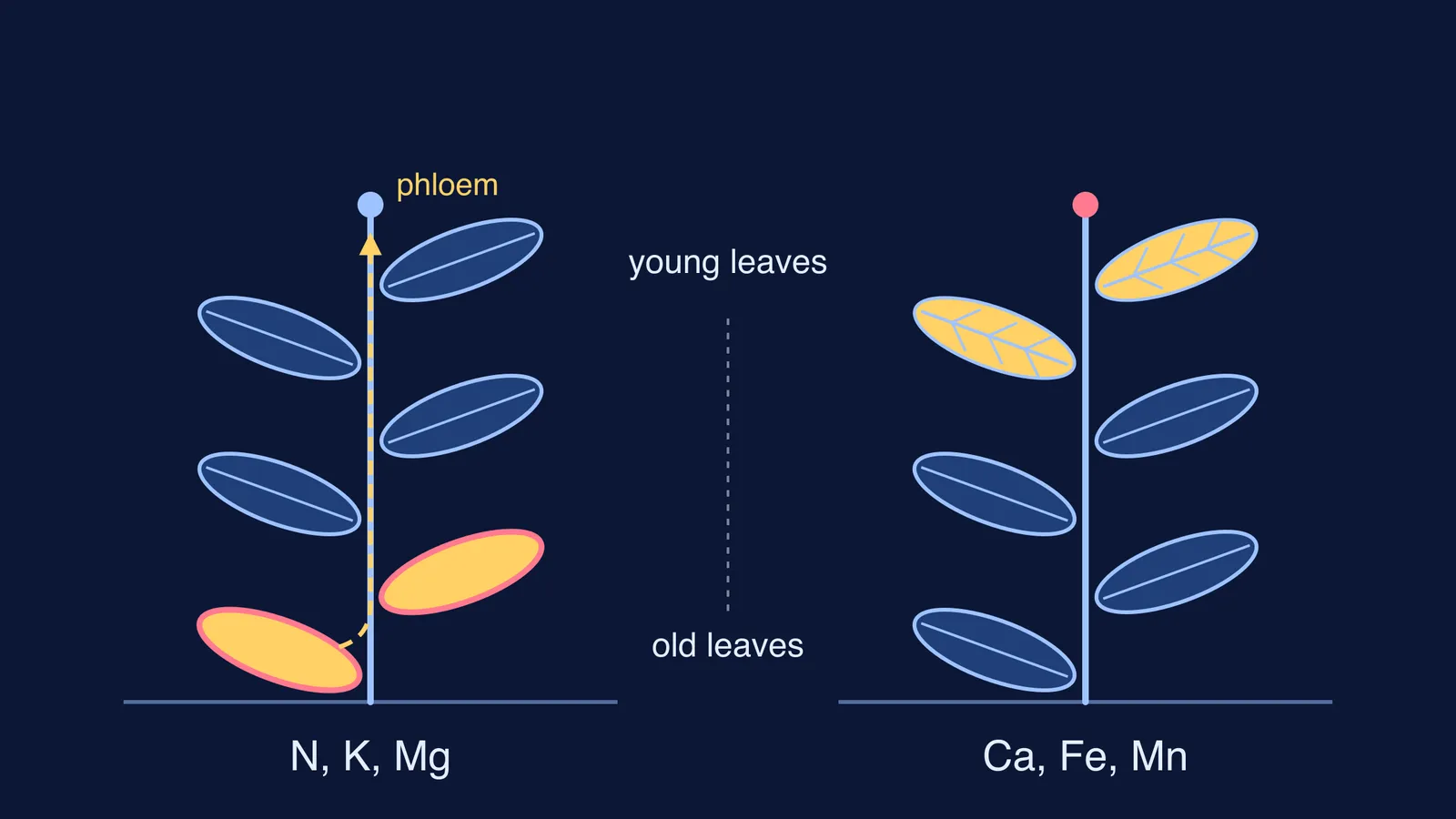
When a plant cannot take up enough of a nutrient, it moves what it already has to where growth is happening. Kansas State University's guide Diagnosing Nutrient Deficiencies in the Field puts it plainly: when uptake is limited, mobile nutrients are moved to the growing parts, leaving the older leaves with the deficiency symptoms. Immobile nutrients cannot be moved this way, so their shortage shows up in the younger leaves.
The route is the phloem. A 2015 study by Anne Maillard and colleagues in Frontiers in Plant Science notes that macronutrients except calcium (nitrogen, phosphorus, sulphur, potassium and magnesium) are highly mobile in the phloem. Among micronutrients, the same paper says, manganese is the exception that does not move well.
The team measured this in field-grown leaves of eight species, five crops and three trees, tracking 13 nutrients as the leaves aged. Wheat and barley moved about 90% of the nitrogen out of their ageing leaves, while calcium was not moved out in any species except those two cereals (Maillard et al., 2015).
One honest wrinkle: that paper counts iron as at least moderately mobile in the phloem. Field guides still treat iron as immobile, and K-State notes iron is not moved from old to young tissue, which is why its symptoms appear on upper leaves first. For your exam answer, put iron with the young-leaf group.
Which symptoms go with N, K, Mg, Fe, Ca and Mn?
This quick-reference list draws on K-State's field guide and the University of Maryland Soil Quality Lab's deficiency page.
Nitrogen (mobile, old leaves): a pale, yellowish-green plant; in maize, a V-shaped yellowing that starts at the tip of the lowest leaves and runs down the midrib.
Potassium (mobile, old leaves): yellowing and necrosis along the leaf margins, starting on the lowest leaves, while new upper leaves may stay green.
Magnesium (mobile, old leaves): interveinal chlorosis on the oldest leaves, giving a herringbone look; in severe cases, dead edges that can be confused with potassium shortage.
Iron (immobile, young leaves): the area between the veins of upper leaves turns pale green to nearly white; favoured by high-pH, calcareous soils.
Calcium (immobile, growing points): new leaves stick together and fail to unfold; in fruit, rot at the blossom end.
Manganese (immobile, young leaves): interveinal chlorosis on younger leaves.
How do you work out the deficiency from a picture?
Ask three questions in order.
Where is it? Old, lower leaves point to a mobile element; young, upper leaves or growing tips point to an immobile one.
What pattern? Uniform yellowing, yellowing between green veins, burnt edges, or tips that fail to open.
Which element in that group matches the pattern?
Worked example 1. A maize plant has yellow stripes between green veins on its lowest leaves. The top leaves are fine. Step 1: old leaves, so N, K or Mg. Step 2: the yellowing is between the veins, not a V down the midrib (nitrogen) or along the edges (potassium). Answer: magnesium.
Worked example 2. A soybean seedling on alkaline soil has young leaves yellow between the veins, with veins still green. Step 1: young leaves, so an immobile element. Step 2: interveinal chlorosis fits both iron and manganese, but K-State links iron shortage to high-pH, calcareous soils. Best answer: iron.
Montana State University Extension lists compaction, poor drainage, drought, herbicides and diseases among the other causes of yellowing. K-State advises confirming a diagnosis with soil testing and tissue analysis.
If the idea of phloem transport is still fuzzy, the Fermi Concept Library covers every concept in biology, chemistry, physics, mathematics and computing, each with its own lesson. For practice, the Fermi Problem Library has worked problems with a step-by-step solver that explains the reasoning rather than printing an answer.
Next time you see a yellow leaf, on a houseplant or in a past paper, look at its position first.