

On this page
A plant's bottom leaves turn pale yellow while the top stays healthy. That pattern is a strong clue to what the plant is missing.
Why do deficiency symptoms appear first in older leaves?
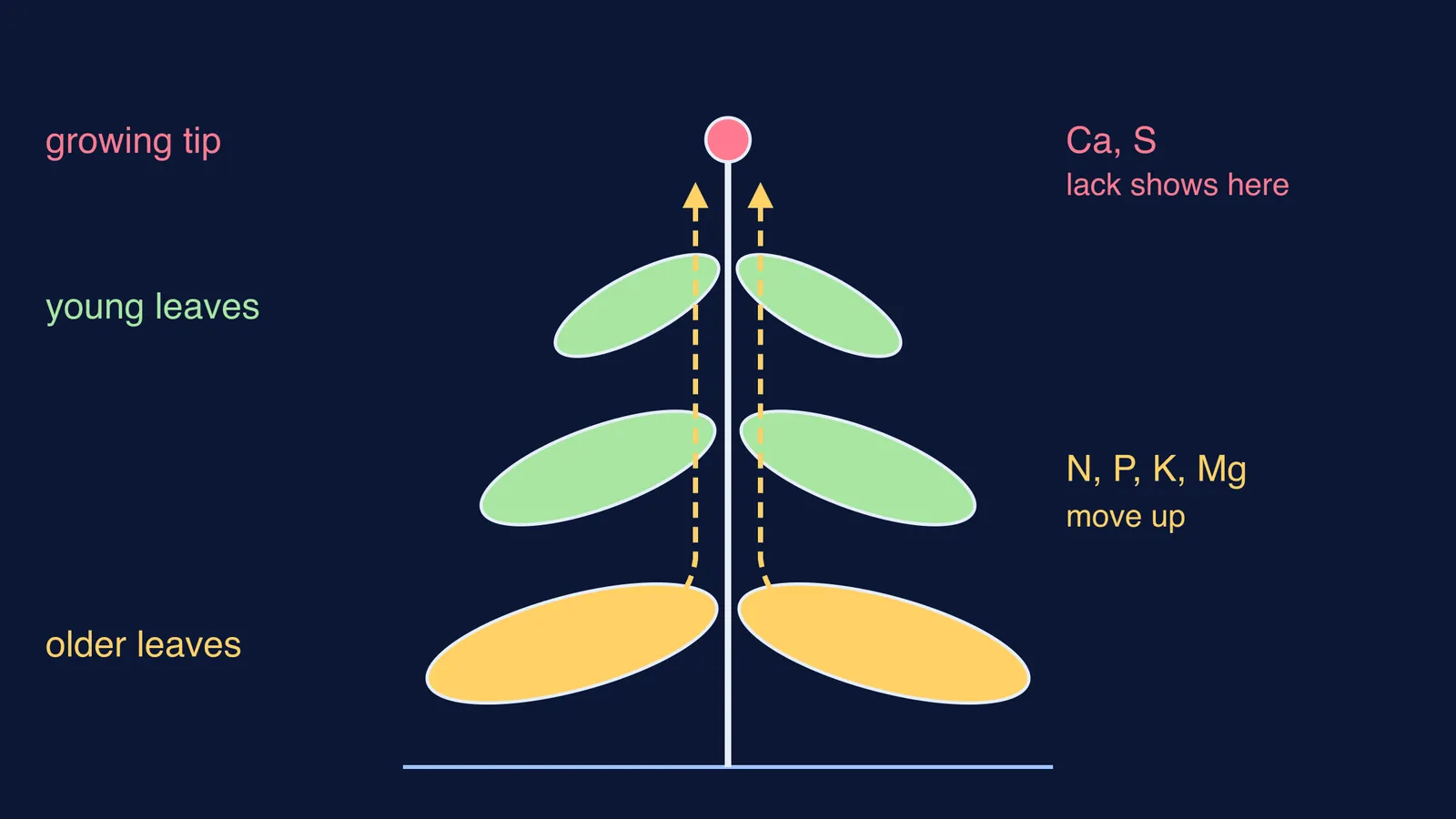
It depends on whether the plant can move the element. Section 12.2.3 of the NCERT Class 11 Biology chapter on Mineral Nutrition (2021-22 edition) puts it plainly: "For elements that are actively mobilised within the plants and exported to young developing tissues, the deficiency symptoms tend to appear first in the older tissues." Its examples are nitrogen, potassium and magnesium, whose symptoms "are visible first in the senescent leaves."
According to the same NCERT section, biomolecules containing these elements are broken down in older leaves, so the elements can be moved to younger leaves. That is why the old leaves go pale first.
A 2015 study in Frontiers in Plant Science by Maillard and colleagues tracked 13 nutrients in the leaves of five crops and three tree species as the leaves aged. Every species moved nitrogen out of its ageing leaves, with efficiencies ranging from 40% in maize to 90% in wheat. Potassium, phosphorus, sulphur and magnesium were moved out in most species.
Which nutrients are mobile and which are immobile?
For exam answers, use this grouping:
Mobile, so symptoms start in older leaves: nitrogen (N), phosphorus (P), potassium (K), magnesium (Mg)
Immobile, so symptoms start in young leaves and growing tips: calcium (Ca), sulphur (S)
The NCERT text names N, K and Mg as its examples. Phosphorus belongs with them: the Maillard study found it was moved out of ageing leaves in most species, and Tamil Nadu Agricultural University's deficiency guide describes phosphorus shortage as purple colouring on the older leaves.
Why do calcium and sulphur stay put? The NCERT chapter says they "are a part of the structural component of the cell and hence are not easily released." The same chapter notes that calcium is built into the cell wall as calcium pectate in the middle lamella, and that sulphur is part of the amino acids cysteine and methionine.
How can you tell which element is missing from leaf age?
The descriptions below follow the TNAU deficiency guide.
Older leaves first (mobile group):
Older leaves turn yellow: suspect nitrogen
Purple colour, especially on the underside: suspect phosphorus
Leaf edges look burned: suspect potassium
Yellow between the veins while the veins stay green (interveinal chlorosis): suspect magnesium
Young leaves and tips first (immobile group):
Growing tips of roots and leaves turn brown and die, and new leaves have ragged edges: suspect calcium
The whole plant turns a pale, light green: suspect sulphur, which NCERT counts as immobile, though TNAU notes the older leaves can yellow as the shortage worsens
One symptom can point to several elements. The NCERT chapter lists N, K, Mg, S, Fe, Mn, Zn and Mo as causes of chlorosis, and it advises studying all the symptoms on every part of the plant before naming the missing element. Leaf age narrows the list; the pattern on the leaf picks the answer.
How do you work out a deficiency question step by step?
Question: a plant's young leaves look normal, but its older leaves are yellow between the veins while the veins stay green. Which element is deficient?
Locate it. The symptoms are on older leaves, so the element is mobile: N, P, K or Mg.
Read the pattern. It is not general yellowing (N), purple (P) or burned edges (K). Yellow between green veins points to Mg.
Check the reason. NCERT says magnesium is part of the ring structure of chlorophyll, so losing it makes the leaf lose its green. Our explainer on what chlorophyll does with light covers why that matters.
Now flip it: the same yellowing between the veins, but only on the youngest leaves. Magnesium is unlikely, because a mobile element would have drained the old leaves first. The TNAU guide links interveinal chlorosis on emerging and young leaves to iron and manganese.
To practise this kind of elimination, try the Fermi Problem Library. It has worked problems with a step-by-step solver that explains the reasoning rather than printing an answer.
Is this topic still in the NCERT textbook?
In the 2026-27 reprint of the NCERT Class 11 Biology textbook, Chapter 12 is Respiration in Plants, not Mineral Nutrition. Check the current syllabus for your board or exam on its official website to see whether this topic is included.
NCERT credited hydroponics experiments with identifying the essential elements and their deficiency symptoms, and our article on how the hydroponics experiment finds essential plant elements explains how they work. For more symptoms, element by element, see our guide to mineral deficiency symptoms in plants. If related terms such as phloem transport or chlorosis still blur together, the Fermi Concept Library gives every concept in biology its own lesson.


