On this page
Look at a neem or peepal leaf in sunlight and the green seems obvious. The reason is a small physics puzzle, and the usual textbook shortcut is not quite right. Here is the fuller story, plus an exam-ready answer.
Which colours of light does chlorophyll absorb?
Sunlight is a mix of wavelengths, from violet through green to deep red. A pigment is a molecule that absorbs some wavelengths much more strongly than others.
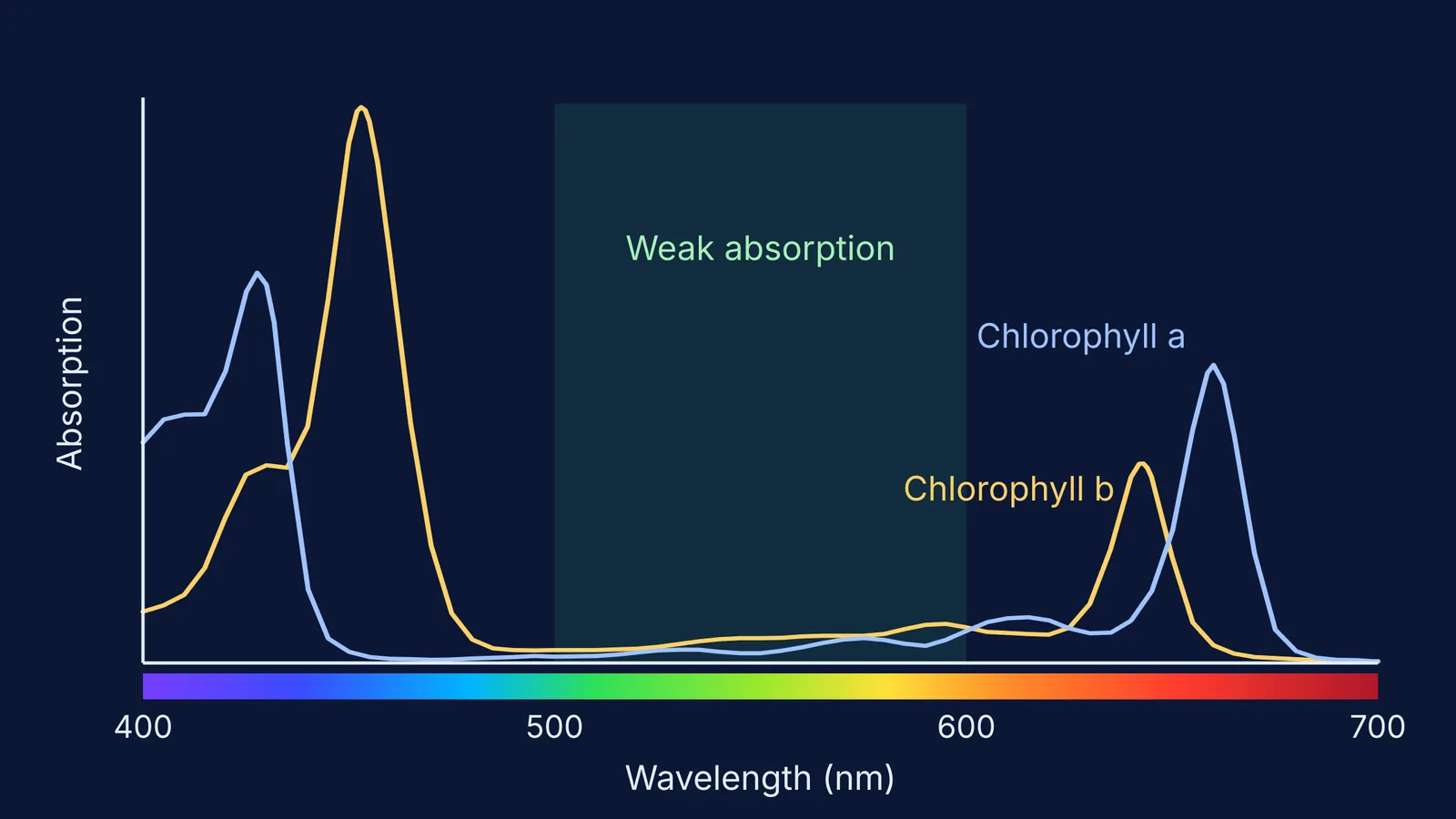
Leaves carry two main chlorophylls, a and b. Their lab absorption spectra, measured in a solvent, are published in the PhotochemCAD database on OMLC:
Chlorophyll a absorbs most strongly at about 428 nm (blue-violet), with a second peak at about 660 nm (red), according to the PhotochemCAD chlorophyll a data.
Chlorophyll b peaks at 453 nm (blue) and about 643 nm (red-orange), according to the PhotochemCAD chlorophyll b data.
Between roughly 500 and 600 nm, both curves fall to a small fraction of their peaks. That is the green and yellow part of the spectrum.
Neither chlorophyll covers the middle well. That dip is the shaded green window in the diagram above.
Why are leaves green if chlorophyll absorbs light?
Light that hits a leaf can be absorbed, pass through, or be scattered back out. Red and blue are absorbed most strongly, so little of them comes back. Green is absorbed less strongly, so relatively more green reaches your eye, and you see the leaf as green. Green is absorbed *less*, not *not at all*.
Does chlorophyll reflect green light?
Not really. In a paper in the Journal of Biological Education (published online in 2020), Virtanen, Constantinidou and Tyystjärvi compared green leaves with chlorophyll-deficient leaves of the same species. The leaves with less chlorophyll reflected green light more, the opposite of what you would expect if chlorophyll did the reflecting. The authors conclude that leaves look green because chlorophyll absorbs blue and red more strongly, and suggest that cellulose in cell walls is what scatters light back out.
As ScienceAlert reported on that study, the green leaves reflected less than 10 percent of the green light that fell on them. A leaf still absorbs most green light; it just absorbs red and blue even more thoroughly.
Green light is not wasted, either. Terashima and colleagues (2009) showed that green light penetrates further into a leaf than red or blue light, reaching deeper chloroplasts. In sunflower leaves under moderate to strong white light, extra green light drove photosynthesis more effectively than extra red light.
Why are some leaves red or purple, and do they still photosynthesise?
Yes, they do. Their colour comes from anthocyanins, a separate group of pigments that sit on top of the green rather than replacing it.
A 2025 study in Plants by Chen and colleagues compared red and green varieties of four leafy vegetables, including bok choy and choy sum. It notes that anthocyanins collect in cell vacuoles, often in the leaf's outer (epidermal) cells. The red and green Brassica varieties had no significant difference in chlorophyll, about 6 mg per gram of fresh leaf in both. Under normal light, all eight varieties showed similar maximum efficiency of photosystem II, a standard health check of the photosynthetic machinery.
Picture a red leaf as a green leaf behind a tinted window. Chlorophyll inside still absorbs red and blue light; the red layer on top masks the green you would otherwise see. The study also links anthocyanins to shielding chloroplasts from excess light, a role researchers still debate.
How do you answer “why are leaves green” in an exam?
Use this four-step frame for a 2-mark or 3-mark answer. It shows you understand absorption, not just the word “reflect”.
Name the pigment: chlorophyll a and b, in the chloroplasts.
State what it absorbs: mainly blue and red. The PhotochemCAD spectra put the peaks at about 428 to 453 nm and 643 to 660 nm.
State what happens to green: it is absorbed weakly, so relatively more green is scattered out or passes through.
Link to colour: the light reaching our eyes is richest in green, so the leaf looks green.
Worked example. *“A red-leaved plant grows normally in sunlight. Explain how it photosynthesises.”* A strong answer: the leaf contains chlorophyll as well as anthocyanins; the anthocyanins sit in the outer cells and mask the green; chlorophyll inside still absorbs red and blue light for photosynthesis.
Common slips to check before you hand in:
Writing “chlorophyll does not absorb green” (it does, weakly).
Forgetting that chlorophyll b absorbs at slightly different wavelengths from chlorophyll a.
Saying red leaves have no chlorophyll.
If absorption spectra still feel abstract, the Fermi Concept Library gives each concept in biology and physics its own lesson and shows its place in the map. For practice, the Fermi Problem Library has worked problems with a step-by-step solver that explains the reasoning rather than printing an answer.
Next time you pass green and maroon leaves side by side, try the four steps out loud.