On this page
Soil is a mix of rock particles, water, air, microbes and many dissolved minerals, so a plant growing in it could be using any of them. To find out which ones it truly needs, you have to take the soil away.
How did Julius von Sachs grow plants without soil?
In 1860, the German botanist Julius von Sachs showed for the first time that plants could be grown to maturity in a defined nutrient solution in the complete absence of soil, according to the NCERT Class 11 biology chapter on mineral nutrition. Growing plants in a nutrient solution is called hydroponics.
The key word is *defined*. If you know every salt you dissolved, you know every element the roots can reach. NCERT notes that these methods need purified water and mineral nutrient salts, and that the solution must be well aerated for good growth. Tap water already carries dissolved minerals that could quietly put the "missing" element back, and roots need oxygen too.
How does removing one element test whether it is essential?
It is a controlled experiment with one variable. NCERT describes experiments in which "an element was added / substituted / removed or given in varied concentration", and says this is how essential elements were identified and their deficiency symptoms discovered (NCERT, Chapter 12).
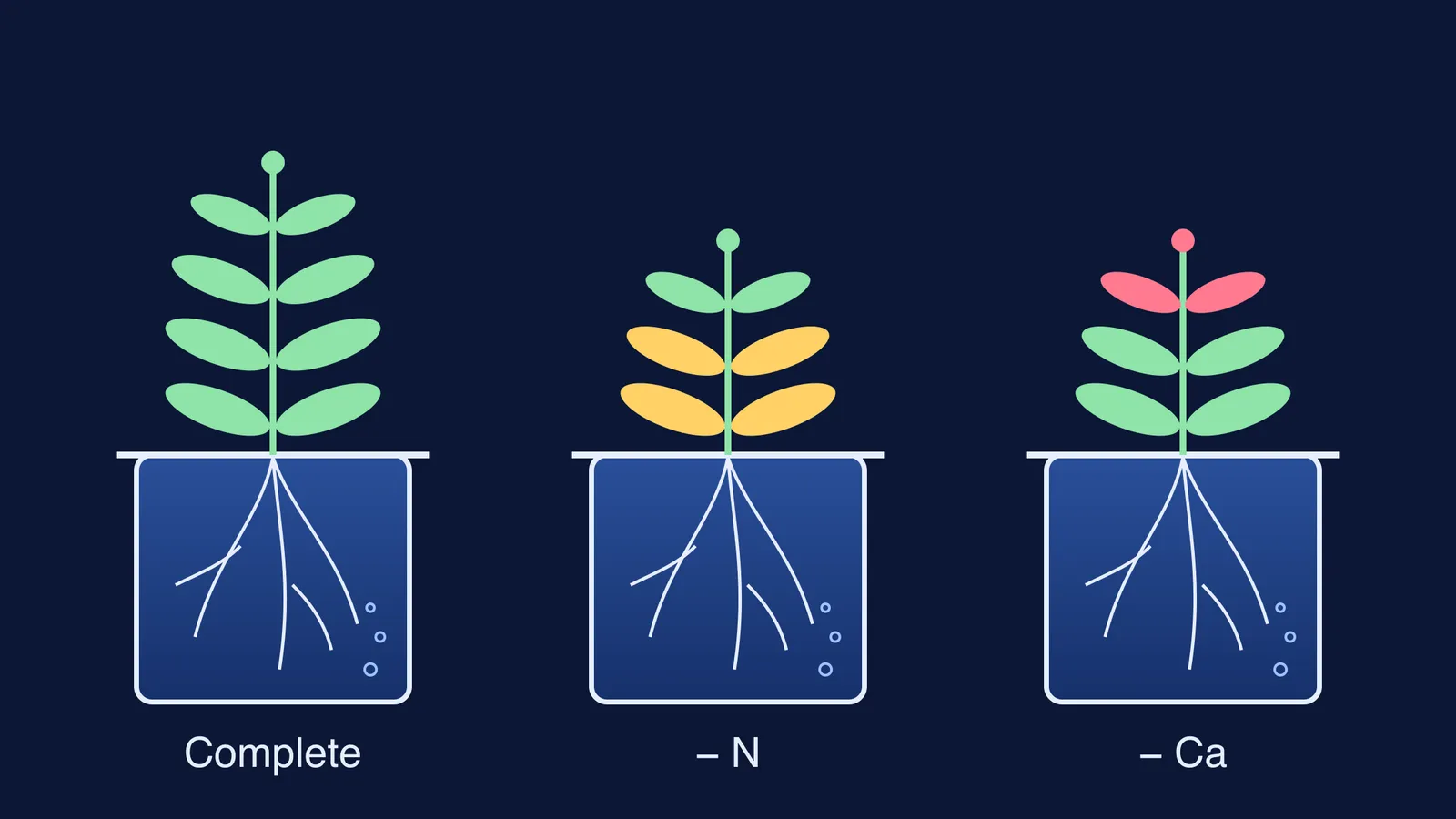
Picture three jars side by side:
Complete solution: every known nutrient. This is your control.
Minus one: identical, except one element is left out, say nitrogen.
Add-back: the minus-one solution with the element returned once symptoms appear.
If jar 2 struggles and jar 3 recovers, the missing element was responsible. NCERT says deficiency symptoms disappear when the deficient nutrient is supplied, but if deprivation continues the plant may eventually die.
Where the symptoms appear is a clue too. NCERT explains that nitrogen, potassium and magnesium are moved out of older leaves to young ones, so their deficiency shows first in older leaves, while relatively immobile elements such as sulphur and calcium show symptoms first in young tissue.
What counts as proof that an element is essential?
Being present in a plant is not enough. NCERT notes that more than sixty of the 105 elements discovered so far have been found in different plants, and some species accumulate selenium or even gold (NCERT, Chapter 12). The test it gives has three parts:
The element is absolutely necessary for normal growth and reproduction: without it the plant does not complete its life cycle or set seed.
The requirement is specific: no other element can stand in for it.
The element is directly involved in the plant's metabolism.
This definition is usually credited to Daniel Arnon and Perry Stout, whose 1939 paper in Plant Physiology on the essentiality of elements needed in minute quantity used copper as its main case. The same year they reported molybdenum as an essential element for higher plants.
By these criteria, NCERT names 17 essential elements: nine macronutrients and eight micronutrients. Macronutrients are present in plant tissue in excess of 10 mmole per kg of dry matter, and micronutrients at less than 10 mmole per kg (NCERT, Chapter 12).
The list has grown within living memory. Patrick Brown, Ross Welch and Earle Cary grew barley in solution culture with under 30 nanograms of nickel per litre, and its grain germinated at rates 50% lower than grain from plants given enough nickel (Plant Physiology, 1987). They concluded that nickel is essential for higher plants: the life-cycle criterion, settled by a minus-one experiment.
How do you reason through a minus-one question?
Worked example: seedlings grown without element X turn yellow in their lower leaves first while new leaves stay green. Adding X back clears the yellowing. Adding a chemically similar element Y instead does not.
Name the symptom. Yellowing is chlorosis, the loss of chlorophyll, which NCERT links to deficiency of N, K, Mg, S, Fe, Mn, Zn and Mo.
Read the location. Older leaves first means X is mobile in the plant, so N, K or Mg are the likely candidates.
Criterion 1. Add-back cured the plant, but strictly you must show it cannot complete its life cycle, so grow the minus-X plants to seed.
Criterion 2. Y did not substitute, so this passes.
Criterion 3. You still need evidence that X does a job, such as magnesium in chlorophyll or nitrogen in proteins.
For a school project:
Use purified water and clean containers for every jar.
Change only one element between the control and the test jar.
Aerate every jar the same way.
Grow several plants per jar, not one.
Record which leaves change first, and when.
If the three criteria blur into one another, the Fermi Concept Library has every concept in biology with its own lesson and its place in the map. To practise questions like the one above, the Fermi Problem Library has worked problems with a step-by-step solver that explains the reasoning rather than printing an answer.