

On this page
When you walk into a chemistry lab, transition metal solutions stand out: blue copper sulfate, violet titanium trichloride, green nickel chloride, and pink cobalt nitrate. Yet test tubes of aqueous scandium(III), titanium(IV), zinc(II), and copper(I) look as clear as water.
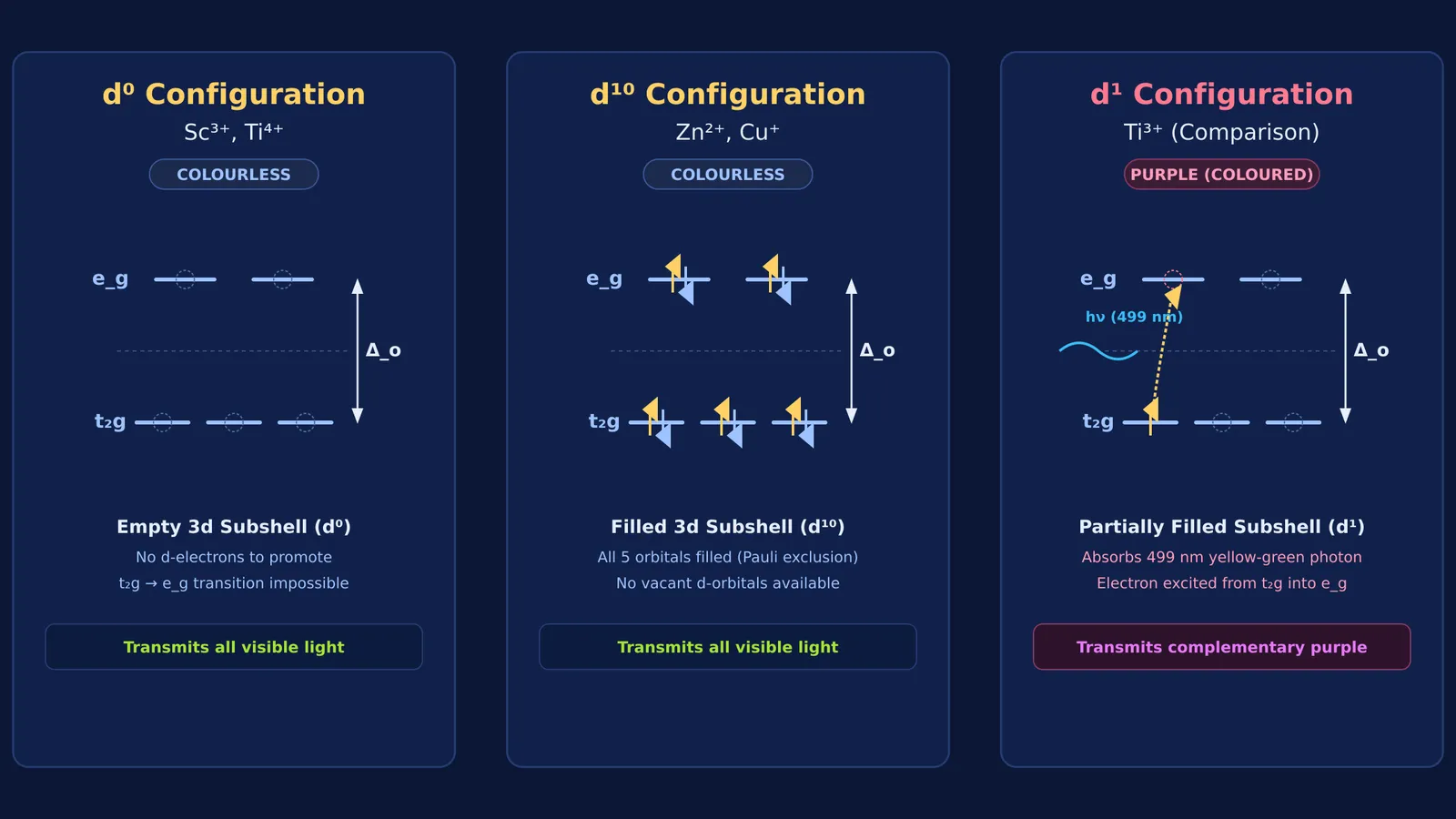
Examiners frequently test this contrast. The explanation rests on crystal field theory: transition metal colour requires a partially filled d-subshell. Metal ions with empty d-orbitals (d⁰) or completely filled d-orbitals (d¹⁰) cannot undergo visible d-d transitions.
How does crystal field splitting create colour in transition metal ions?
In an isolated gaseous transition metal atom, all five 3d orbitals share the same energy. Hans Bethe showed how surrounding charges break this degeneracy in Termaufspaltung in Kristallen (1929). In water, six molecules form an octahedral complex, [M(H₂O)₆]ⁿ⁺. The d_x²-y² and d_z² orbitals point along Cartesian axes and experience stronger repulsion, rising to form the e_g set. The d_xy, d_yz, and d_zx orbitals point between axes, experiencing weaker repulsion to form the lower t₂g set.
The energy gap between these sets is the crystal field splitting energy, Δ_o. As documented in OpenStax Chemistry 2e, Section 19.3, Δ_o in coordination complexes often matches visible photon energies. In [Ti(H₂O)₆]³⁺, Δ_o is 3.99 × 10⁻¹⁹ J per ion. An electron absorbs a matching photon, jumping from t₂g to e_g in a d-d transition. According to Chemistry LibreTexts/Crystal_Field_Theory/Colors_of_Coordination_Complexes), the solution displays the complementary colour of the absorbed wavelengths. For periodic trends, see our guide to d- and f-block elements.
Why are Sc³⁺ and Ti⁴⁺ ions colourless in aqueous solution?
Predicting colour begins with the 3d electron count. Neutral scandium (atomic number 21, [Ar] 3d¹ 4s²) loses three electrons to form Sc³⁺ ([Ar] 3d⁰). Neutral titanium (atomic number 22, [Ar] 3d² 4s²) loses four electrons to form Ti⁴⁺ ([Ar] 3d⁰). For ionization rules, see our guide to the electron configuration of ions.
Both Sc³⁺ and Ti⁴⁺ have vacant 3d subshells (t₂g⁰ e_g⁰). Without d-electrons, no visible photon can initiate a t₂g → e_g transition. As detailed on Chemistry LibreTexts/Crystal_Field_Theory/Colors_of_Coordination_Complexes), these ions absorb no light across the 400 nm to 750 nm spectrum, transmitting all visible light.
Why do Zn²⁺ and Cu⁺ remain colourless despite filled d-orbitals?
Neutral zinc (atomic number 30, [Ar] 3d¹⁰ 4s²) forms Zn²⁺ ([Ar] 3d¹⁰) by losing its 4s electrons. Copper (atomic number 29, [Ar] 3d¹⁰ 4s¹) forms Cu⁺ ([Ar] 3d¹⁰) by losing its 4s electron. Both have full d-subshells (t₂g⁶ e_g⁴). Under the Pauli exclusion principle, every orbital holds two paired electrons, leaving no vacancy to accept an excited electron.
Promoting an electron out of Zn²⁺ or Cu⁺ requires jumping to higher 4s or 4p orbitals. As noted in OpenStax Chemistry 2e, Section 19.3, bridging that gap requires ultraviolet photons. Visible photons lack the energy for this promotion, so visible light passes through unabsorbed.
When exploring coordination complexes and mapping crystal field splitting, the Fermi Concept Library covers every concept in physics, chemistry, biology, mathematics and computing, each with its own lesson and its place in the map.
Why are Ti³⁺ and Cu²⁺ brightly coloured while d⁰ and d¹⁰ ions are not?
Partially filled d-orbitals provide both donor electrons and empty acceptor orbitals:
Ti³⁺ (3d¹): In [Ti(H₂O)₆]³⁺ (t₂g¹ e_g⁰), Hermann Hartmann and Hans Ludwig Schläfer showed in Zeitschrift für Naturforschung A that absorption peaks near 20,300 cm⁻¹ (499 nm in OpenStax). Absorbing yellow-green light transmits red and violet, producing purple solutions.
Cu²⁺ (3d⁹): In [Cu(H₂O)₆]²⁺ (t₂g⁶ e_g³), an e_g vacancy accepts an electron. As documented in OpenStax Chemistry 2e, Section 19.3, d⁹ copper complexes absorb red light (620 nm to 800 nm), transmitting blue light.
For coordination geometry details, see our guide to coordination compounds and crystal field basics.
What about permanganate: why is MnO₄⁻ purple despite having a d⁰ metal?
Potassium permanganate (KMnO₄) is royal purple and potassium dichromate (K₂Cr₂O₇) is orange, despite having d⁰ metal centers (Mn⁷⁺ and Cr⁶⁺). Their colour arises from Ligand-to-Metal Charge Transfer (LMCT). As shown by Max Wolfsberg and Lindsay Helmholz in The Spectra and Electronic Structure of the Tetrahedral Ions MnO4−, CrO4−−, and ClO4− (1952), visible light excites an oxygen 2p lone-pair electron into an empty metal 3d orbital. Because LMCT transitions change orbital parity (p to d), they are Laporte-allowed. Normal centrosymmetric d-d transitions are Laporte-forbidden. LMCT transitions absorb light far more strongly, giving d⁰ oxoanions vivid colours.
How can you predict whether a transition metal ion is coloured?
Use this checklist to predict ion colour:
Find the configuration: Note atomic number Z (Sc is 21, [Ar] 3d¹ 4s²; Cu is 29, [Ar] 3d¹⁰ 4s¹).
Remove 4s electrons first: Strip outermost 4s electrons before 3d.
Count remaining d-electrons: If d⁰ or d¹⁰, the aqua ion is colourless. If d¹ through d⁹, visible d-d transitions produce colour.
Account for ligands: As noted on Chemistry LibreTexts/Crystal_Field_Theory/Colors_of_Coordination_Complexes), stronger ligands increase Δ_o, shifting absorption to shorter wavelengths.
Check for LMCT: High-valent d⁰ oxoanions like MnO₄⁻ absorb strongly via charge transfer.
When analysing electronic configurations and predicting coordination spectra, the Fermi Problem Library offers worked problems with a step-by-step solver that explains the reasoning rather than printing an answer.


