On this page
Before a chip fab can print a circuit pattern, it has to cover a silicon wafer with a layer of light-sensitive resist about a micrometre thick, and that layer must be the same thickness from the centre to the edge. The way fabs do it looks almost too simple: put a puddle of liquid in the middle and spin the wafer at a few thousand revolutions per minute. The physics uses two Class 11 ideas, viscous force F = ηA dv/dy and centripetal force mω²r, and explains why the film comes out even and how its thickness depends on spin speed.
What is spin coating and where is it used?
Spin coating is the step where a liquid, usually a photoresist dissolved in a solvent, is spread into a thin uniform film by spinning the substrate. It is one of many steps in making a chip; the full sequence from wafer to packaged device is in how semiconductor chips are made in India's new fabs. Most of the liquid flies off the edge; what stays is a film a few micrometres thick or less.
What pushes the liquid outwards on a spinning wafer?
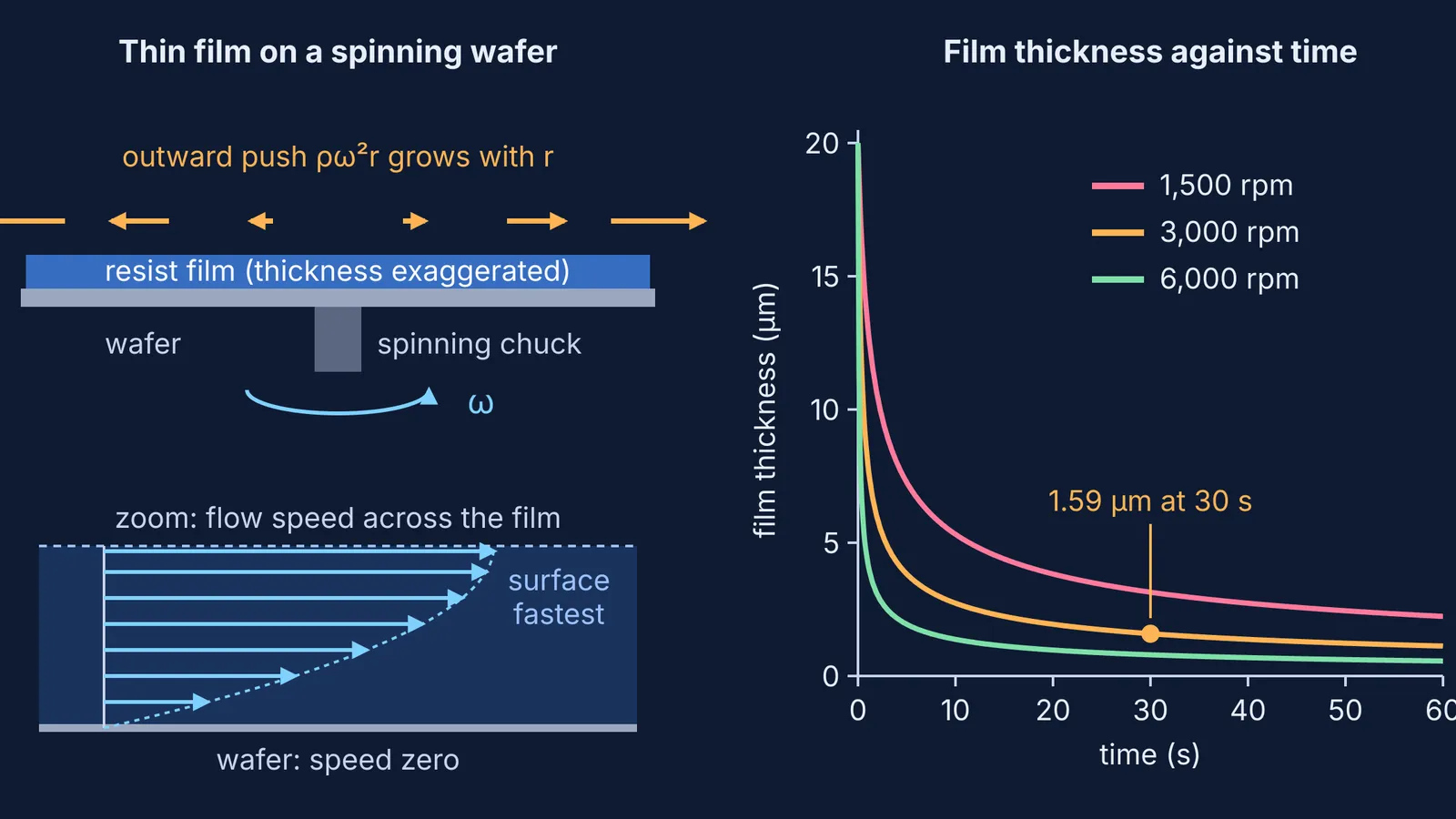
In the frame of the wafer, every bit of liquid at radius r feels an outward centrifugal force. Per unit volume it is ρω²r, where ρ is the density and ω the angular speed in rad/s. At 3,000 rpm, ω = 314 rad/s, so at r = 5 cm the push is about 4.9 × 10⁶ N/m³. Gravity on the same liquid is ρg ≈ 9.8 × 10³ N/m³, so the outward push is about 500 times stronger. That is why gravity can be ignored here, unlike in a deep spinning bucket, where gravity and rotation together shape the paraboloid surface of a rotating liquid.
What holds the liquid back is viscosity. The layer touching the wafer cannot slip, so its speed relative to the wafer is zero. Layers higher up move faster, and each layer drags on the one below. If you need a refresher on η, F = ηA dv/dy and the units pascal second and poise, see the SI unit of viscosity and how to convert it.
How fast does the liquid flow in the thin film?
Take a film of thickness h and look at the liquid between height z and the free surface at height h. Its outward push per unit area of wafer is ρω²r(h − z). In steady flow the only thing balancing it is the viscous shear stress on its lower face, η du/dz. So:
η du/dz = ρω²r(h − z)
The shear is largest at the wafer and zero at the free surface, where nothing is pulling back. Integrating with u = 0 at z = 0 gives a half-parabola profile:
u(z) = (ρω²r/η)(hz − z²/2)
The surface speed is ρω²rh²/(2η). Adding up the flow across the whole film gives the outward volume flow per unit width of the ring:
q = ρω²rh³/(3η)
Notice the h³: halve the thickness and the flow drops eightfold, so the film thins quickly at first and then ever more slowly.
Why does spin coating give an even film?
Look at the liquid inside a circle of radius r. Its volume is πr²h. It leaks out through the rim, of length 2πr, at rate q per unit length. So:
πr² dh/dt = −2πr × ρω²rh³/(3η), which gives dh/dt = −2ρω²h³/(3η)
The r has cancelled. Further out the push is stronger, so the liquid flows faster, but that ring also has more area to drain. The two grow together, so every part of the film thins at the same rate. If the film starts uniform it stays uniform, and Emslie, Bonner and Peck showed in 1958 that an uneven film tends to level out as it spins (Journal of Applied Physics, 29, 858).
Separating the variables and integrating from h₀ at t = 0 gives their result:
h(t) = h₀/√(1 + 4ρω²h₀²t/(3η))
At long times the 1 in the bracket is small, and h ≈ √(3η/(4ρω²t)). The thickness then forgets where it started, and goes as 1/ω and 1/√t.
Worked example: how thick is the film after 30 seconds?
Take a liquid with η = 0.01 Pa s (ten times as viscous as water), ρ = 1,000 kg/m³ and a starting film h₀ = 20 µm, spun at 3,000 rpm. These are illustrative values, not a real resist recipe.
Angular speed. ω = 2π × 3,000/60 = 314.2 rad/s, so ω² = 9.87 × 10⁴ s⁻².
The constant. 4ρω²/(3η) = 4 × 1,000 × 9.87 × 10⁴/(3 × 0.01) = 1.32 × 10¹⁰ m⁻² s⁻¹.
Multiply by h₀². h₀² = 4 × 10⁻¹⁰ m², so 4ρω²h₀²/(3η) = 5.26 s⁻¹. Check the units: m⁻² s⁻¹ × m² = s⁻¹, so multiplying by t gives a pure number, as it must inside a square root next to 1.
After 30 s. 1 + 5.26 × 30 = 158.9, √158.9 = 12.6, so h = 20/12.6 = 1.59 µm.
Other times. The same steps give 8.0 µm after 1 s, 2.7 µm after 10 s and 1.12 µm after 60 s. The film halves its thickness in the first 0.57 s, but needs another full 30 s to go from 1.59 to 1.12 µm.
Other speeds, 30 s each. 1,500 rpm leaves 3.14 µm and 6,000 rpm leaves 0.80 µm. Doubling the speed very nearly halves the film, as the 1/ω rule predicts.
By 30 s the film at 3,000 rpm is thinning at only about 0.03 µm per second, which is why longer spinning barely changes the result.
If you want to go over viscosity, shear and rotating frames from the start, the Fermi Concept Library covers each of these ideas on its own.
Do real photoresists follow the 1/ω rule?
Not quite. The model above is for a Newtonian liquid that does not evaporate. A real resist is a polymer dissolved in a solvent, and the solvent evaporates as the wafer spins. As it does, the film gets more viscous and finally stops flowing. Meyerhofer added uniform evaporation to the model and compared it with positive photoresists (Journal of Applied Physics, 49, 3993). He found h ∝ f^(−2/3) e^(1/3), where f is the spin speed and e the evaporation rate. Because faster spinning also speeds up evaporation, with e ∝ f^(1/2), the overall result is h ∝ f^(−1/2).
So in practice, doubling the speed thins a resist film by a factor of about 1/√2 ≈ 0.71, not 0.5. That is why resist makers publish measured spin-speed curves for each product rather than a formula. The model also leaves out the first second of spreading and the thicker edge bead that forms at the rim, which fabs remove in a separate step.
Quick checklist
Outward push per unit volume: ρω²r, hundreds of times gravity at fab speeds.
Viscous balance gives a half-parabola velocity profile, zero at the wafer and fastest at the surface.
Flow per unit width: q = ρω²rh³/(3η). The h³ makes thinning slow down sharply.
Push and drained area both grow with r, so dh/dt does not depend on r: the film stays even.
h(t) = h₀/√(1 + 4ρω²h₀²t/(3η)); late in the spin h goes as 1/ω.
Real resists evaporate, which changes the scaling to about 1/√ω.
Always convert rpm to rad/s first.