

On this page
Many viscosity questions in Class 11 physics and JEE Main come down to keeping units straight. Here is the law, both units and a conversion you can rebuild.
What is Newton's law of viscosity?
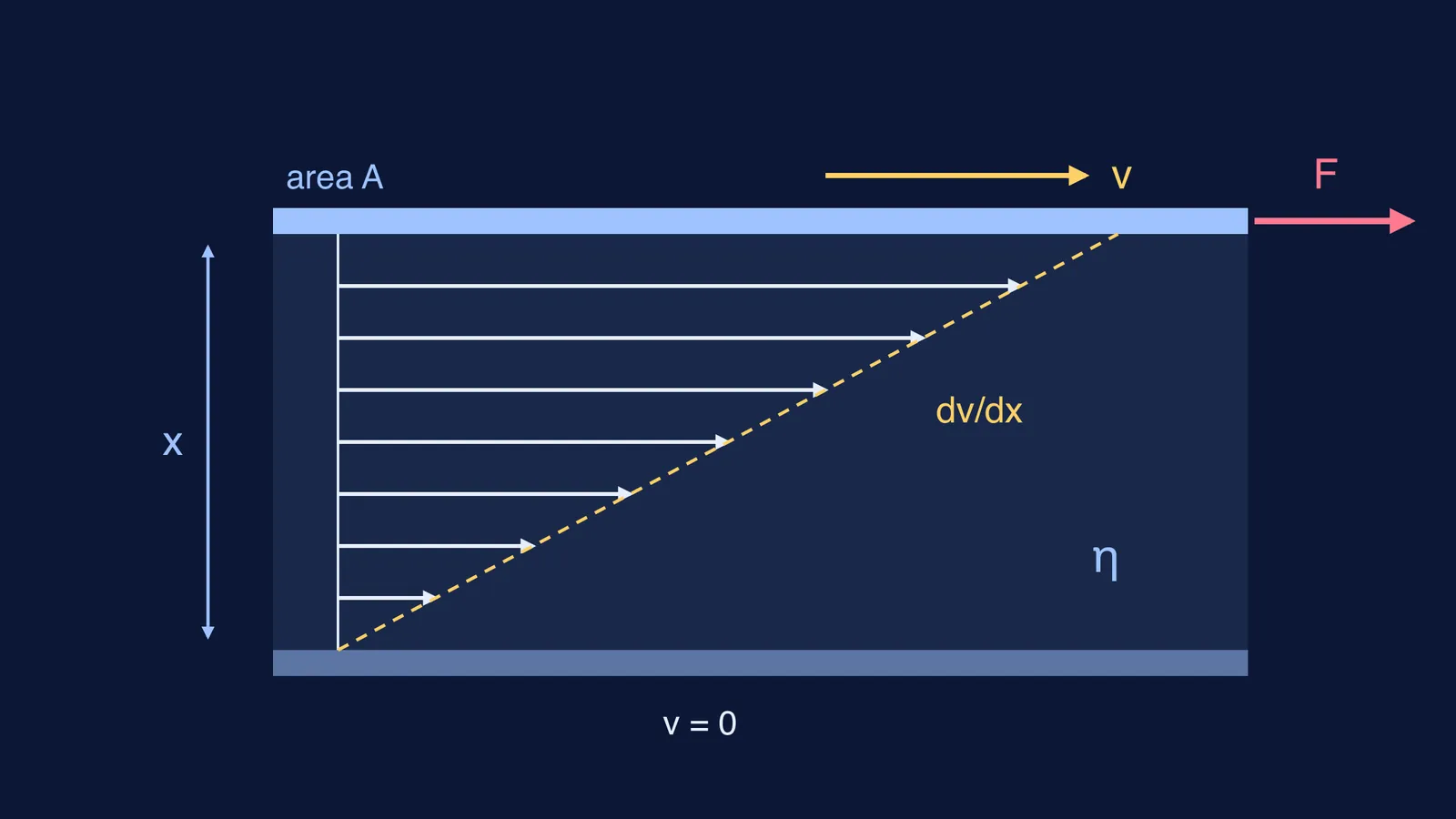
When a liquid flows in layers, each faster layer drags the slower one beneath it. NCERT's Class 11 Physics chapter Mechanical Properties of Fluids likens this resistance to internal friction and calls it viscosity, and defines the coefficient of viscosity η as the ratio of shearing stress to strain rate.
Written as a force law, that is Newton's law of viscosity: F = ηA (dv/dx).
F is the tangential (viscous) force between two layers, in newtons.
A is the area of the layers in contact, in m².
dv/dx is the velocity gradient: how fast speed changes from one layer to the next, in s⁻¹.
η (eta) is the coefficient of viscosity, a property of the fluid at a given temperature.
When a plate slides at speed v over a thin film of thickness l, the gradient is simply v/l, which gives NCERT's form η = Fl/(vA). We work through that exact set-up in the force needed to move a plate over an oil layer.
What is the SI unit of coefficient of viscosity?
Rearrange the law: η = F / (A × dv/dx). The units are N ÷ (m² × s⁻¹), which is N s m⁻², which is Pa·s.
The SI unit of dynamic viscosity is the pascal second (Pa s), equal to kg m⁻¹ s⁻¹ in base units, according to Table 6 of the BIPM's SI Brochure.
That gives the dimensional formula [ML⁻¹T⁻¹], the same one stated in the NCERT fluids chapter. NCERT also names the SI unit the poiseuille (Pl) and lists N s m⁻² and Pa s as its other units, so 1 Pl = 1 Pa·s. Do not confuse it with the poise, which is ten times smaller.
How do you convert poise to pascal second?
The poise (P) is the CGS unit of viscosity, and NIST's Guide for the Use of the SI gives 1 P = 1 dyn·s/cm² = 0.1 Pa·s and 1 dyn = 10⁻⁵ N.
You can rebuild that in three lines:
Start with 1 Pa·s = 1 N s m⁻².
Replace 1 N with 10⁵ dyn and 1 m² with 10⁴ cm².
1 Pa·s = 10⁵ dyn s / 10⁴ cm² = 10 dyn s cm⁻² = 10 P.
So 1 Pa·s = 10 P, and 1 P = 0.1 Pa·s. The centipoise (cP) is 10⁻³ Pa·s, according to NIST's viscosity conversion factors, so 1 cP = 1 mPa·s.
Table 9.2 of the NCERT chapter lists water at 20 °C as 1.0 mPl (about 1 cP), blood at 37 °C as 2.7 mPl and glycerine at 20 °C as 830 mPl.
Keep the stokes separate too. NIST's guide lists the stokes (St) as the CGS unit of kinematic viscosity, with 1 St = 10⁻⁴ m²/s. You cannot convert it to poise or Pa·s without the fluid's density.
Worked example: one problem, both unit systems
A plate of area 0.05 m² slides at 0.10 m/s over a 2.0 mm layer of glycerine at 20 °C. Take η = 0.83 Pa·s (830 mPl in NCERT's Table 9.2). What force keeps it moving?
In SI:
dv/dx = 0.10 / 0.002 = 50 s⁻¹.
F = ηA (dv/dx) = 0.83 × 0.05 × 50 = 2.075 N, about 2.1 N.
In CGS, as a check:
η = 0.83 × 10 = 8.3 P, and A = 0.05 m² = 500 cm².
dv/dx is still 10 cm/s ÷ 0.2 cm = 50 s⁻¹.
F = 8.3 × 500 × 50 = 207,500 dyn, and with 1 dyn = 10⁻⁵ N from the NIST guide, that is 2.075 N.
Same answer both ways; if your two routes disagree, a conversion went wrong. Our guide on using dimensions to check your physics answers applies the same idea to other formulas.
If you stall on setting up problems like this, the Fermi Problem Library has worked problems with a step-by-step solver that explains the reasoning rather than printing an answer.
Which viscosity unit mistakes cost marks?
Check these before answering:
Film thickness left in mm or cm while η is in Pa·s.
Poise mixed with SI area or speed in the same line.
Poiseuille (Pl) read as poise (P): since 1 P = 0.1 Pa·s, the answer ends up off by a factor of 10.
A kinematic viscosity in stokes used where the question asks for η.
Temperature ignored: the NCERT chapter notes that the viscosity of liquids decreases with temperature, while that of gases increases.
To see how η is measured, read our walkthrough of the steel ball terminal velocity practical. If stress, strain rate and viscosity still feel unconnected, the Fermi Concept Library gives every concept in physics its own lesson and its place in the map.


