

On this page
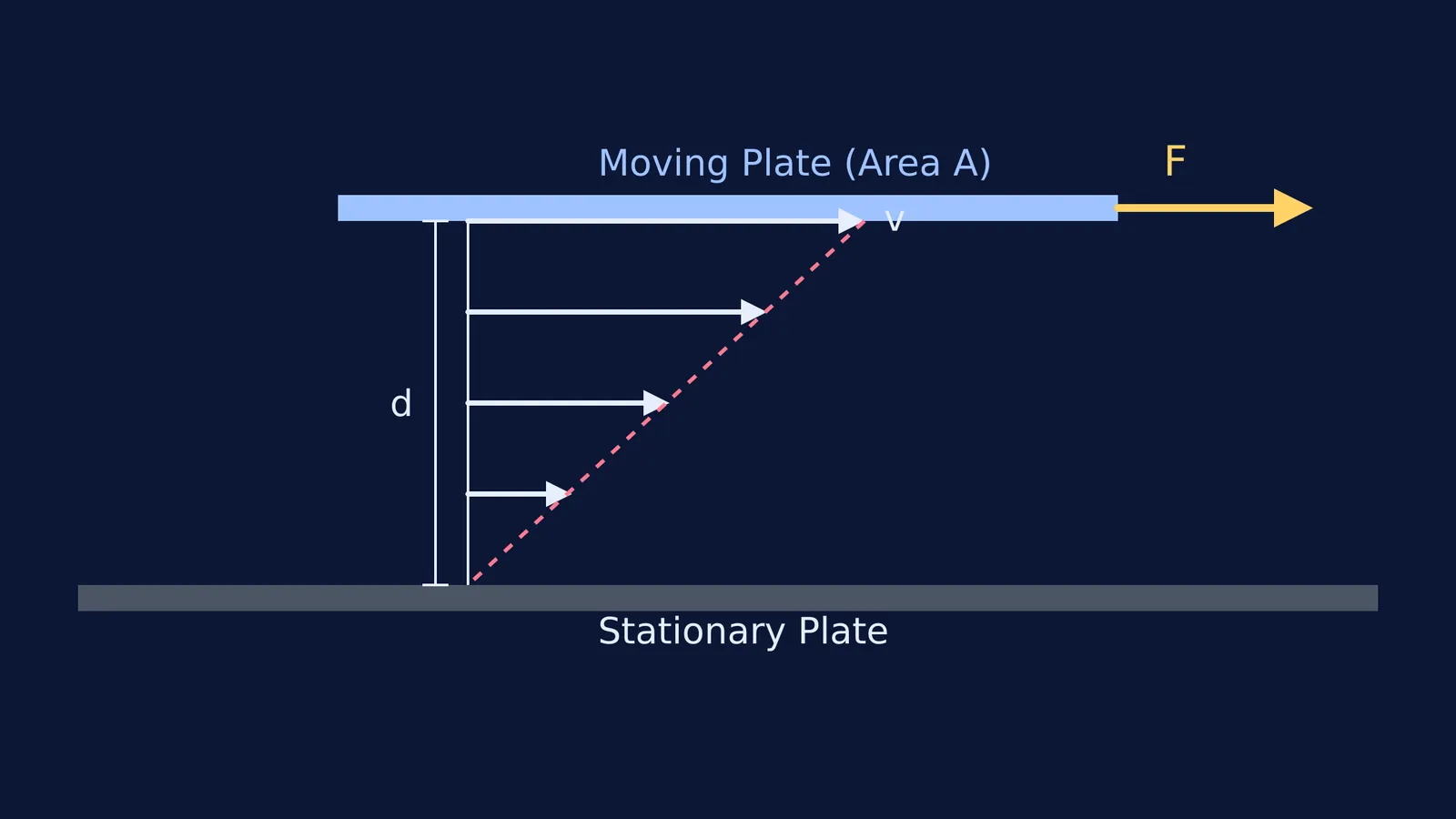
When a solid plate slides over a thin layer of oil, it does not simply glide frictionlessly across the surface. The fluid actively resists the motion. Because of a principle called the no-slip condition, the layer of oil directly touching the moving plate is dragged along at the exact same velocity as the plate. Meanwhile, the layer of oil touching the stationary surface below remains completely at rest.
This difference in speeds means the fluid is being sheared. Imagine the oil layer as a thick deck of playing cards. As you push the top card, it drags the card below it, which drags the one below that, and so on. The top card moves the fastest, while the bottom card does not move at all. This smooth, gradual change in speed across the thickness of the oil is known as a velocity gradient.
What is Newton's law of viscosity?
Newton's law of viscosity describes the exact mathematical relationship needed to maintain this steady, shearing motion. It states that the required force (F) is directly proportional to the surface area of the plate (A), the velocity (v), and the fluid's dynamic viscosity (η), and inversely proportional to the oil thickness (d).
The equation is written as: F = η A (v/d)
Here, the term v/d is the velocity gradient—a measure of how rapidly the velocity drops off from the moving plate to the stationary one.
Dynamic viscosity (η) is a fundamental property of the fluid itself, measuring its internal friction or resistance to flow. Water has a very low viscosity, meaning its internal layers slide past each other easily. Thick engine oil, syrup or honey has a high viscosity, requiring a much larger force to maintain the same velocity gradient.
Why does doubling the oil thickness halve the force?
The inverse relationship between force and the thickness of the fluid layer is a frequent trap in competitive physics exams like JEE Main and NEET-UG.
If you double the thickness (d) of the oil layer, you are spreading the same change in velocity over twice the distance. This means the velocity gradient (v/d) is cut exactly in half. Because the fluid's layers are stretched over a larger gap, the shear stress (the force per unit area) between adjacent layers decreases. As a result, the total force (F) required to maintain the plate at the same steady speed (v) halves.
Conversely, if the oil layer becomes very thin, the velocity gradient becomes incredibly steep. The adjacent layers of fluid are forced to slide past each other at radically different speeds over a tiny distance, generating immense internal friction. This causes the force required to slide the plate to shoot up. In mechanical engineering, this is why a thin film of lubricating oil can suddenly cause engine parts to seize if the gap between metal surfaces becomes too small.
Real-world meaning: engine oils and temperature
Viscosity is not a fixed number; it changes dramatically with temperature. If you have ever tried to pour cold syrup compared to warm syrup, you have seen this in action.
In car engines, the moving metal plates and cylinders are separated by a thin layer of motor oil. When the engine is cold, the oil is thick (high viscosity). According to Newton's law of viscosity, this high viscosity means the engine starter motor must exert a massive force to overcome the fluid friction and get the parts moving.
As the engine warms up, the oil's viscosity drops significantly. The fluid layers slide past each other much more easily, and the force required to keep the parts moving drops. This is why modern cars use multigrade oils (like 5W-30) that are engineered to remain thin enough for a cold start while still maintaining a protective layer when the engine runs hot.
How to solve plate and oil layer problems
When calculating the drag on a plate in an exam setting, the underlying physics is straightforward, but the challenge usually lies in keeping the units straight. For example, if a problem gives area in cm², thickness in mm, speed in cm/s, and viscosity in poise, you must convert everything to SI units (m², m, m/s, and Pa·s) before applying the formula.
If you are struggling to set up the geometry of a new problem, Fermi's AI tutor can work out what you already know, build a plan for the session, and teach through it—writing on a board, drawing the figure, and checking understanding as it goes.
If you find yourself forgetting which unit to convert, the Fermi Concept Library contains every concept in physics, chemistry, biology, mathematics and computing, each with its own lesson and its place in the map.
Exploring related ideas
To master fluid mechanics for your exams, practice is key. Surface tension and viscosity: capillary rise to terminal velocity covers how fluids behave when they fall rather than slide. You can also explore the history of these ideas by learning about George Stokes and why tiny drops fall so slowly through air, which will help you connect the mechanics of sliding plates to the concept of terminal velocity.


