

On this page
Spin a jar of water steadily on a turntable and, once the water turns with the jar, the surface dips in the middle and climbs the walls. The shape has a clean formula you can derive in four lines, and once you have it, the rotating U-tube and its JEE cousins become routine.
Why does a rotating liquid form a paraboloid?
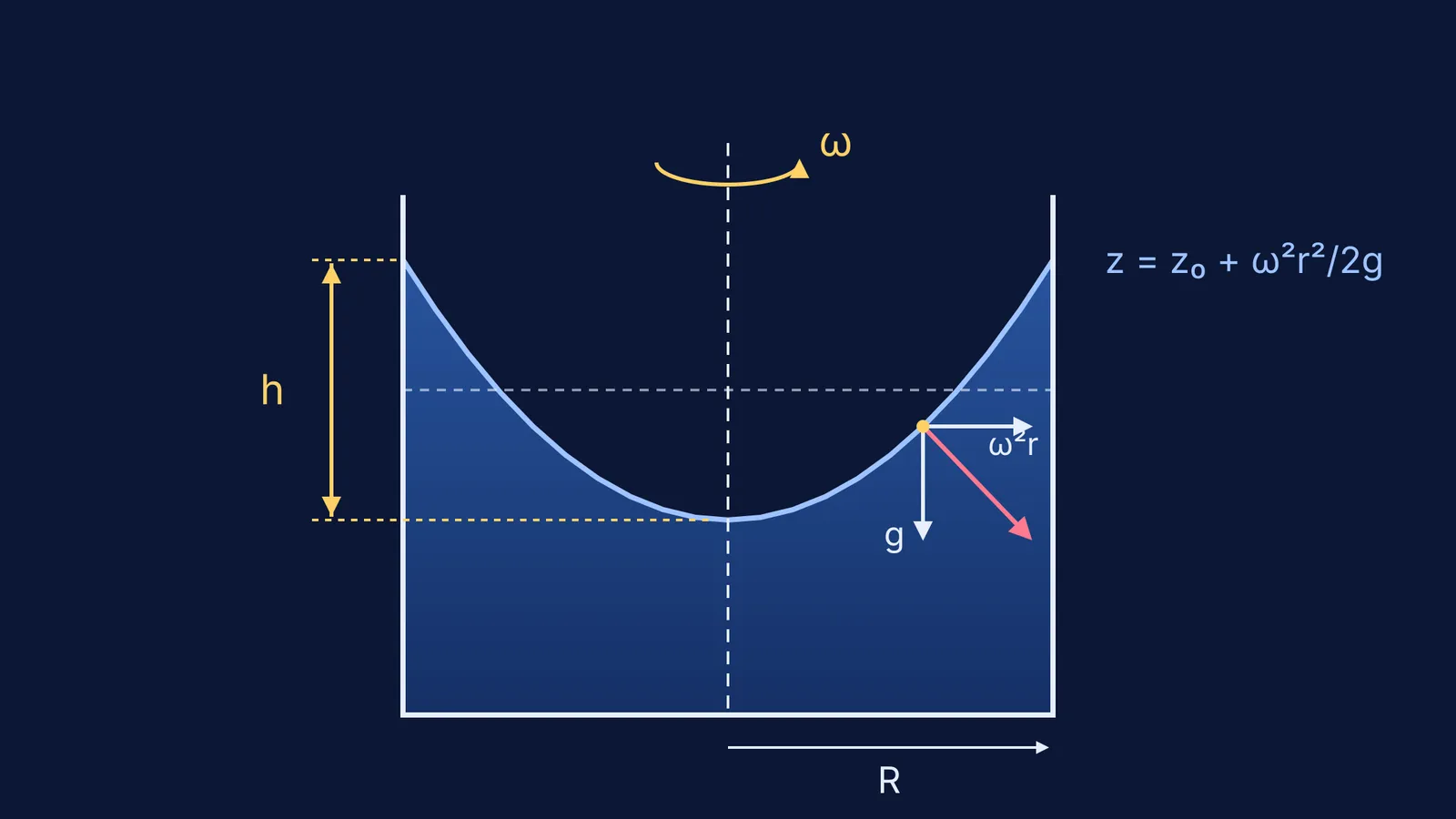
Work in the frame that rotates with the container. Once the liquid has caught up with the walls, it is at rest in that frame, and every bit of it feels: gravity g downwards and a centrifugal pseudo-acceleration ω²r pointing away from the axis. If pseudo forces feel shaky, our guide to solving problems from an accelerating frame covers the idea.
A free liquid surface at rest always sits perpendicular to the effective gravity, for the same reason a still pond is horizontal. That gives the slope at distance r from the axis:
tan θ = dz/dr = ω²r/g
Integrate from the axis outwards and you get z = z₀ + ω²r²/2g, where z₀ is the height of the surface on the axis. Carl Mungan and Trevor Lipscombe show the same result follows from Newton's second law in their paper on Newton's rotating bucket, the experiment Newton described in the *Principia*. Height grows with r², so the surface is a paraboloid of revolution.
Compare this with liquid in a linearly accelerating container, where tan θ = a/g is the same everywhere and the surface is a flat tilted plane. In rotation the sideways acceleration ω²r grows with distance from the axis, so the slope keeps steepening and the plane bends into a curve.
How much higher is the liquid at the wall?
Put r = R, the radius of the container: the height difference between the wall and the centre is h = ω²R²/2g. Density does not appear, so water, oil and mercury take the same shape at the same ω.
The volume of liquid does not change, and Mungan and Lipscombe show that the centre drops to z₀ = h₀ − ω²R²/4g, where h₀ is the still depth. So in a cylinder, if no water spills and the base stays covered, the centre falls by half of h and the wall rises by the other half.
Worked example. A cylinder of radius 10 cm holds water and spins at ω = 10 rad/s. Take g = 9.8 m/s².
h = ω²R²/2g = (100 × 0.01)/(2 × 9.8) ≈ 0.051 m, about 5.1 cm.
The centre falls about 2.6 cm below the still level, and the water at the wall rises about 2.6 cm.
Two checks: the water spills if the still level was less than 2.6 cm below the rim, and the base is exposed at the centre if the still depth was less than 2.6 cm.
The same shape makes a real telescope mirror. The 4 m International Liquid Mirror Telescope at ARIES, Devasthal in Uttarakhand, uses a rotating pool of mercury as its primary mirror, with its camera at the prime focus about 8 m above the mirror; ARIES reports first light on 29 April 2022. A parabola z = r²/4f has focal length f = g/2ω², so by this formula an 8 m focus needs ω = √(9.8/16) ≈ 0.78 rad/s, roughly 7.5 revolutions a minute.
How do you solve rotating U-tube problems?
A U-tube spun about a vertical axis is the same physics with most of the liquid removed: both open surfaces lie on the same paraboloid. If the limbs are at distances r₁ and r₂ from the axis, the height difference is:
Δh = ω²(r₂² − r₁²)/2g, with the outer limb higher
Use this routine on any version:
Mark the axis and measure each limb's distance from it. Side does not matter, only r.
Write Δh = ω²(r₂² − r₁²)/2g.
If the question asks how far each level moves, use conservation of volume: with equal limb areas and a horizontal section that stays full, one side rises by Δh/2 and the other falls by Δh/2.
Three quick cases with g = 9.8 m/s²:
Axis through one limb, limbs 20 cm apart, ω = 7 rad/s: Δh = 49 × 0.04/19.6 = 0.10 m, so 10 cm.
Axis exactly midway between the limbs: r₁ = r₂, so Δh = 0, however fast it spins.
Limbs on opposite sides of the axis at 5 cm and 15 cm, ω = 5 rad/s: Δh = 25 × (0.0225 − 0.0025)/19.6 ≈ 0.026 m, about 2.6 cm.
What should you practise next?
Try a cone instead of a cylinder, or find the ω at which the base just shows. If the curved surface is hard to picture, the Fermi Simulation Lab has interactive simulations for ideas that are easier to see than to read. For more practice, the Fermi Problem Library has worked problems with a step-by-step solver that explains the reasoning rather than printing an answer.


