On this page
Bend a wire coat hanger round your finger and it stays bent. Push a steel guitar string into a gentle curve and it springs straight the moment you let go. Both are steel wire, so the difference is not the metal's stiffness. It is how much the wire's surface is stretched by the bend, compared with how much stretch the metal can take before it yields. One ratio, wire radius over bend radius, decides which wire springs back.
What happens inside a wire when you bend it?
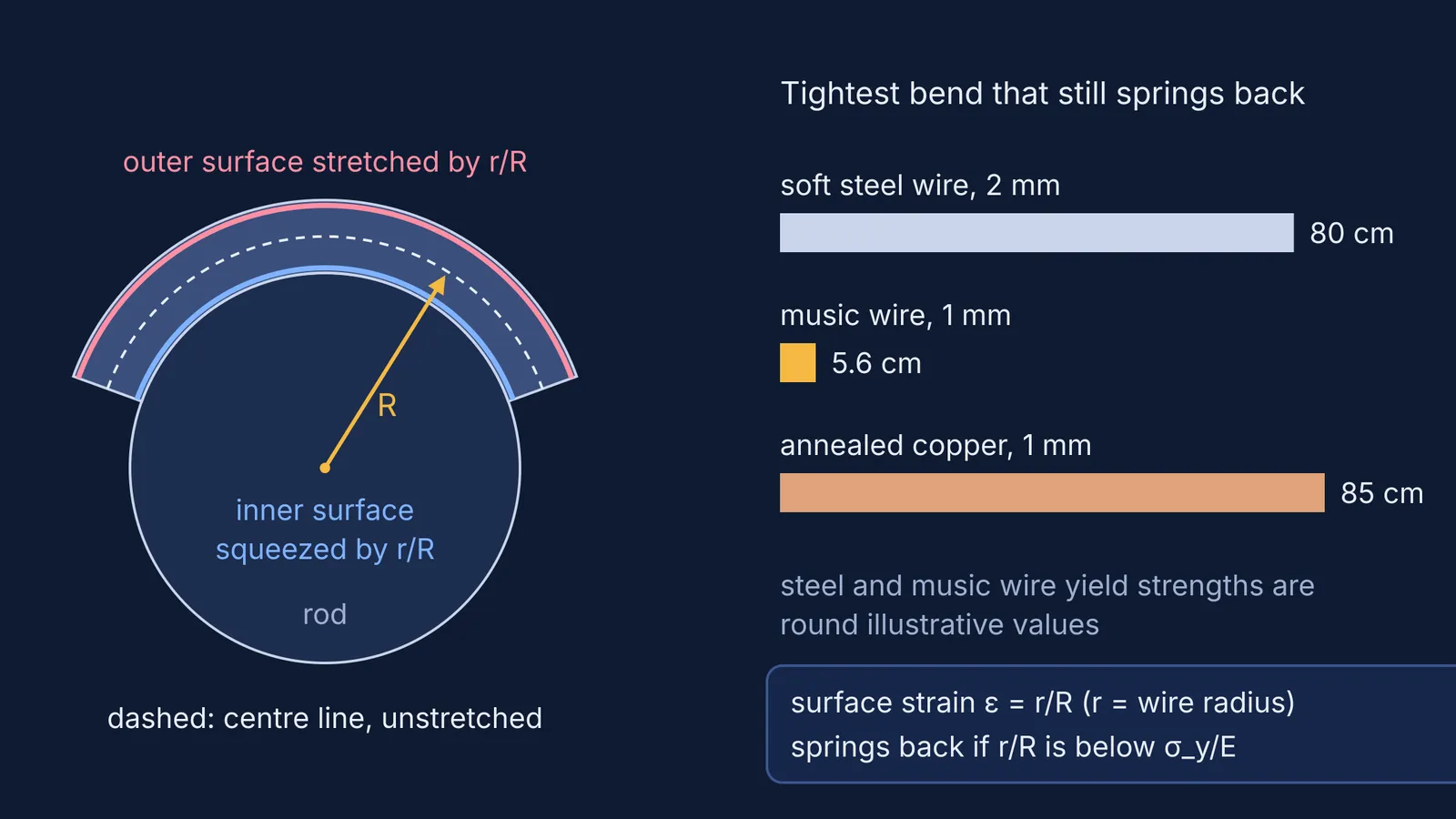
Picture a wire of radius r bent round a curve, with R the radius measured to the wire's centre line. The outside of the bend has a longer path than the inside.
The centre line keeps its original length. It is called the neutral axis.
The outer surface is a distance r further from the centre of the curve, so it is stretched.
The inner surface is a distance r closer, so it is squeezed.
For a bend through an angle φ (in radians), the centre line has length Rφ and the outer surface has length (R + r)φ. The extra length is rφ, so the strain at the outer surface is
ε = rφ/(Rφ) = r/R
The inner surface has the same strain, but compressive. Notice what is missing: the angle and the material. A wire bent to a radius 100 times its own radius has a surface strain of 1%, whatever it is made of.
When does a bent wire stay bent?
Every metal has a yield strain: the strain at which it stops behaving like a spring and starts to flow. Up to that point, stress = E × strain (Hooke's law), and the metal returns to its shape when the load is removed. Beyond it, the metal takes a permanent set. How to read the yield point and Young's modulus off a test curve is explained in how to read the stress-strain curve of a wire.
The yield strain is
ε_y = σ_y/E
where σ_y is the yield strength and E is Young's modulus. Put the two results together. A bent wire springs back if
r/R is less than σ_y/E, which means R is greater than rE/σ_y
So the tightest bend that is still fully elastic has radius R_min = rE/σ_y. Thin wire and high yield strength both make R_min small.
Why can music wire bend so much further than hanger wire?
The two steels have almost the same Young's modulus, about 200 GPa. What differs is the yield strength. Music wire, also called piano wire, is drawn cold through dies many times until it is very hard. Its standard, ASTM A228, describes it as cold-drawn wire intended especially for springs subject to high stresses. The soft, low-carbon steel in a hanger has a much lower yield strength.
The yield strengths of both steels vary a lot with grade, diameter and how much the wire has been worked. The values below are round illustrative numbers, not data for a particular product: 250 MPa for soft steel wire and 1,800 MPa for music wire. Annealed copper is better pinned down. A supplier datasheet for electrolytic tough pitch copper, C11000 in the soft OS050 temper, lists a yield strength of 10 ksi (69 MPa) and a modulus of 17,000 ksi (about 117 GPa).
Worked example: hanger wire, music wire and copper wire
Find the tightest bend each wire can take and still spring back. Use E = 200 GPa for both steels.
Soft steel wire, 2 mm thick (illustrative σ_y = 250 MPa). Radius r = 1 mm. Yield strain ε_y = 250 × 10⁶/200 × 10⁹ = 0.00125, or 0.125%. R_min = 1 mm/0.00125 = 800 mm = 0.80 m.
Bend it round a rod 2 cm across. The centre line is at R = 10 mm + 1 mm = 11 mm. Surface strain = 1/11 = 0.091, about 9%. That is about 73 times the yield strain, so the hanger takes a permanent bend.
Music wire, 1 mm thick (illustrative σ_y = 1,800 MPa). Radius r = 0.5 mm. ε_y = 1,800 × 10⁶/200 × 10⁹ = 0.009, or 0.9%. R_min = 0.5 mm/0.009 = 56 mm, about 5.6 cm.
Push it into a 10 cm curve. Surface strain = 0.5/100 = 0.005, or 0.5%. This is below 0.9%, so the wire springs straight again.
Annealed copper wire, 1 mm thick (σ_y = 69 MPa, E = 117 GPa). ε_y = 69/117,000 = 0.00059, or 0.059%. R_min = 0.5 mm/0.00059 = 850 mm, about 0.85 m.
Units check: σ_y/E is MPa/MPa, a pure number, so R_min comes out in the units of r.
The soft steel wire, twice as thick, needs a curve more than 14 times wider than the music wire before it yields. Copper is worse still: almost any bend you make by hand sets it. That is why the copper wiring inside a switchboard stays where an electrician shapes it.
Why does a bent wire spring back a little even when it stays bent?
Only the outer layers of a sharply bent wire yield. The metal near the centre line has a strain smaller than ε_y and is still elastic. When you let go, that elastic core, and the elastic part of the strain in the outer layers, push back. The wire relaxes to a bend of larger radius than the one you made. This is called springback.
So a coat hanger bent round a 2 cm rod opens out slightly when released, but it keeps most of the bend. Wire-benders allow for this by bending a little past the shape they want.
How is this different from glass or a bimetallic strip?
A brittle material such as glass has almost no plastic range. Strain it past its limit and it cracks instead of taking a set, which is covered in why glass shatters while plastic bends. The same r/R idea also appears in a bimetallic strip bending to a radius, but there the curvature is caused by unequal expansion, not by your hands.
For a refresher on stress, strain, Young's modulus and the elastic limit, use the Concept Library, which covers every concept in physics, chemistry, biology, mathematics and computing.
Quick checklist
Surface strain of a bent wire: ε = r/R, with R to the centre line.
The wire springs back if r/R is less than σ_y/E.
Tightest elastic bend: R_min = rE/σ_y.
Steels share E of about 200 GPa; yield strength decides the difference.
Hard music wire stays elastic at a few centimetres; soft wire and copper yield at under a metre.
Past yield, the wire still springs back partly (springback).