

On this page
A bimetallic strip is two metals bonded along their whole length, usually steel and copper, or sometimes steel and brass (Wikipedia: Bimetallic strip). Exam questions ask three things: which way it bends, how sharply, and what it does in a thermostat or fire alarm.
Why does a bimetallic strip bend towards the metal that expands less?
Each metal wants to grow by ΔL = αL₀ΔT, and the two values of α differ. Typical linear expansion coefficients, in 10⁻⁶ per kelvin, are about 11–13 for mild steel, 16–17 for copper, 18–19 for brass and 1–2 for invar (Wikipedia: Bimetallic strip).
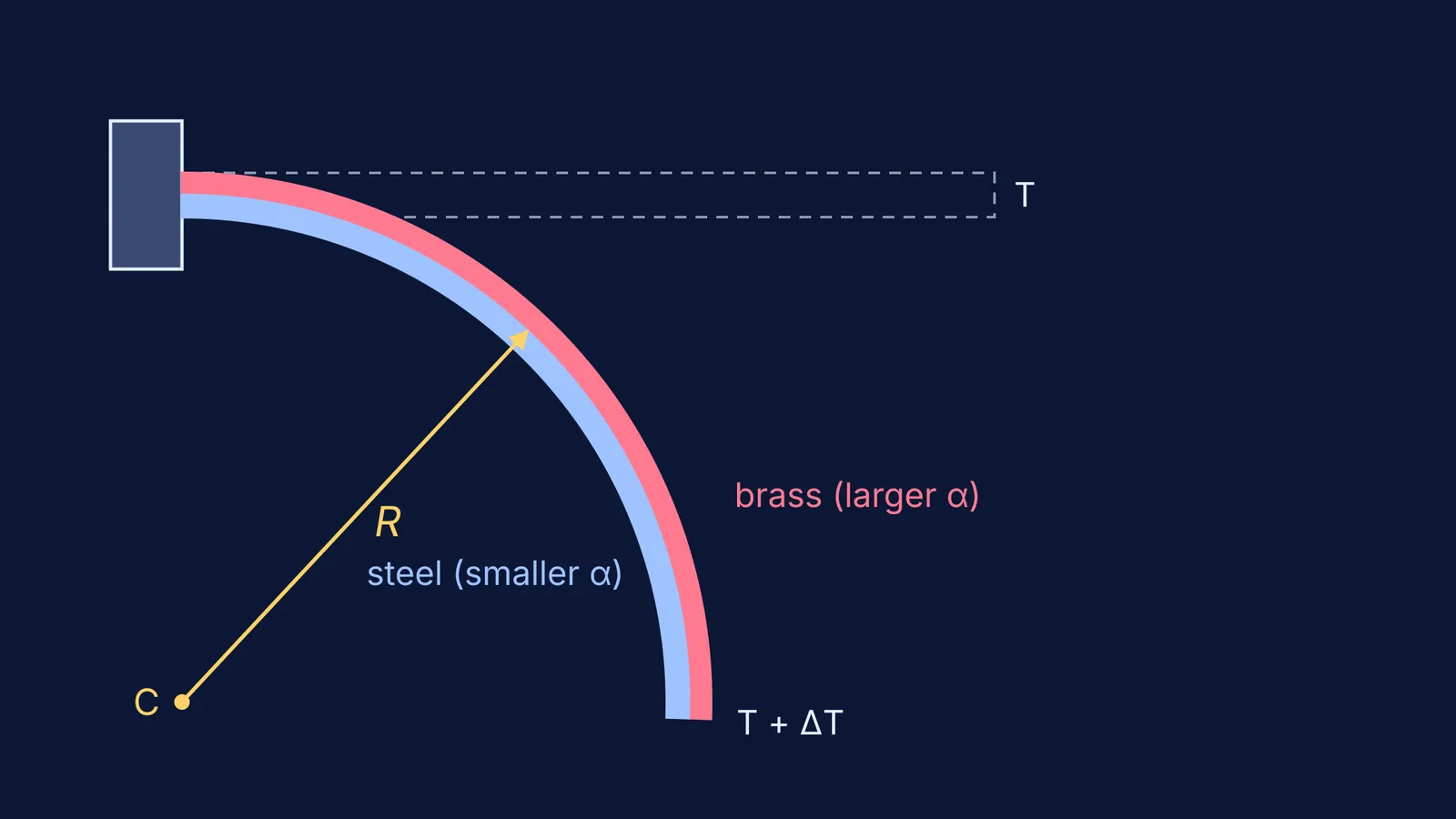
The bonded layers can't slide, so the strip curves, and on a curve the outer arc is longer. When heated, the metal with the higher expansion coefficient is on the outer side of the curve; when cooled, it is on the inner side (Wikipedia: Bimetallic strip).
The misfit strain between the layers is Δε = (α₁ − α₂)ΔT (DoITPoMS, University of Cambridge). The bending depends on this difference, not on how much either metal expands on its own.
How do you derive the radius of curvature of a bimetallic strip?
Both layers start at length L₀ and, after heating, form an arc of angle θ. Let R be the radius of the interface and d the distance between the mid-lines of the two layers (d = t for two layers each of thickness t).
High-α layer, outside: L₀(1 + α₁ΔT) = (R + d/2)θ.
Low-α layer, inside: L₀(1 + α₂ΔT) = (R − d/2)θ.
Subtract: L₀(α₁ − α₂)ΔT = dθ.
Add, using αΔT ≪ 1: 2L₀ ≈ 2Rθ, so θ ≈ L₀/R.
Substitute: R ≈ d / [(α₁ − α₂)ΔT].
A thicker strip bends less, and a bigger mismatch or temperature change bends it more. Doubling ΔT halves R. Length doesn't appear: it only decides how far the free tip moves.
Worked example: brass and steel
Take brass at 19 × 10⁻⁶ /K and steel at 12 × 10⁻⁶ /K, inside the typical ranges above. Each layer is 0.5 mm thick, so d = 0.5 mm, and the strip is heated by 100 K.
Mismatch: Δα·ΔT = (7 × 10⁻⁶)(100) = 7 × 10⁻⁴.
Radius: R ≈ (0.5 × 10⁻³ m) / (7 × 10⁻⁴) ≈ 0.71 m.
Angle turned by a 5 cm strip clamped at one end: θ = L/R ≈ 0.05/0.71 ≈ 0.070 rad, about 4°.
Tip deflection: δ ≈ L²/(2R) ≈ (0.05)²/1.43 ≈ 1.75 mm.
Each layer grows by less than 0.2%, yet the tip moves sideways by almost 2 mm. That amplification makes it a sensor. With invar in place of steel, Δα is more than twice as large and R drops to under half.
How exact is R = d/(Δα ΔT)?
The textbook formula is pure geometry. A real strip must also balance forces: the high-α layer is squeezed, the low-α layer stretched, and both resist bending. Stephen Timoshenko published an elastic analysis of the problem in his 1925 paper Analysis of Bi-Metal Thermostats, and the general curvature depends on both Young's moduli and both thicknesses (DoITPoMS).
For layers of similar thickness and Young's modulus, the curvature becomes 1/R = 3Δε/(2h), where h is the total thickness, the formula Yvon Villarceau published in 1863 (Wikipedia: Bimetallic strip). With h = 2d, R = 4d/(3ΔαΔT), which is 4/3 of the textbook value: about 0.95 m instead of 0.71 m in the example.
If a question gives the distance between the strips' centres and no moduli, it wants R = d/(ΔαΔT). For more practice, see our guides to linear, area and volume thermal expansion problems and thermal stress when expansion is blocked.
How do you solve thermostat and fire-alarm questions?
Thermostats are the classic use of bimetallic strips (DoITPoMS). One checklist covers most versions:
Find the contact, and decide whether heating should close the circuit or open it.
Fire alarm or overheat warning: heating must push the strip towards the contact, so the high-α metal goes on the side facing away from it.
Iron or heater thermostat: heating must pull the strip away from the contact, so the high-α metal goes on the side facing it.
Cooled below the temperature where it was straight: the strip bends the other way, towards the high-α metal.
More sensitivity: a larger Δα (brass with invar), a thinner strip, or a longer or coiled strip.
Thermal expansion also drives the clock problem in our post on why a pendulum clock loses time in summer. If you keep getting the direction wrong, the Fermi Problem Library has worked problems with a step-by-step solver that explains the reasoning rather than printing an answer. If misfit strain still feels slippery, the Fermi Concept Library gives every physics concept its own lesson and its place in the map.
Next step: redo the worked example with copper instead of brass, and check that R comes out larger.


