On this page
Take a line segment one unit long. Cut out its middle third. Cut out the middle third of each of the two pieces left. Repeat forever. What survives is the Cantor set. It has no length at all, yet it holds as many points as the whole line, and every step of the argument needs only school maths: a geometric series and writing numbers in another base.
What is the Cantor set?
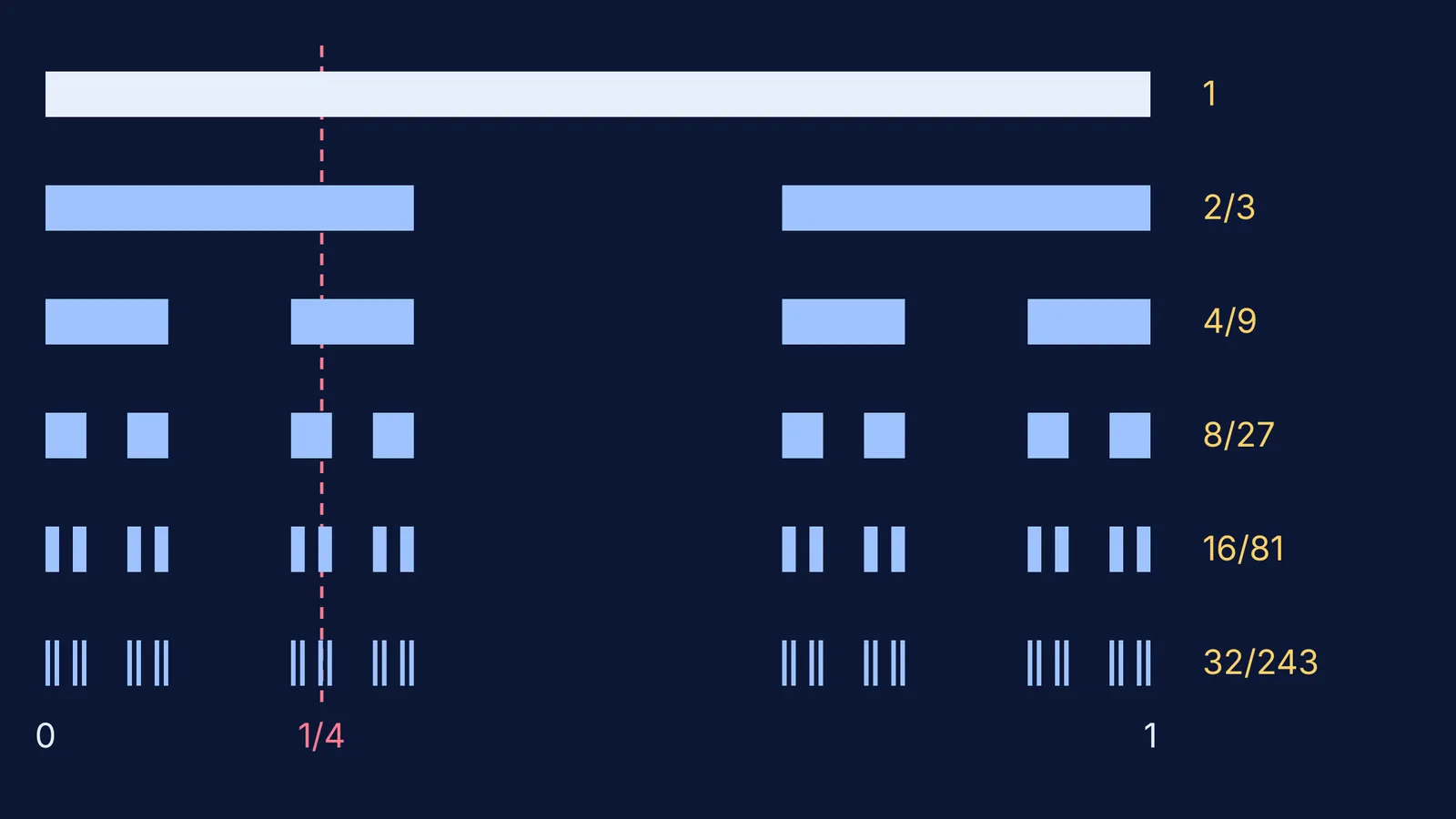
The Cantor set is built by taking [0, 1], removing the open middle third, removing the open middle third of each remaining piece, and continuing ad infinitum (Wolfram MathWorld). After step 1 you keep [0, 1/3] and [2/3, 1]. After step 2 you keep four pieces, each 1/9 long. After step n you keep 2^n pieces, each 1/3^n long.
It was discovered in 1874 by Henry John Stephen Smith and mentioned by Georg Cantor in 1883 (Wikipedia, Cantor set). Cantor's 1883 paper appeared in Mathematische Annalen, volume 21 (Mathematische Annalen, doi:10.1007/BF01446819).
Why does the removed length add up to 1?
Count what you throw away at each step:
Step 1 removes one piece of length 1/3.
Step 2 removes two pieces of length 1/9, so 2/9.
Step 3 removes four pieces of length 1/27, so 4/27.
Step n removes 2^(n−1) pieces of length 1/3^n.
That is a geometric series with first term a = 1/3 and ratio r = 2/3. Its sum is a / (1 − r) = (1/3) / (1/3) = 1. The whole unit of length has been removed, so the proportion left is 1 − 1 = 0 (Wikipedia, Cantor set).
You can see it shrinking another way. After n steps the length left is (2/3)^n. After 10 steps that is 1024/59049, under 2% of the original line. In the language of advanced courses, the Cantor set has Lebesgue measure 0 (Wolfram MathWorld).
Which numbers are left in the Cantor set?
Write numbers in base 3 (ternary), where the only digits are 0, 1 and 2. A number in [0, 1] is in the Cantor set exactly when it has a ternary expansion that uses only the digits 0 and 2 (Wolfram MathWorld).
Why? The first ternary digit tells you which third of [0, 1] you are in; a 1 means the middle third, which step 1 removed. The second digit picks a third of that third, and so on. Avoiding 1 forever means never landing in a removed middle.
Worked example: is 1/4 in the Cantor set?
Multiply by 3: 3/4. The whole-number part is 0, so the first digit is 0.
Multiply 3/4 by 3: 9/4 = 2 + 1/4. The digit is 2, and you are back at 1/4.
The pattern repeats: 1/4 = 0.020202… in base 3.
No digit 1 appears, so 1/4 survives every step, even though it is never an endpoint of any piece. Wikipedia gives the same expansion (Wikipedia, Cantor set). Try 1/2: it comes out as 0.111…, so it is out. (1/3 is in: it can be written 0.0222….)
How can a set of length zero be uncountable?
Take any Cantor point written with digits 0 and 2, replace every 2 with a 1, and read the result as a binary number. For 1/4 = 0.0202…, that gives 0.0101… in binary, which is 1/3. Every number in [0, 1] has a binary expansion, so every one is hit. This map from the Cantor set onto [0, 1] shows the Cantor set has at least as many points as the whole interval, so it is uncountable (Wikipedia, Cantor set).
If matching one set to another to compare sizes is new to you, our explainer on how to count using a bijection walks through the idea with finite examples first.
What is the dimension of the Cantor set?
Zoom into the left third of the Cantor set and you see a copy of the whole set, shrunk by a factor of 3. The set is made of 2 such copies. For a line, 3 copies at scale 1/3 rebuild it (dimension 1); for a square, 9 copies (dimension 2, since 3^2 = 9). In general N = 3^d, so here 3^d = 2 and d = log 2 / log 3. Its capacity dimension is ln 2 / ln 3 ≈ 0.6309 (Wolfram MathWorld).
The same self-similarity idea runs through the Mandelbrot set and the Sierpinski triangle you can draw with the chaos game.
A 15-minute paper check
Draw [0, 1] and the first three steps. Label every surviving endpoint as a fraction.
Write the removed lengths as a series and sum it with a / (1 − r).
Convert 1/4, 3/4 and 1/2 to base 3 and decide which survive.
Map 3/4 = 0.2020… to binary and find the number it lands on.
Explain to someone at home, in two sentences, why length zero and uncountable do not contradict each other.
If a step here felt shaky, the Fermi Concept Library gives each mathematics concept, such as geometric series, its own lesson. To practise the summing step on fresh questions, the Fermi Problem Library has a step-by-step solver that explains the reasoning rather than printing an answer.