On this page
Your textbook calls 496 kJ/mol the ionisation enthalpy of sodium and −349 kJ/mol the electron gain enthalpy of chlorine. Now read the small print. A footnote under Table 3.7 of the NCERT Class 11 chapter on periodicity says that electron affinity is defined at absolute zero, so at any other temperature ΔegH = −Ae − 5/2 RT. A box in the NCERT Class 11 thermodynamics chapter gives the matching rule for ionisation, ΔiH = E₀ + 5/2 RT. Yet the same chapter puts uncorrected numbers into its Born–Haber cycle. Here is which numbers are energies, which are enthalpies, and why your answers still come out right.
What is the difference between ionisation energy and ionisation enthalpy?
Ionisation energy is a spectroscopic number. It is the energy needed to pull an electron off an isolated gaseous atom in its ground state, with nothing moving, which is the situation at 0 K. The NIST Chemistry WebBook notes on ion energetics define both the ionisation energy and the electron affinity as 0 K enthalpy changes.
Ionisation enthalpy is the enthalpy change for X(g) → X⁺(g) + e⁻ at a stated temperature, usually 298 K. At 298 K the particles are moving, and the reaction changes the number of gas particles. That adds a small, fixed amount: 5/2 RT per mole.
Where does 5/2 RT come from?
Two routes give it, both from your syllabus.
From kinetic energy and ΔH = ΔU + Δn(gas)RT. A mole of an ideal monatomic gas carries 3/2 RT of translational kinetic energy. Ionisation turns one gas particle into two, the ion and the electron. So at temperature T the internal energy change is ΔU = IE + 3/2 RT. The moles of gas rise by one, so ΔH = ΔU + RT = IE + 5/2 RT.
From heat capacities. This is NCERT's route. Every species is an ideal monatomic gas with Cp = 5/2 R. For ionisation, ΔCp = Cp(X⁺) + Cp(e⁻) − Cp(X) = +5/2 R. Integrate from 0 K to T and ΔH(T) = ΔH(0) + 5/2 RT. In electron gain one particle disappears, ΔCp = −5/2 R, and ΔegH = −Ae − 5/2 RT.
At 298.15 K, 5/2 RT = 2.5 × 8.314 × 298.15 J/mol = 6.197 kJ/mol. The CODATA Key Values for Thermodynamics list H°(298.15 K) − H°(0) = 6.197 kJ/mol for monatomic gases such as Na, He, Ar and atomic H. Same number.
The derivation assumes the atoms and ions have no low-lying excited levels that soak up heat. That holds for Na. A chlorine atom has one, which is why CODATA lists 6.272 kJ/mol for Cl(g), but the difference is under 0.1 kJ/mol.
Are the textbook values energies or enthalpies?
Compare them with spectroscopy. The NIST WebBook lists the ionisation energy of sodium as 5.13908 eV, and the electron affinities of chlorine as 3.612709 eV (Trainham and co-workers, 1987) and fluorine as 3.401191 eV (Blondel and co-workers, 2001). Multiply by 96.485 to get kJ/mol; the reason for that factor is in how to convert eV per atom to kJ/mol.
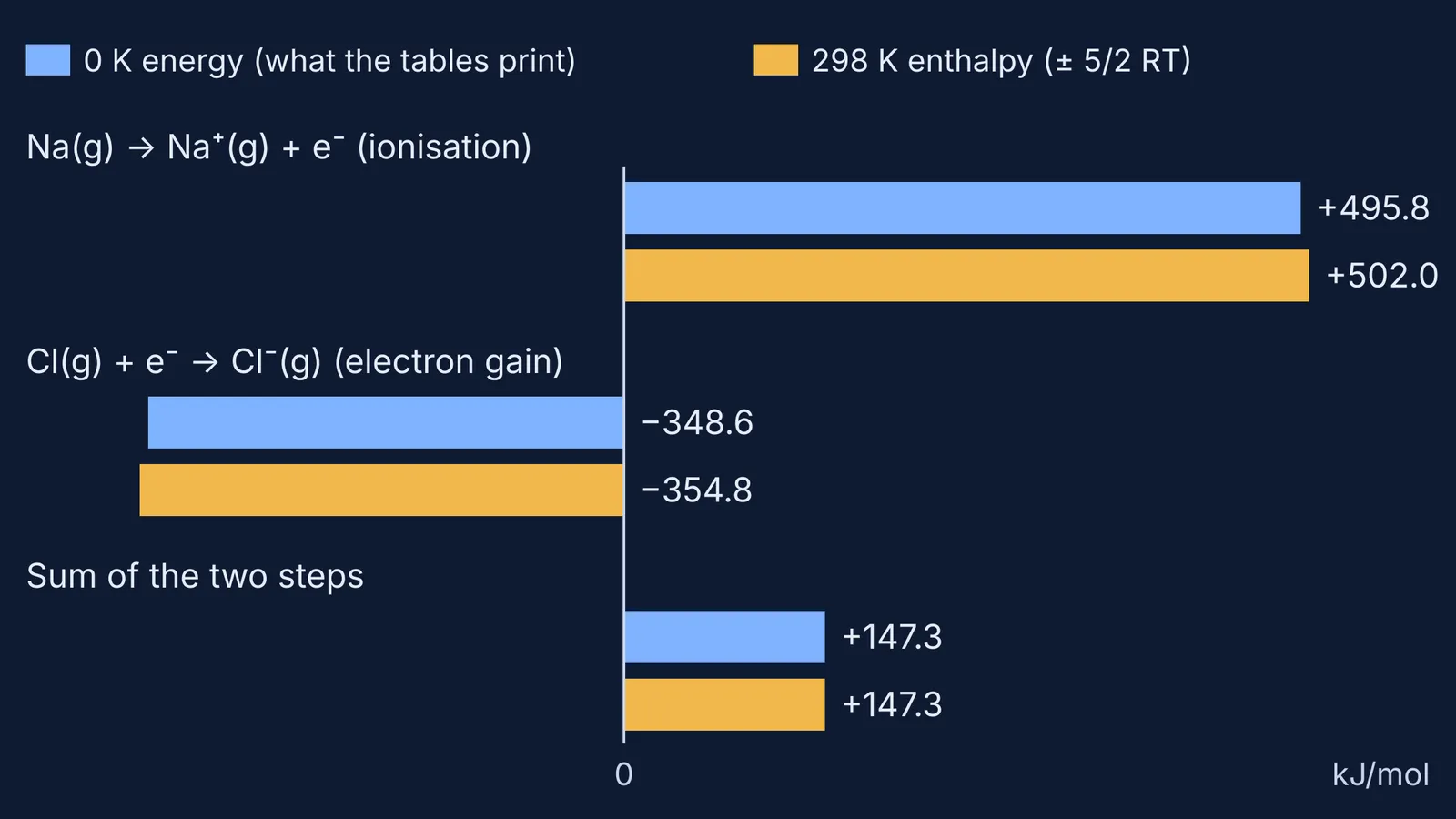
Na ionisation: 0 K value +495.8; textbook +496; true 298 K enthalpy +502.0 kJ/mol.
Cl electron gain: 0 K value −348.6; textbook −349 (Unit 3) and −348.6 (Unit 5); 298 K enthalpy −354.8 kJ/mol.
F electron gain: 0 K value −328.2; textbook −328; 298 K enthalpy −334.4 kJ/mol.
The textbook numbers match the 0 K column every time: they are ionisation energies and electron affinities under enthalpy labels. That is a simplification, not a wrong measurement. The gap is about 1.2% for Na and 1.8% for Cl, and the NIST notes say that when high accuracy is not needed, treating the ionisation energy as the 298 K enthalpy of ionisation "is usually adequate". NCERT's own footnote tells you exactly what was simplified.
Worked example: does the correction change the lattice enthalpy of NaCl?
NCERT's cycle, rebuilt in our Born–Haber lattice enthalpy walkthrough, uses ΔsubH(Na) = 108.4, ½ΔbondH(Cl₂) = 121, ΔiH(Na) = 496, ΔegH(Cl) = −348.6 and ΔfH(NaCl) = −411.2 kJ/mol, and gets ΔlatticeH = +788 kJ/mol. Redo it with true 298 K enthalpies.
Convert the ionisation energy: 5.13908 × 96.485 = 495.8 kJ/mol.
Add 5/2 RT: ΔiH(298 K) = 495.8 + 6.2 = 502.0 kJ/mol.
Convert the electron affinity: 3.612709 × 96.485 = 348.6 kJ/mol.
Subtract 5/2 RT: ΔegH(298 K) = −348.6 − 6.2 = −354.8 kJ/mol.
Add the two ion-forming steps: 502.04 − 354.77 = 147.27 kJ/mol. Without corrections, 495.85 − 348.57 = 147.27 kJ/mol. Identical, because +6.2 and −6.2 cancel.
Close the cycle: ΔlatticeH = 411.2 + 108.4 + 121 + 147.3 = +787.9 kJ/mol, which rounds to the same +788.
Why do the 5/2 RT terms always cancel in a Born–Haber cycle?
Every electron taken from the metal ends up on the non-metal. Each ionisation adds +5/2 RT, each electron gain subtracts 5/2 RT, and in a neutral compound the two counts are equal. In MgO there are two ionisations (+2 × 5/2 RT) and two electron gains to make O²⁻ (−2 × 5/2 RT). The free electron is created and used up inside the cycle, so its heat content never reaches the total.
The correction matters only when a step stands alone: a question that asks for the enthalpy of one ionisation at 298 K, or gives an electron affinity in eV and asks for ΔegH at 25 °C.
Is there only one way to count the electron's enthalpy?
Not quite, though this is beyond the exam. The NIST notes describe two conventions. Thermodynamics tables use the "electron convention", treating the electron as an ideal gas, as NCERT's box does. Ion chemists use the "ion convention", in which the electron's heat content drops out of ion enthalpies of formation. NIST adds that a strict Fermi–Dirac treatment gives the electron 3.145 kJ/mol at 298 K, not 6.197. None of this touches a Born–Haber answer, because the electron term cancels whatever value you choose.
What should you write in the exam?
Data given in the question: use it as given. NCERT itself uses 496 and −348.6 as ΔiH and ΔegH.
Born–Haber or any cycle that ends in a neutral compound: no 5/2 RT correction.
"Electron affinity is 3.61 eV; find ΔegH at 298 K": convert with 96.485, then write ΔegH = −Ae − 5/2 RT = −348.6 − 6.2 = −354.8 kJ/mol. For ionisation, ΔiH = IE + 5/2 RT.
A one-line reason: "Ionisation energy and electron affinity are defined at 0 K. At temperature T the enthalpies differ by 5/2 RT because of the heat capacities of the gaseous species." Keep the sign rules from why electron gain enthalpy is negative: the correction makes ΔegH more negative and ΔiH more positive.
For more exam-style energetics practice, Fermi Test Prep is JEE Main and Advanced test prep with an AI tutor. If heat capacity and ΔH = ΔU + Δn(gas)RT still feel loose, revise them in the Fermi Concept Library first.
Quick checklist
Tabulated ΔiH and ΔegH values are 0 K energies under enthalpy labels.
At 298 K: ΔiH = IE + 5/2 RT and ΔegH = −Ae − 5/2 RT, with 5/2 RT = 6.2 kJ/mol.
5/2 RT = 3/2 RT of kinetic energy + RT from one extra mole of gas.
Na: 495.8 becomes 502.0. Cl: −348.6 becomes −354.8.
In a Born–Haber cycle the corrections cancel, so the lattice enthalpy does not change.