On this page
Walk into a large coal, gas or nuclear power station and the machine that actually makes the electricity, the generator at the end of the turbine shaft, is usually sealed and filled with hydrogen. That sounds odd: hydrogen is the gas people worry about catching fire. The reason is plain Class 11 physics. Hydrogen is so light that a fast rotor barely drags on it, and when it is squeezed to a few bar it soaks up heat several times better than air. Here are the numbers.
Why does a power-station generator get hot inside?
Large generators are very efficient, but not perfectly so. GE Vernova lists its hydrogen-cooled generators at up to 750 MVA and up to 99.0% efficiency, and Siemens Energy lists its SGen-3000W series at up to 1,300 MVA and up to 99%. The last 1% becomes heat inside the machine: current in the copper windings, eddy currents in the iron, friction in the bearings and the drag of the gas on the rotor.
One per cent of a big number is still big. Mitsubishi Heavy Industries tested a 474 MVA hydrogen-cooled generator at 99.14% efficiency with a power factor of 0.8. Its electrical output is 474 × 0.8 = 379.2 MW, so the heat released inside is 379.2/0.9914 − 379.2 ≈ 3.3 MW. All of it has to be carried away.
The rotor of a two-pole machine on a 50 Hz grid spins at 3,000 rpm, as explained in why the grid's frequency dips when a power station trips. At that speed the surface of a metre-wide rotor moves at over 150 m/s, so the gas around it matters twice over: it must carry the heat out, and it drags on the rotor. That drag is called windage loss.
Why not just cool the generator with air?
Siemens Energy's air-cooled SGen-1000A series covers 180 to 370 MVA at up to 98.9% efficiency. Bigger machines switch to hydrogen because of two properties:
Low density. For turbulent flow at a fixed speed, the drag on the rotor grows roughly in proportion to the gas density. This is a fair approximation, not an exact law, but it shows the trend.
High thermal conductivity. NIST's fluid property tables give hydrogen a thermal conductivity of about 0.193 W/(m·K) at 40 °C and 1 bar, against about 0.027 W/(m·K) for nitrogen and oxygen, the gases in air. That is about seven times as much, so heat crosses from hot metal into the gas far more easily.
How light is hydrogen, even under pressure?
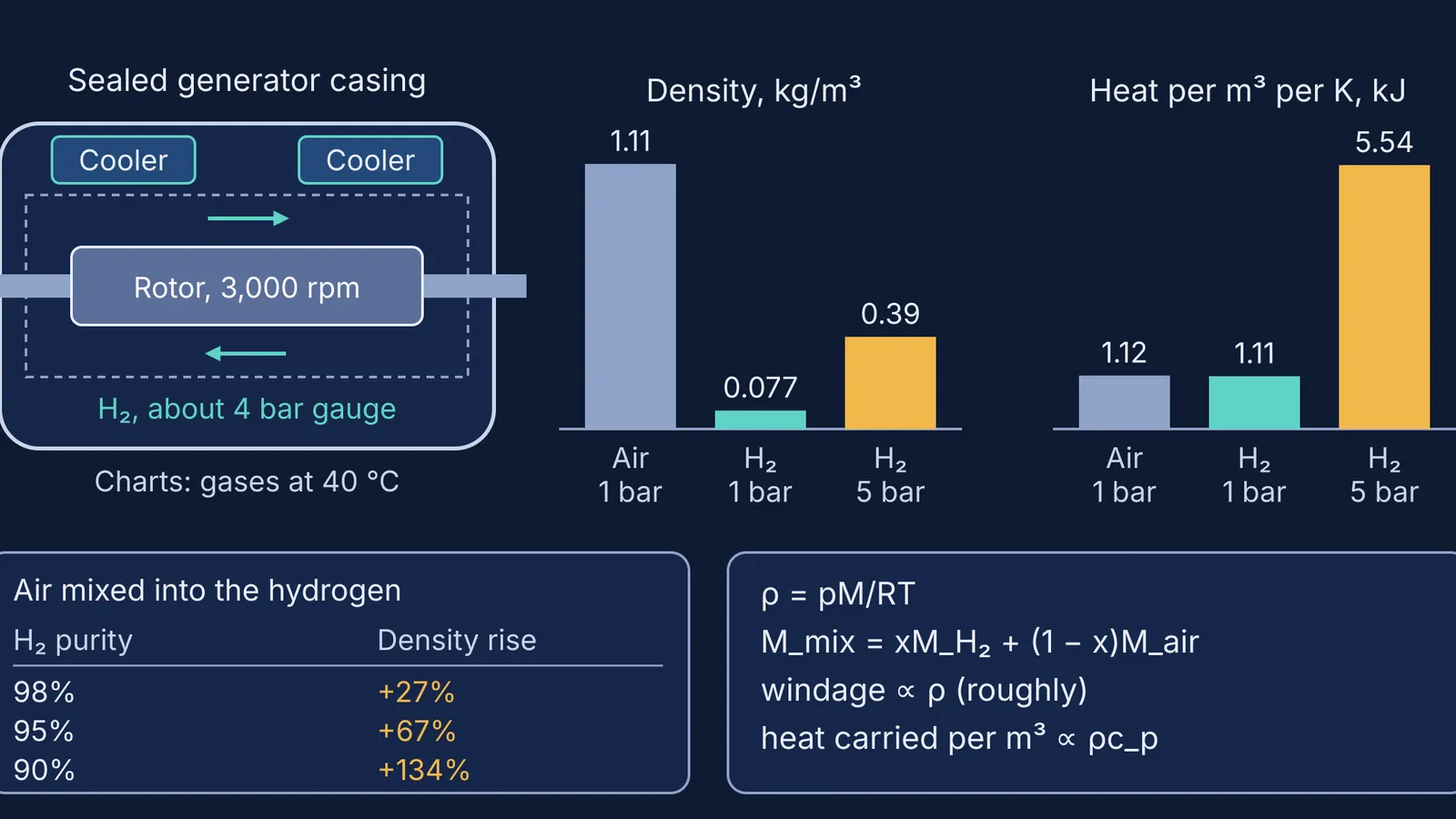
Use ρ = pM/RT at 40 °C (T = 313.15 K), with R = 8.314 J/(mol·K), M_air = 28.96 g/mol and M_H₂ = 2.016 g/mol.
Air at 1 bar: ρ = (1.0 × 10⁵ × 0.02896)/(8.314 × 313.15) = 1.112 kg/m³.
Hydrogen at 1 bar: ρ = (1.0 × 10⁵ × 0.002016)/(8.314 × 313.15) = 0.0774 kg/m³, only 7.0% of air.
Hydrogen at 5 bar absolute: density is proportional to pressure, so ρ = 5 × 0.0774 = 0.387 kg/m³.
Compare: 0.387/1.112 = 0.348. Even compressed five times, hydrogen is only about 35% as dense as air at normal pressure, so the windage loss is roughly a third of what air would cause.
Five bar absolute is a realistic figure. In the Mitsubishi test, the earlier 474 MVA design ran at 0.41 MPa gauge, which is about 5.1 bar absolute, and the newer design at 0.19 MPa gauge, about 2.9 bar absolute.
Why does pressurised hydrogen carry so much more heat?
The heat a gas carries away per cubic metre for each kelvin it warms is ρc_p.
Air at 1 bar: 1.112 kg/m³ × 1,007 J/(kg·K) = 1,120 J/(m³·K).
Hydrogen at 1 bar: 0.0774 × 14,300 = 1,107 J/(m³·K). Almost exactly the same as air.
Hydrogen at 5 bar: 0.387 × 14,300 = 5,536 J/(m³·K).
Ratio: 5,536/1,120 = 4.94.
Hydrogen has a huge c_p per kilogram, but per litre at the same pressure it holds the same heat as air. The reason is kinetic theory: both are diatomic, so each has a molar heat capacity close to 7R/2 ≈ 29 J/(mol·K), and a litre of any ideal gas at the same p and T holds the same number of moles. The 4.94 comes almost entirely from the fivefold pressure. Pressurising lets you pack in more moles to carry heat while the density stays low enough to keep the windage small.
This is a trade-off, not a free gift. The Mitsubishi paper notes that lowering the hydrogen pressure cuts the mechanical loss but also lowers the heat transfer rate and heat capacity, so parts run hotter. If the idea of equal moles per litre feels shaky, the Concept Library covers kinetic theory and molar heat capacities concept by concept.
What happens when air leaks into the hydrogen?
Air is about 14 times heavier per mole than hydrogen, so a little of it raises the density a lot. Use the mixture rule from average molar mass of a gas mixture, M_mix = xM_H₂ + (1 − x)M_air, where x is the mole fraction of hydrogen. At the same pressure and temperature, density is proportional to M.
98% hydrogen: M = 0.98 × 2.016 + 0.02 × 28.96 = 1.976 + 0.579 = 2.555 g/mol. Density rise = 2.555/2.016 − 1 = 26.7%.
95% hydrogen: M = 1.915 + 1.448 = 3.363 g/mol. Rise = 66.8%.
90% hydrogen: M = 1.814 + 2.896 = 4.710 g/mol. Rise = 134%.
If windage is roughly proportional to density, it rises in step. So purity is watched closely. These are illustrative calculations, not any machine's alarm settings.
Is a generator full of hydrogen dangerous?
Hydrogen burns in air only within a range of mixtures. The US Department of Energy's safety basics page gives that range as about 4.1% to 74% hydrogen by volume. A generator is filled with nearly pure hydrogen, far above the upper limit, so the gas inside cannot burn. The danger is the moment of change, when hydrogen and air could meet.
The industry avoids that moment by never letting them mix directly. A paper at the ASME 2016 Power Conference describes how hydrogen-cooled generators are purged with carbon dioxide before being put into service and when taken offline, so the casing goes from air to CO₂ to hydrogen and back, never straight from one to the other. Shaft seals keep the hydrogen in while the rotor turns. The hazard is managed by keeping the mixture outside the flammable range at every stage. For what happens when that control is lost in a large volume of hydrogen, see why the Hindenburg caught fire.
Quick checklist
A large generator turns about 1% of its output into heat inside the casing.
Windage loss grows roughly with gas density; hydrogen at 5 bar is still only about 35% as dense as air at 1 bar.
Per litre at the same pressure, hydrogen and air hold the same heat (both have C_p ≈ 7R/2); pressure gives hydrogen its 4.9 times advantage.
Hydrogen conducts heat about seven times better than air.
2% of air by moles makes the gas 27% denser, because M_air is 14 times M_H₂.
The gas stays far above hydrogen's upper flammable limit, and CO₂ separates hydrogen from air during filling and emptying.